
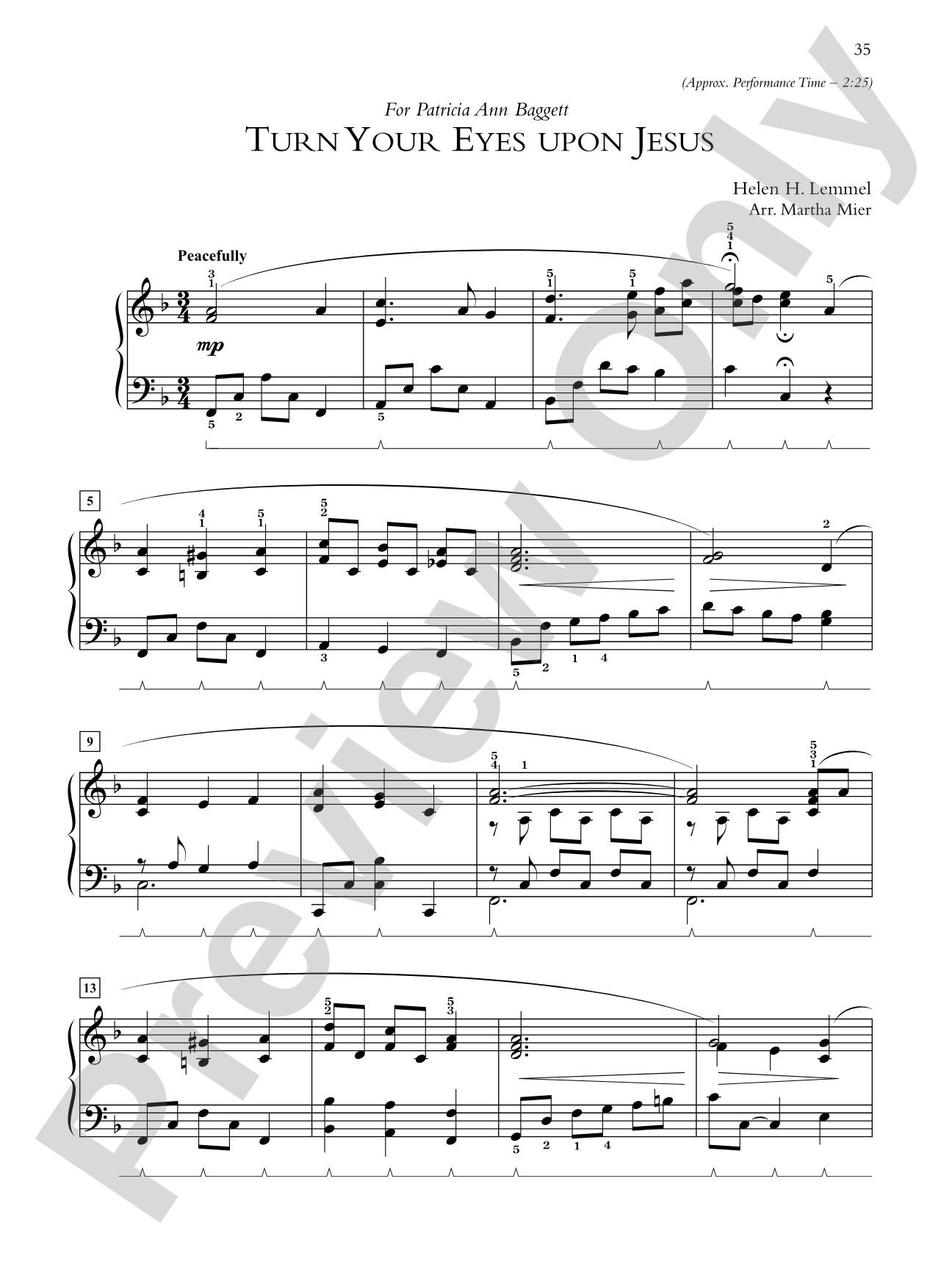

Turn Your Eyes upon Jesus - Piano Solo: Piano Solo
12 Hymns of Grace and Reflection
Arranged by Martha Mier
Level: Late Intermediate / Early Advanced
Item: 00-PS-0017533
$4.99
Pickup currently not available
Related Items
Amazing Grace - Piano Solo: Piano Solo |
$4.99
|
View | |
His Eye Is on the Sparrow - Piano Solo: Piano Solo |
$4.99
|
View | |
In the Garden - Piano Solo: Piano Solo |
$4.99
|
View | |
It Is Well with My Soul - Piano Solo: Piano Solo |
$4.99
|
View | |
Jesus Loves Me - Piano Solo: Piano Solo |
$4.99
|
View | |
Joyful, Joyful, We Adore Thee - Piano Solo: Piano Solo |
$4.99
|
View | |
Morning Has Broken - Piano Solo: Piano Solo |
$4.99
|
View | |
My Jesus, I Love Thee - Piano Solo: Piano Solo |
$4.99
|
View | |
Near to the Heart of God - Piano Solo: Piano Solo |
$4.99
|
View | |
This Is My Father's World - Piano Solo: Piano Solo |
$4.99
|
View | |
What a Friend We Have in Jesus - Piano Solo: Piano Solo |
$4.99
|
View | |
In the Light of His Glory: Piano Book |
$12.99
|
View |
Description
These heartfelt arrangements are some of Martha Mier's favorite hymns. Their warm melodies and rich harmonies will bring hope, solace, and the nearness of God to listeners and performers alike. To assist in planning, approximate performance times are included with each arrangement. Titles: Amazing Grace * His Eye Is on the Sparrow * In the Garden * It Is Well with My Soul * Jesus Loves Me * Joyful, Joyful, We Adore Thee * Morning Has Broken * My Jesus, I Love Thee * Near to the Heart of God * This Is My Father's World * Turn Your Eyes upon Jesus * What a Friend We Have in Jesus. A Federation Festivals 2024-2028 selection.


Discover MakeMusic Cloud: thousands of interactive titles your students can play along with today.
Sample Audio
No sample audio found.
Sample Video
No sample videos found.
Additional Details
Series:
Sacred Performer Collections
Publisher:
Alfred Music
Page Count:
40
SKU:
00-PS-0017533
More about this title
About the Composer: Helen H. Lemmel
Helen H. Lemmel (1864, 1936) wrote 'Turn Your Eyes upon Jesus' in 1922, composing both the text and melody during a period of personal struggle. Her hymn became one of the most recorded and performed sacred songs of the twentieth century, translated into dozens of languages and embraced across denominational lines. Lemmel's gift was for creating melodies that lodge in memory while carrying emotional weight, giving her work enduring appeal in worship and concert settings.
Why we love this
Martha Mier's collection demonstrates how thoughtful arrangement deepens a hymn's emotional reach without overshadowing its singability. Each piece respects the melodic integrity listeners know while adding harmonic color and textural variety that rewards careful listening. This is sacred music that speaks to musicians first.
What to expect
Tender and introspective, yet affirming. These arrangements invite quiet reflection rather than bombast, with warm harmonic support that makes the familiar hymn melodies feel both comforting and newly discovered. There's gratitude woven into the writing.
Who it's for
Sacred music pianists preparing for recital, worship leaders looking to expand their hymn-based repertoire, and students working toward late intermediate technique who need musically mature material with emotional depth. This collection also serves pianists studying for festival competitions where hymn arrangements are listed as approved selections.
How to get the most out of it
- Honor the hymn tunes' inherent phrasing; these melodies have shaped congregational singing for generations, so resist the urge to subdivide phrases with excessive rubato.
- Balance melody and accompaniment by allowing the top voice to breathe slightly ahead of the harmony, creating space rather than thickness.
- Lean into the harmonic richness during sustained chords; let the sonority speak before moving to the next phrase.
- Consult the provided performance times to gauge your interpretive tempo; Mier's timing suggestions reflect natural breath points built into the arrangements.
How to use it
Build a recital section around one or two pieces from this collection, pairing them with other sacred or song-based repertoire to create a thematic program block. Select two contrasting arrangements for a sacred music concert that reaches both regular churchgoers and classical music audiences. Individual pieces also work well as communion or offertory music in worship contexts when the pianist wants scored concert arrangements rather than lead sheets.
Skills your students will build
- Sustaining harmonic color through varied textures and voicings
- Interpreting hymn melodies with clarity and restraint
- Managing pedal control in music with rich tertian harmony
- Reading and performing across a broad dynamic range (pp to f)
- Shaping longer melodic lines across multiple systems