
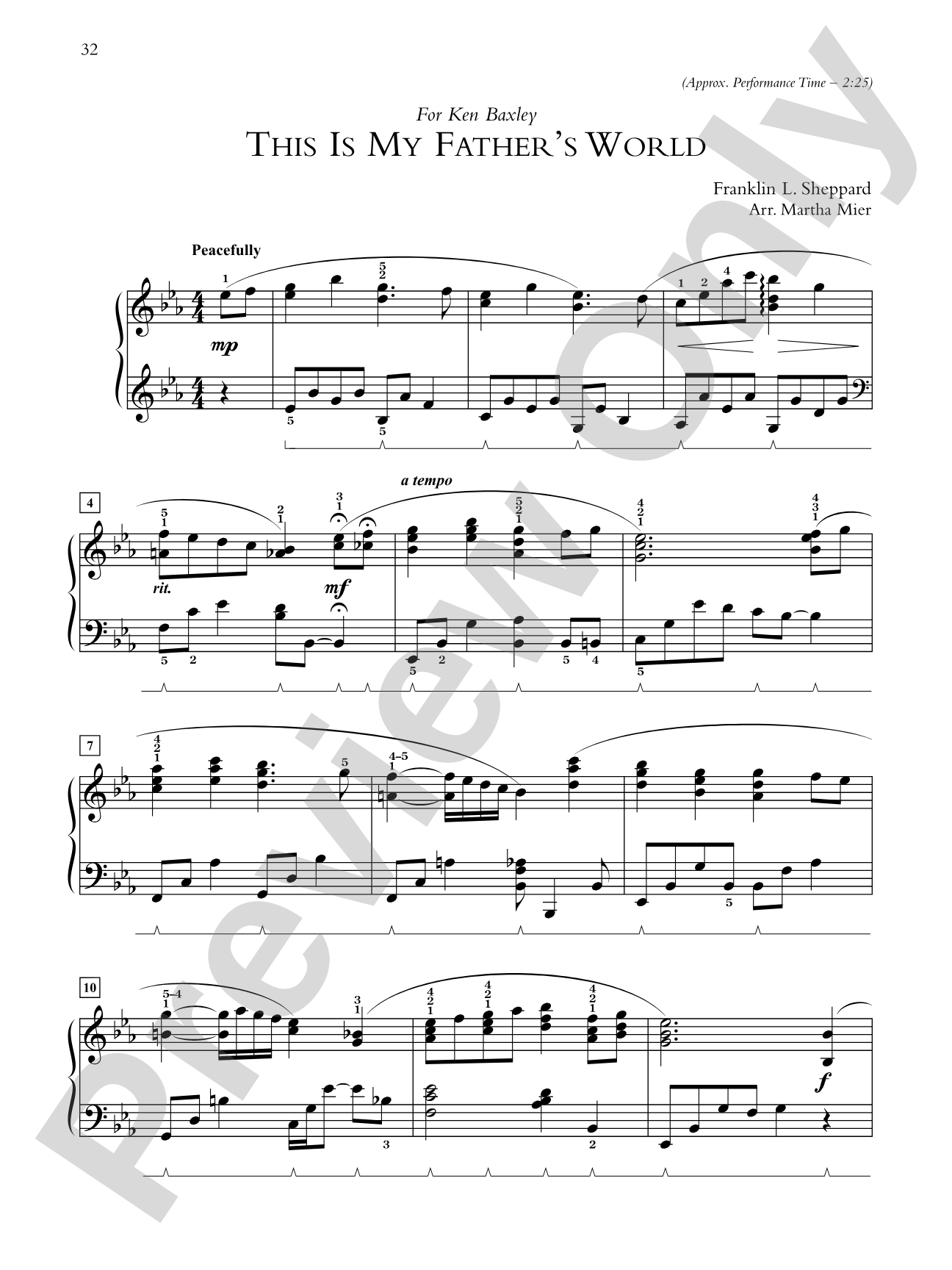

This Is My Father's World - Piano Solo: Piano Solo
12 Hymns of Grace and Reflection
Arranged by Martha Mier
Level: Late Intermediate / Early Advanced
Item: 00-PS-0017532
$4.99
Pickup currently not available
Related Items
Amazing Grace - Piano Solo: Piano Solo |
$4.99
|
View | |
His Eye Is on the Sparrow - Piano Solo: Piano Solo |
$4.99
|
View | |
In the Garden - Piano Solo: Piano Solo |
$4.99
|
View | |
It Is Well with My Soul - Piano Solo: Piano Solo |
$4.99
|
View | |
Jesus Loves Me - Piano Solo: Piano Solo |
$4.99
|
View | |
Joyful, Joyful, We Adore Thee - Piano Solo: Piano Solo |
$4.99
|
View | |
Morning Has Broken - Piano Solo: Piano Solo |
$4.99
|
View | |
My Jesus, I Love Thee - Piano Solo: Piano Solo |
$4.99
|
View | |
Near to the Heart of God - Piano Solo: Piano Solo |
$4.99
|
View | |
Turn Your Eyes upon Jesus - Piano Solo: Piano Solo |
$4.99
|
View | |
What a Friend We Have in Jesus - Piano Solo: Piano Solo |
$4.99
|
View | |
In the Light of His Glory: Piano Book |
$12.99
|
View |
Description
These heartfelt arrangements are some of Martha Mier's favorite hymns. Their warm melodies and rich harmonies will bring hope, solace, and the nearness of God to listeners and performers alike. To assist in planning, approximate performance times are included with each arrangement. Titles: Amazing Grace * His Eye Is on the Sparrow * In the Garden * It Is Well with My Soul * Jesus Loves Me * Joyful, Joyful, We Adore Thee * Morning Has Broken * My Jesus, I Love Thee * Near to the Heart of God * This Is My Father's World * Turn Your Eyes upon Jesus * What a Friend We Have in Jesus. A Federation Festivals 2024-2028 selection.


Discover MakeMusic Cloud: thousands of interactive titles your students can play along with today.
Sample Audio
No sample audio found.
Sample Video
No sample videos found.
Additional Details
Series:
Sacred Performer Collections
Publisher:
Alfred Music
Page Count:
40
SKU:
00-PS-0017532
More about this title
About the Composer: Franklin L. Sheppard
Franklin L. Sheppard (1852-1930) composed "This Is My Father's World" in 1901, setting words by Maltbie D. Babcock to a melody that has become one of the most beloved hymn tunes in American Protestant worship. His gift lay in writing singable, memorable melodies that carried theological weight without sacrificing accessibility, making his work especially valuable in congregational and educational settings.
Why we love this
Martha Mier has chosen twelve hymns that work beautifully on the piano, and her arrangements respect both the spiritual substance of each tune and the performer's need for musical interest. These pieces sit comfortably in the late intermediate range without condescension, offering enough harmonic color and textural variety to keep advanced students engaged while remaining accessible to solid intermediate players. The inclusion of performance times makes program planning straightforward.
What to expect
Warm and reflective without sentimentality. These arrangements invite you into quiet contemplation, with moments of brightness that feel earned rather than imposed. The harmonies suggest depth and experience; this is music that assumes you know something about how melody and accompaniment can create meaning together.
Who it's for
Pianists in the late intermediate to early advanced range who want repertoire with spiritual depth and immediate audience connection. This collection works equally well for recital performers, church musicians, and students exploring arrangement techniques and harmonic language.
How to get the most out of it
- Honor the hymn tune's melodic line as your primary voice, even when accompaniment figures grow busier; listeners recognize these melodies from memory, and clarity serves the music better than virtuosity.
- Shape each phrase with gentle dynamic contours that follow the text's emotional arc, since these arrangements carry the weight of their original lyrics even when sung by the piano alone.
- Pedal sparingly in the lower register to maintain harmonic clarity; the rich voicings can blur quickly, especially in the later pieces in this collection.
How to use it
A single hymn arrangement makes an elegant opening or closing piece for a recital mixing styles and eras. Alternatively, program two or three as a short suite mid-concert to create a moment of harmonic rest and spiritual reflection alongside more dramatic contemporary works. Church musicians will find these essential for concerts or special services where hymn-based programming strengthens congregational participation.
Skills your students will build
- Reading and interpreting harmonic voice-leading beyond block chord accompaniment
- Balancing melodic projection with accompaniment texture
- Pedaling control in rich harmonic contexts
- Shaping musical phrases aligned with hymn text and theological content
- Understanding arrangement as a compositional skill, not mere reduction