
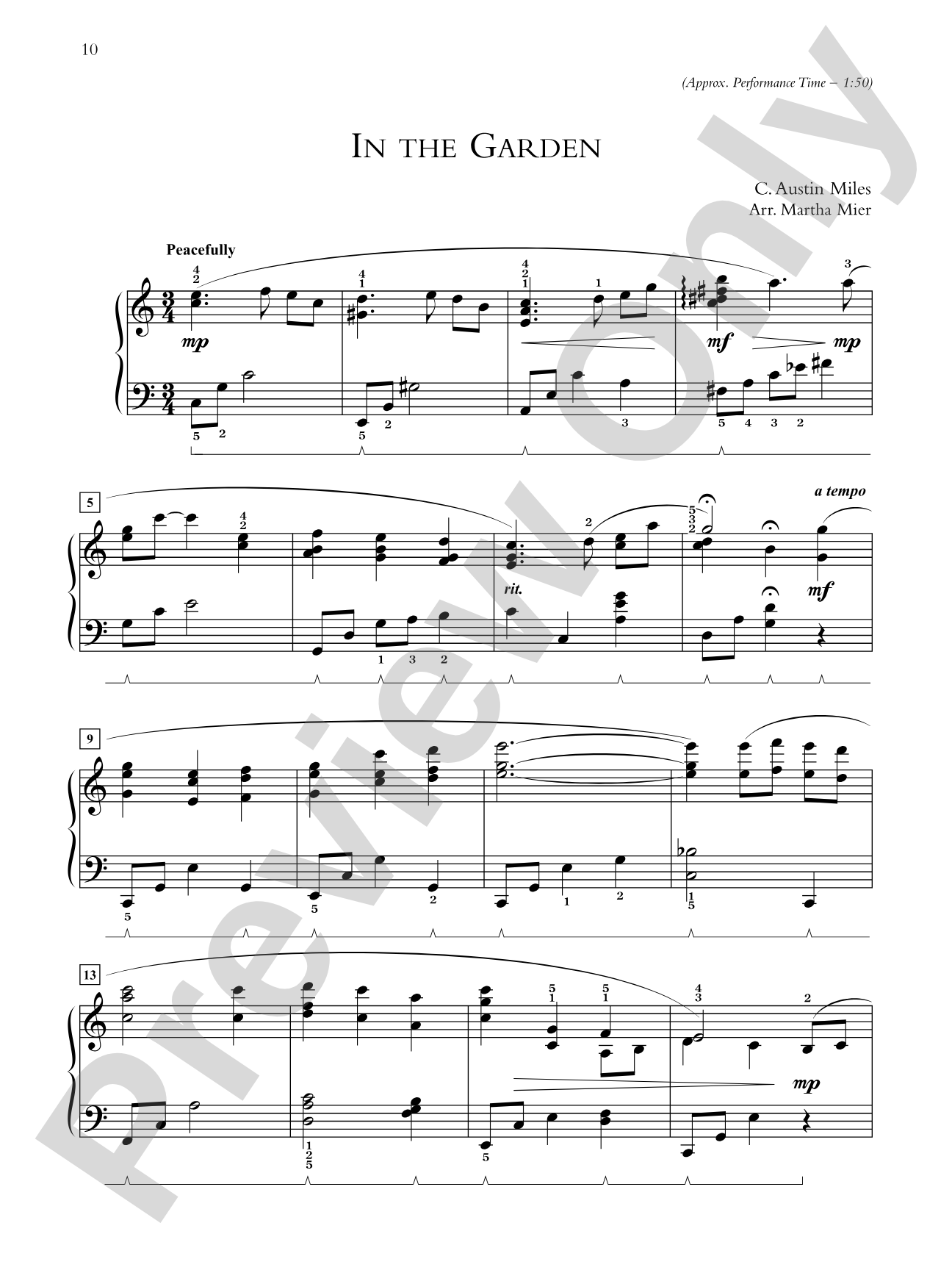

In the Garden - Piano Solo: Piano Solo
12 Hymns of Grace and Reflection
Arranged by Martha Mier
Level: Late Intermediate / Early Advanced
Item: 00-PS-0017525
$4.99
Pickup currently not available
Related Items
Amazing Grace - Piano Solo: Piano Solo |
$4.99
|
View | |
His Eye Is on the Sparrow - Piano Solo: Piano Solo |
$4.99
|
View | |
It Is Well with My Soul - Piano Solo: Piano Solo |
$4.99
|
View | |
Jesus Loves Me - Piano Solo: Piano Solo |
$4.99
|
View | |
Joyful, Joyful, We Adore Thee - Piano Solo: Piano Solo |
$4.99
|
View | |
Morning Has Broken - Piano Solo: Piano Solo |
$4.99
|
View | |
My Jesus, I Love Thee - Piano Solo: Piano Solo |
$4.99
|
View | |
Near to the Heart of God - Piano Solo: Piano Solo |
$4.99
|
View | |
This Is My Father's World - Piano Solo: Piano Solo |
$4.99
|
View | |
Turn Your Eyes upon Jesus - Piano Solo: Piano Solo |
$4.99
|
View | |
What a Friend We Have in Jesus - Piano Solo: Piano Solo |
$4.99
|
View | |
In the Light of His Glory: Piano Book |
$12.99
|
View |
Description
These heartfelt arrangements are some of Martha Mier's favorite hymns. Their warm melodies and rich harmonies will bring hope, solace, and the nearness of God to listeners and performers alike. To assist in planning, approximate performance times are included with each arrangement. Titles: Amazing Grace * His Eye Is on the Sparrow * In the Garden * It Is Well with My Soul * Jesus Loves Me * Joyful, Joyful, We Adore Thee * Morning Has Broken * My Jesus, I Love Thee * Near to the Heart of God * This Is My Father's World * Turn Your Eyes upon Jesus * What a Friend We Have in Jesus. A Federation Festivals 2024-2028 selection.


Discover MakeMusic Cloud: thousands of interactive titles your students can play along with today.
Sample Audio
No sample audio found.
Sample Video
No sample videos found.
Additional Details
Series:
Sacred Performer Collections
Publisher:
Alfred Music
Page Count:
40
SKU:
00-PS-0017525
More about this title
About the Composer: C. Austin Miles
C. Austin Miles (1849, 1935) was an American hymn writer and composer whose works shaped Protestant worship music for generations. Though he trained as a newspaperman and poet, Miles found his true calling in sacred music, crafting both lyrics and melodies that resonated deeply with congregations seeking spiritual expression and comfort.
Miles's "In the Garden" stands as one of the most beloved hymns in American hymnals, recorded countless times across genres and recognized instantly by church musicians everywhere. His gift lay in writing singable, memorable melodies paired with emotionally direct texts, qualities that made his hymns endure long after his contemporaries faded from regular use.
Why we love this
Martha Mier's arrangements honor the spiritual weight of these hymns while giving pianists genuine interpretive work to do. The harmonies are sophisticated enough to engage advanced students without becoming precious or overwritten; each arrangement feels like a conversation with the melody rather than a decoration of it. Programming this collection lets you offer students meaningful sacred music alongside secular repertoire, and the included performance times make festival and recital planning straightforward.
What to expect
Quiet dignity paired with warmth. These pieces invite rather than proclaim, creating intimate space where melody and harmony work together to evoke reflection and peace. The playing feels contemplative, rooted, grounded in the kind of harmonic language that lets listeners feel held.
Who it's for
Late intermediate and early advanced pianists ready to inhabit sacred repertoire with both technical and expressive maturity. This collection works equally well for students exploring hymn settings in classical piano tradition, church musicians seeking polished solo arrangements for services or special events, and festival participants looking for repertoire with spiritual substance and modest but genuine technical demands.
How to get the most out of it
- Let the hymn tune breathe. These melodies don't need rushing, and Mier's harmonies deserve space to unfold, resist the impulse to fill silence with busier tempos.
- Shape dynamics by voice, not by hand position. The inner voices often carry harmonic movement that deserves gentle projection, especially in passages where the melody sits quietly.
- Consider the registration of each arrangement. Some feel complete at a single dynamic level; others invite subtle wave-like shaping that respects the hymn's declarative nature.
- Balance pedal use with harmonic clarity. These arrangements often feature rich voicings that blur easily; find the threshold where resonance serves the harmony without obscuring voice leading.
How to use it
String these arrangements throughout a recital to offer listeners moments of repose and spiritual grounding, or program several in succession to create a mini-concert within a concert that honors the hymn tradition. They sit naturally on church music recitals, memorial services, and educational concerts focused on American sacred music, and they pair well with vocal arrangements of the same texts if your program includes both piano and choir.
Skills your students will build
- voicing and redistribution of chord members across registers
- pedal control in richly harmonized textures
- shaping of inner-voice melodies through touch and dynamic layering
- interpretive choices in tempos, rubato, and phrasing of familiar melodies
- reading and performing arrangements that balance simplicity of melody with harmonic sophistication