
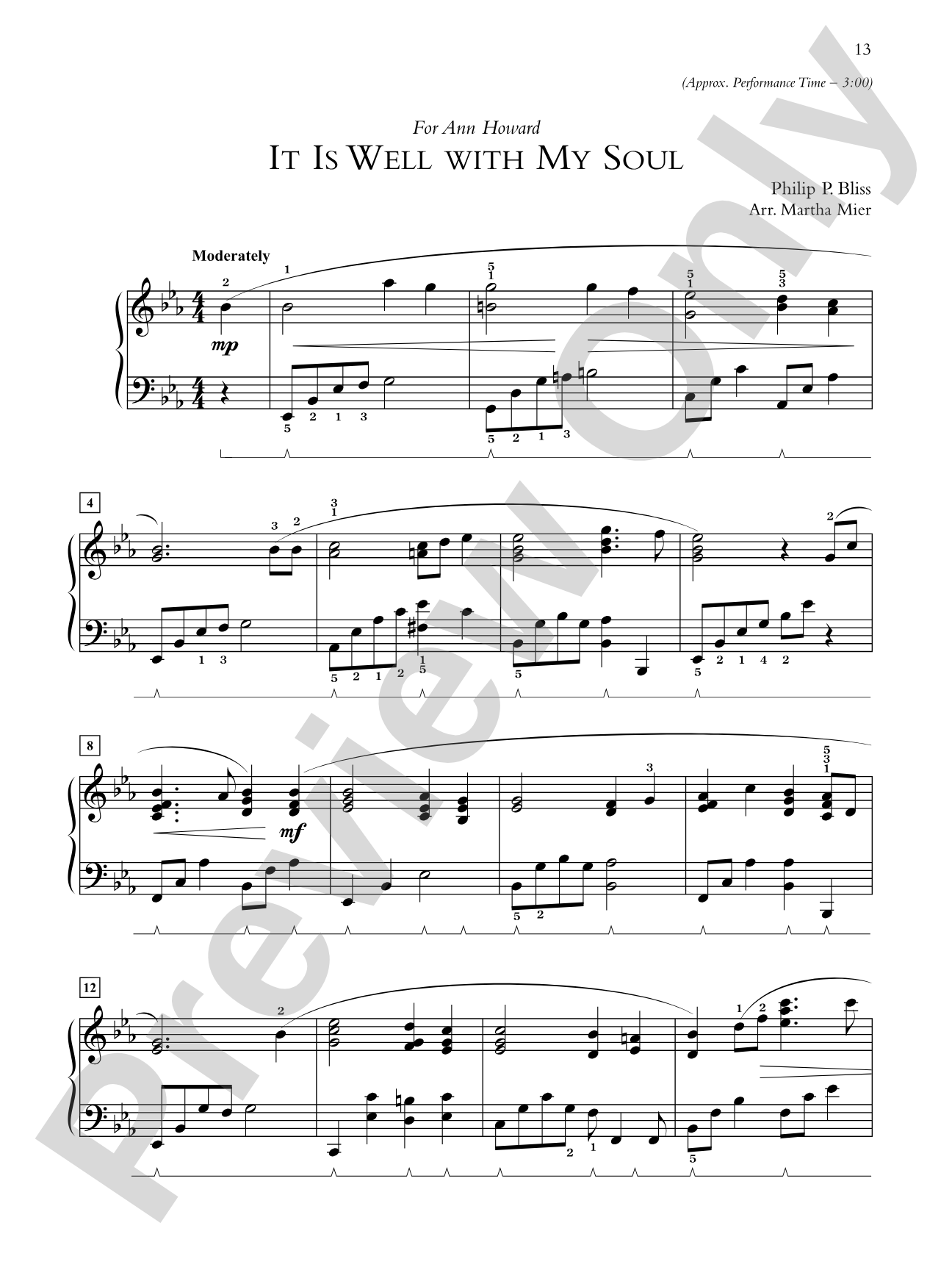

It Is Well with My Soul - Piano Solo: Piano Solo
12 Hymns of Grace and Reflection
Arranged by Martha Mier
Level: Late Intermediate / Early Advanced
Item: 00-PS-0017526
$4.99
Pickup currently not available
Related Items
Amazing Grace - Piano Solo: Piano Solo |
$4.99
|
View | |
His Eye Is on the Sparrow - Piano Solo: Piano Solo |
$4.99
|
View | |
In the Garden - Piano Solo: Piano Solo |
$4.99
|
View | |
Jesus Loves Me - Piano Solo: Piano Solo |
$4.99
|
View | |
Joyful, Joyful, We Adore Thee - Piano Solo: Piano Solo |
$4.99
|
View | |
Morning Has Broken - Piano Solo: Piano Solo |
$4.99
|
View | |
My Jesus, I Love Thee - Piano Solo: Piano Solo |
$4.99
|
View | |
Near to the Heart of God - Piano Solo: Piano Solo |
$4.99
|
View | |
This Is My Father's World - Piano Solo: Piano Solo |
$4.99
|
View | |
Turn Your Eyes upon Jesus - Piano Solo: Piano Solo |
$4.99
|
View | |
What a Friend We Have in Jesus - Piano Solo: Piano Solo |
$4.99
|
View | |
In the Light of His Glory: Piano Book |
$12.99
|
View |
Description
These heartfelt arrangements are some of Martha Mier's favorite hymns. Their warm melodies and rich harmonies will bring hope, solace, and the nearness of God to listeners and performers alike. To assist in planning, approximate performance times are included with each arrangement. Titles: Amazing Grace * His Eye Is on the Sparrow * In the Garden * It Is Well with My Soul * Jesus Loves Me * Joyful, Joyful, We Adore Thee * Morning Has Broken * My Jesus, I Love Thee * Near to the Heart of God * This Is My Father's World * Turn Your Eyes upon Jesus * What a Friend We Have in Jesus. A Federation Festivals 2024-2028 selection.


Discover MakeMusic Cloud: thousands of interactive titles your students can play along with today.
Sample Audio
No sample audio found.
Sample Video
No sample videos found.
Additional Details
Series:
Sacred Performer Collections
Publisher:
Alfred Music
Page Count:
40
SKU:
00-PS-0017526
More about this title
About the Composer: Philip P. Bliss
Philip P. Bliss (1838, 1876) was an American hymn writer and composer whose melodies became standards of Protestant worship. Though his life was cut short by a train accident, his output shaped congregational singing for generations. Bliss had a gift for pairing singable, memorable melodies with texts that moved people spiritually, and his work remains central to American hymn traditions.
Why we love this
Martha Mier's arrangements honor the emotional core of these hymns without burying their melodies in ornament. The collection balances accessibility with genuine musical substance, giving pianists room to shape phrasing and respond to text without demanding virtuosity. As a Federation Festivals selection, this book already carries curricular weight; it's the kind of repertoire that works equally well in a student's practice room and on a recital program.
What to expect
These arrangements live in quiet conviction. You encounter rich, well-voiced harmonies that give each familiar melody new dimensions while keeping the tune front and center. The overall effect is contemplative but never sentimental; there's strength in the spiritual directness of these hymns.
Who it's for
Late intermediate to early advanced pianists seeking repertoire with depth and purpose. Teachers building programs around sacred themes, recital selections, or festival requirements will find genuine musical substance here rather than simplified arrangements.
How to get the most out of it
- Respect the hymn's original pacing. These melodies are built to breathe; resist the urge to rush emotional moments even when the notation appears straightforward.
- Let the harmony guide your dynamic choices. Mier's richer passages often mark moments of spiritual intensity or resolution; shape the accompaniment around what the chords are saying.
- Study the text alongside the score. Knowing the words behind each melody informs phrasing decisions and helps you communicate the arrangement's intent to your audience.
- Use the approximate performance times to help students understand proportional pacing across different arrangements and to plan program flow.
How to use it
This collection pairs naturally with a sacred or thematic concert; several arrangements at varying lengths let you build a program of different moods and tempos. Individual pieces also work as encores or as part of a longer recital where a moment of reflection serves the program's arc.
Skills your students will build
- voicing four-part hymn arrangements at the keyboard
- shaping legit phrasing across longer hymn melodies
- understanding harmonic function in traditional sacred music
- balancing melodic clarity with supportive accompaniment textures
- connecting textual meaning to musical interpretation