
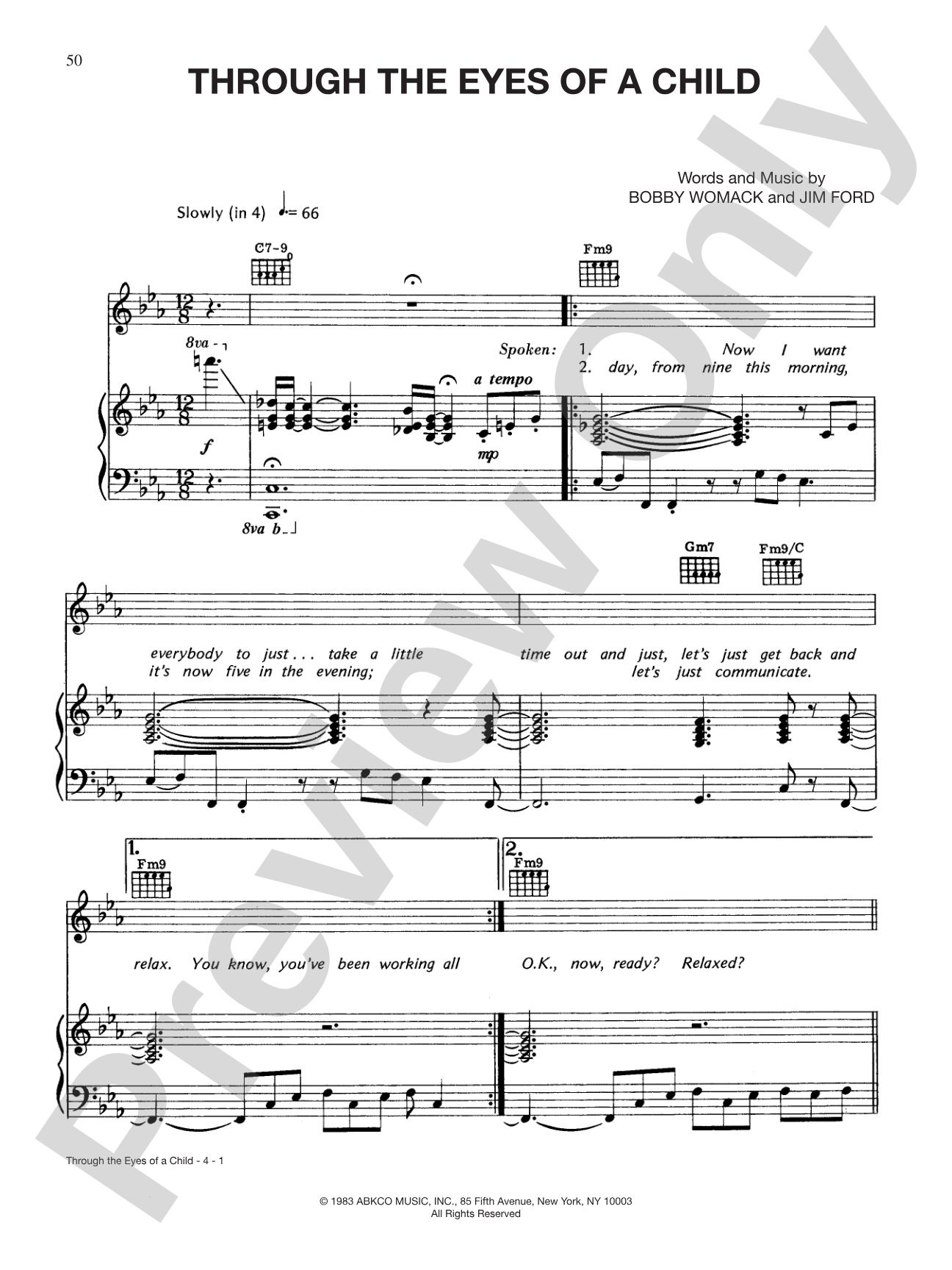

Through the Eyes of a Child: Piano/Vocal/Chords
Bobby Womack
Item: 00-PS-0012090
$4.99
Pickup currently not available
Related Items
I Wish I Had Someone to Go Home To: Piano/Vocal/Chords |
$4.99
|
View | |
Just My Imagination: Piano/Vocal/Chords |
$4.99
|
View | |
If You Think You're Lonely Now: Piano/Vocal/Chords |
$4.99
|
View | |
Love Has Finally Come at Last: Piano/Vocal/Chords |
$4.99
|
View | |
American Dream: Piano/Vocal/Chords |
$4.99
|
View | |
Surprise, Surprise: Piano/Vocal/Chords |
$5.99
|
View | |
Tell Me Why (Can't We Work it Out): Piano/Vocal/Chords |
$4.99
|
View | |
Trying to Get Over You: Piano/Vocal/Chords |
$5.99
|
View | |
Who's Fooling Who: Piano/Vocal/Chords |
$5.99
|
View | |
Games: Piano/Vocal/Chords |
$4.99
|
View | |
It Takes a lot of Strength to Say Goodbye: Piano/Vocal/Chords |
$5.99
|
View | |
Lay Some Lovin' On Me: Piano/Vocal/Chords |
$4.99
|
View | |
Secrets: Piano/Vocal/Chords |
$4.99
|
View | |
So Many Sides of You: Piano/Vocal/Chords |
$4.99
|
View | |
Where Do We Go From Here: Piano/Vocal/Chords |
$5.99
|
View | |
Bobby Womack: The Poet / The Poet II: Piano/Vocal/Chords Book |
$19.95
|
View |
Description
The consecutive release in the 1980s of The Poet and The Poet II propelled Bobby Womack to the top ranks of soul music majesty. Now, in celebration of Womack's ongoing career and his Rock and Roll Hall of Fame induction, this songbook makes sheet music for these landmark albums available to music makers.
Titles:
* American Dream
* Games
* I Wish I Had Someone to Go Home To
* If You Think You're Lonely Now
* It Takes a Lot of Strength to Say Goodbye
* Just My Imagination
* Lay Your Lovin' on Me
* Love Has Finally Come at Last
* Secrets
* So Many Sides of You
* Stand Up
* Surprise, Surprise
* Tell Me Why
* Through the Eyes of a Child
* Trying to Get Over You
* Where Do We Go from Here
* Who's Fooling Who


Titles:
* American Dream
* Games
* I Wish I Had Someone to Go Home To
* If You Think You're Lonely Now
* It Takes a Lot of Strength to Say Goodbye
* Just My Imagination
* Lay Your Lovin' on Me
* Love Has Finally Come at Last
* Secrets
* So Many Sides of You
* Stand Up
* Surprise, Surprise
* Tell Me Why
* Through the Eyes of a Child
* Trying to Get Over You
* Where Do We Go from Here
* Who's Fooling Who
Through the Eyes of a Child: Piano/Vocal/Chords isn't in MakeMusic Cloud just yet...but it could be. Let us know you'd like to see it, and you'll help shape what comes next. In the meantime, start a free trial and dive into thousands of interactive titles your students can play along with today.
Request This Title
Tell us you want it.
Start Your Free Trial
Explore everything that's ready to play right now.
Sample Audio
No sample audio found.
Sample Video
No sample videos found.
Additional Details
Publisher:
Alfred Music
Page Count:
84
SKU:
00-PS-0012090
More about this title
About the Composer: Bobby Womack
Bobby Womack emerged as one of soul music's most vital voices during the 1970s and 1980s, building a career that spanned gospel roots, R&B innovation, and timeless songwriting. His albums The Poet and The Poet II became watershed moments in soul music, showcasing his ability to craft emotionally resonant songs that balanced vulnerability with sophisticated production. Womack's induction into the Rock and Roll Hall of Fame recognized not only his artistry as a performer but his significance as a composer and bandleader who shaped the sound of contemporary soul.
Why we love this
This collection captures some of soul music's most enduring compositions during a creatively fertile period, giving pianists and singers direct access to songs that defined an era. The piano/vocal/chords format makes these arrangements immediately playable for singers with piano accompaniment, whether for recital, classroom study, or ensemble use. These are songs with genuine emotional depth and harmonic sophistication that reward close musical study.
What to expect
These songs inhabit a space of sophistication and sincerity: they're smooth without being slick, soulful without indulgence. The arrangements balance lush production sensibilities with intimate vocal storytelling, creating music that feels both polished and deeply human.
Who it's for
This songbook serves singers preparing material for recital, choral directors programming soul and R&B repertoire, pianists studying contemporary songwriting and accompaniment, and music students exploring the harmonic language of 1980s soul. It's equally valuable for music theater students, jazz singers, and anyone building a repertoire of emotionally authentic, well-crafted songs.
How to get the most out of it
- Balance the vocal line with sensitivity to the lyrics; these songs carry real emotional weight, and nuance in phrasing will reveal layers in Womack's songwriting.
- Pay attention to the chord voicings provided; they often suggest the original arrangements' harmonic richness, so explore different voicing options to find what serves the song.
- Let the rhythm section establish the groove through the piano part before adding vocal melody; these songs rely on pocket and feel rather than strict metronomic timing.
- Experiment with the tempo and dynamic range suggested by the chord chart; soul music thrives on flexibility within the pocket, and small shifts in intensity can unlock the song's emotional core.
How to use it
Feature individual songs as recital selections for advanced singers, or program a thematic set around soul balladry and contemporary love songs. In a music history or appreciation course, these pieces provide concrete examples of 1980s soul composition and arrangement practice. Voice studios can use this repertoire to develop students' interpretation of modern soul standards alongside classical and musical theater material.
Skills your students will build
- Reading piano/vocal scores with chord symbols
- Interpreting and voicing chord changes in real time
- Phrasing with emotional intention and lyrical sensitivity
- Understanding soul and R&B harmonic language (extended chords, passing harmonies, modal interchange)
- Collaborating between vocalist and accompanist to balance melody and harmonic support