
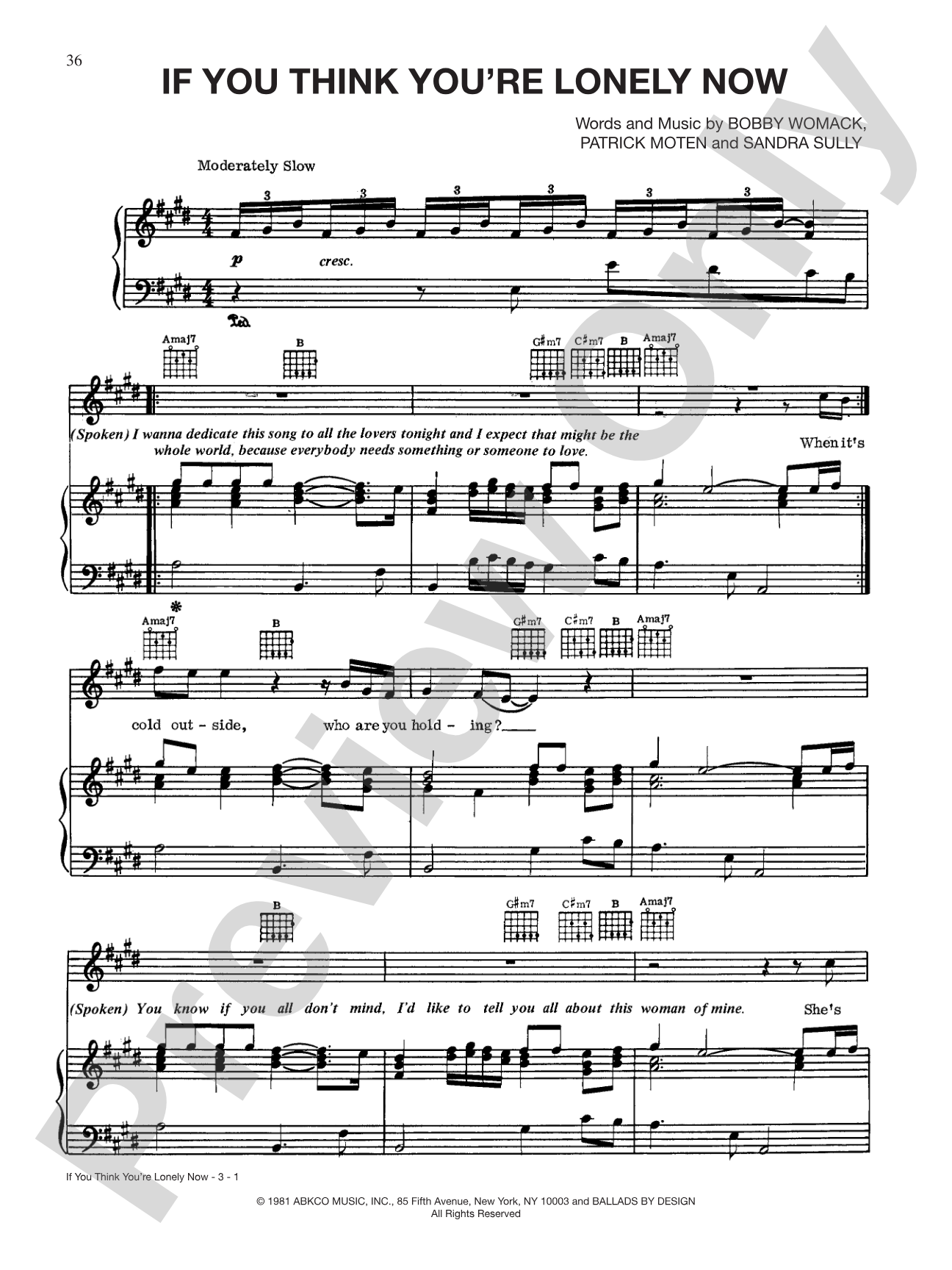

If You Think You're Lonely Now: Piano/Vocal/Chords
Bobby Womack
Item: 00-PS-0012085
$4.99
Pickup currently not available
Related Items
I Wish I Had Someone to Go Home To: Piano/Vocal/Chords |
$4.99
|
View | |
Just My Imagination: Piano/Vocal/Chords |
$4.99
|
View | |
Love Has Finally Come at Last: Piano/Vocal/Chords |
$4.99
|
View | |
American Dream: Piano/Vocal/Chords |
$4.99
|
View | |
Surprise, Surprise: Piano/Vocal/Chords |
$5.99
|
View | |
Tell Me Why (Can't We Work it Out): Piano/Vocal/Chords |
$4.99
|
View | |
Through the Eyes of a Child: Piano/Vocal/Chords |
$4.99
|
View | |
Trying to Get Over You: Piano/Vocal/Chords |
$5.99
|
View | |
Who's Fooling Who: Piano/Vocal/Chords |
$5.99
|
View | |
Games: Piano/Vocal/Chords |
$4.99
|
View | |
It Takes a lot of Strength to Say Goodbye: Piano/Vocal/Chords |
$5.99
|
View | |
Lay Some Lovin' On Me: Piano/Vocal/Chords |
$4.99
|
View | |
Secrets: Piano/Vocal/Chords |
$4.99
|
View | |
So Many Sides of You: Piano/Vocal/Chords |
$4.99
|
View | |
Where Do We Go From Here: Piano/Vocal/Chords |
$5.99
|
View | |
Bobby Womack: The Poet / The Poet II: Piano/Vocal/Chords Book |
$19.95
|
View |
Description
The consecutive release in the 1980s of The Poet and The Poet II propelled Bobby Womack to the top ranks of soul music majesty. Now, in celebration of Womack's ongoing career and his Rock and Roll Hall of Fame induction, this songbook makes sheet music for these landmark albums available to music makers.
Titles:
* American Dream
* Games
* I Wish I Had Someone to Go Home To
* If You Think You're Lonely Now
* It Takes a Lot of Strength to Say Goodbye
* Just My Imagination
* Lay Your Lovin' on Me
* Love Has Finally Come at Last
* Secrets
* So Many Sides of You
* Stand Up
* Surprise, Surprise
* Tell Me Why
* Through the Eyes of a Child
* Trying to Get Over You
* Where Do We Go from Here
* Who's Fooling Who


Titles:
* American Dream
* Games
* I Wish I Had Someone to Go Home To
* If You Think You're Lonely Now
* It Takes a Lot of Strength to Say Goodbye
* Just My Imagination
* Lay Your Lovin' on Me
* Love Has Finally Come at Last
* Secrets
* So Many Sides of You
* Stand Up
* Surprise, Surprise
* Tell Me Why
* Through the Eyes of a Child
* Trying to Get Over You
* Where Do We Go from Here
* Who's Fooling Who
If You Think You're Lonely Now: Piano/Vocal/Chords isn't in MakeMusic Cloud just yet...but it could be. Let us know you'd like to see it, and you'll help shape what comes next. In the meantime, start a free trial and dive into thousands of interactive titles your students can play along with today.
Request This Title
Tell us you want it.
Start Your Free Trial
Explore everything that's ready to play right now.
Sample Audio
No sample audio found.
Sample Video
No sample videos found.
Additional Details
Publisher:
Alfred Music
Page Count:
84
SKU:
00-PS-0012085
More about this title
About the Composer: Bobby Womack
Bobby Womack emerged as one of soul music's most distinctive voices during the 1970s and 1980s, crafting deeply personal songs that blended emotional vulnerability with sophisticated production. His albums The Poet (1981) and The Poet II (1983) became definitive works of the era, earning him induction into the Rock and Roll Hall of Fame and establishing him as a master of soul songwriting whose influence extends across multiple generations of artists.
Why we love this
These arrangements preserve the melodic richness and harmonic sophistication of Womack's most celebrated work while remaining fully accessible at the piano. Singers and pianists gain direct insight into how Womack constructed his emotional narratives, learning from a composer who understood that great soul music rests on the foundation of thoughtful chord voicing and lyrical clarity.
What to expect
These songs breathe with the intimacy and emotional directness that defined Womack's artistry. Moving through them feels like reading a series of honest personal reflections set to music that balances restraint with genuine warmth, drawing listeners into moments of vulnerability where every harmonic detail carries weight.
Who it's for
Pianists preparing material for solo recitals, singers developing a soul and R&B repertoire, and musicians studying the craft of popular songwriting in the soul tradition will find these charts essential. This collection serves anyone seeking to understand how memorable melodies and sophisticated harmonies work together in authentic American soul music.
How to get the most out of it
- Attend closely to the lyrical phrasing indicated in the vocal line; Womack's melodies reward singers who treat text rhythm as a rhythmic and emotional guide rather than a constraint.
- Explore the harmonic movement beneath the melody to understand voice leading choices; this collection reveals how Womack used unexpected chord progressions to deepen emotional impact.
- Balance accompaniment texture with vocal presence by varying dynamics in the piano part across sections, allowing the voice to remain the focal point while maintaining harmonic richness.
- Use the chord symbols as a springboard for personal interpretation at the keyboard; these songs work beautifully with both faithful renderings and stylistically informed reharmonizations.
How to use it
Feature individual selections as standalone recital pieces, or program several songs consecutively to create a thematic evening centered on soul songwriting and emotional expression. These arrangements work equally well in educational settings where students study popular composition or in performance contexts celebrating African American musical traditions.
Skills your students will build
- Reading and interpreting lead sheets with chord symbols
- Voicing jazz and soul harmonies idiomatically at the piano
- Balancing rhythmic freedom with harmonic structure in vocal performance
- Understanding phrase construction and emotional arc in soul composition
- Translating recorded arrangements into singable, performance-ready charts