
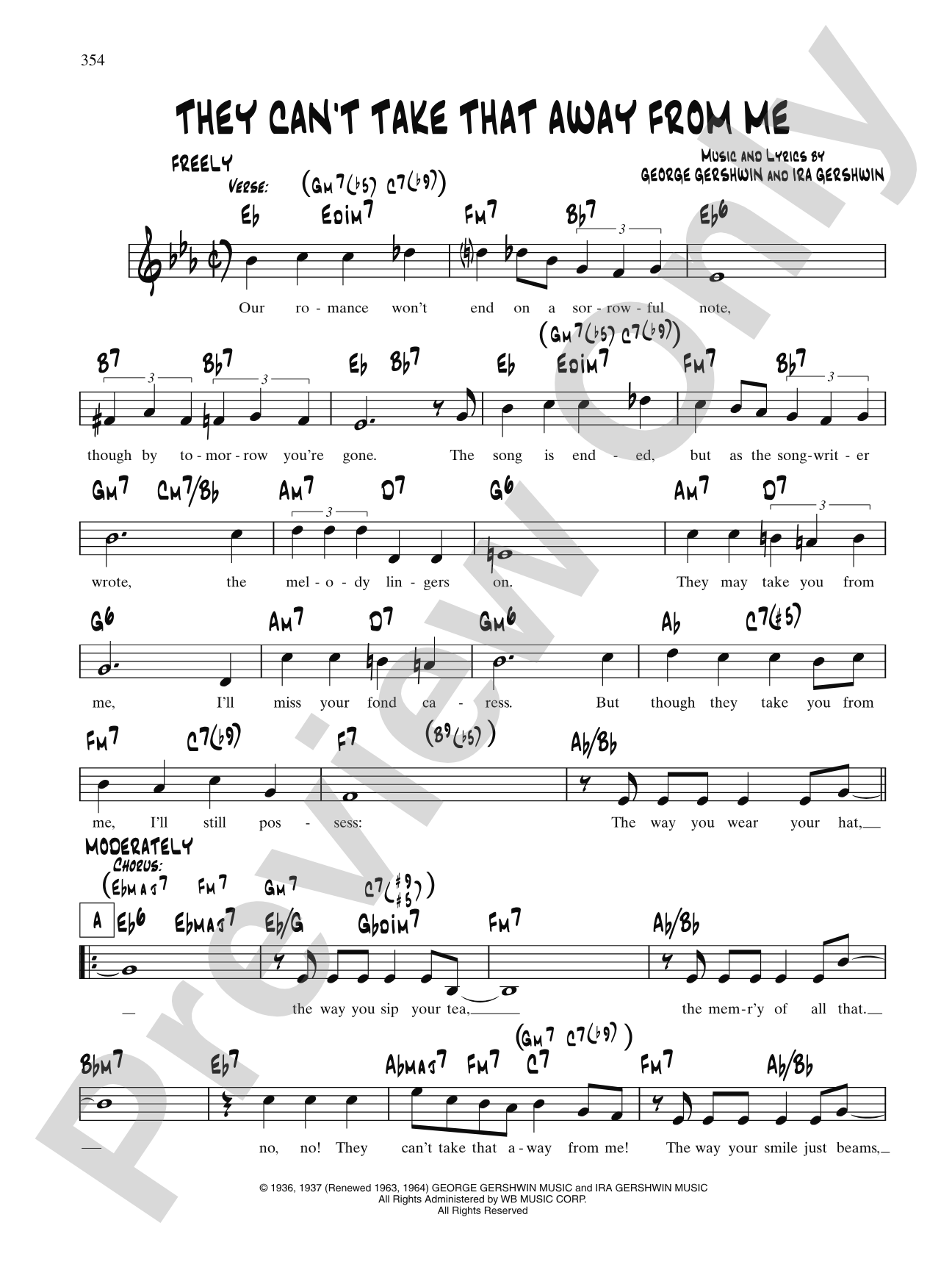

They Can't Take That Away From Me (From "Shall We Dance"): Lead Sheet
Tony Bennett
Item: 00-PSL-000237
$4.99
One moment…
Related Items
I Wanna Be Around: Lead Sheet |
$4.99
|
View | |
Nice Work If You Can Get It (From "Damsel In Distress"): Lead Sheet |
$4.99
|
View | |
The Boulevard Of Broken Dreams (From "Moulin Rouge"): Lead Sheet |
$4.99
|
View | |
People (From "Funny Girl"): Lead Sheet |
$4.99
|
View | |
They All Laughed: Lead Sheet |
$4.99
|
View | |
He Loves And She Loves: Lead Sheet |
$4.99
|
View |
Description
Titles in this 42-song folio include I Left My Heart in San Francisco * Because of You * Nice Work If You Can Get It * Steppin' Out with My Baby * I'll Be Seeing You * Cold, Cold Heart * I Got Rhythm * The Best Is Yet to Come * Rags to Riches * People * Fly Me to the Moon * Call Me Irresponsible * and many more.


They Can't Take That Away From Me (From "Shall We Dance"): Lead Sheet isn't in MakeMusic Cloud just yet...but it could be. Let us know you'd like to see it, and you'll help shape what comes next. In the meantime, start a free trial and dive into thousands of interactive titles your students can play along with today.
Request This Title
Tell us you want it.
Start Your Free Trial
Explore everything that's ready to play right now.
Sample Audio
No sample audio found.
Sample Video
No sample videos found.
Additional Details
Publisher:
Alfred Music
Page Count:
152
SKU:
00-PSL-000237
More about this title
About the Artist: Tony Bennett
Tony Bennett brought a sophisticated vocal style and impeccable phrasing to American popular song, recording across jazz, pop, and standards repertoire from the 1950s onward. His interpretations of the Great American Songbook set a standard for vocal musicality and emotional authenticity that continues to influence singers and musicians across genres.
Why we love this
This folio captures some of the most enduring songs in American music, all presented in lead sheet format that works equally well for pianists accompanying singers, vocalists developing their jazz and standards vocabulary, or musicians exploring the harmonic richness of classic American songwriting. The range of styles and moods across these 42 pieces makes it a working reference that stays useful across years of teaching and performance.
What to expect
Sophisticated and intimate. These are songs born from the Great American Songbook, crafted with elegant lyrics and harmonies that reward close listening and thoughtful playing. Whether you're approaching a tender ballad or a syncopated swing number, there's a sense of timelessness and craft in every melody.
Who it's for
Pianists and keyboardists who accompany singers, vocalists building fluency with jazz standards and American songbook repertoire, and musicians preparing for jazz or standards-focused recitals and performance opportunities. This collection serves both classroom settings where standards are studied and private studios where singers develop interpretive skills.
How to get the most out of it
- Study the original recordings to understand the phrasing and lyrical interpretation Bennett brought to each song; the lead sheet gives you the skeleton, but the artistry lives in how you shape the melody and respond to the harmony.
- Pay attention to the chord extensions and alterations typical of jazz standards; these details significantly affect the harmonic flavor and your accompanying voice leading.
- Treat the melodies as singable lines even when playing them on piano; these are songs first, and maintaining a vocal quality in your touch preserves their character.
- Use the chord symbols to explore comping rhythms and substitutions, especially in uptempo numbers where the rhythm section's flexibility becomes a feature of the arrangement.
How to use it
Use individual pieces from this folio to build a standards-focused recital or concert, mixing tempos and moods to create shape and variety. Many of these songs work beautifully in pops concerts, jazz ensemble settings, or accompanying voice students in studio recitals. The breadth of the collection makes it easy to find repertoire that fits specific programming themes or complements other works on the calendar.
Skills your students will build
- Reading and interpreting lead sheet notation with chord symbols and melody lines
- Understanding jazz chord extensions and their harmonic function
- Developing interpretive choices in melody phrasing and rhythmic nuance
- Comping and accompanying from a lead sheet in jazz and pop idioms
- Recognizing and performing standard forms (AABA, 32-bar song form) found throughout American songwriting