
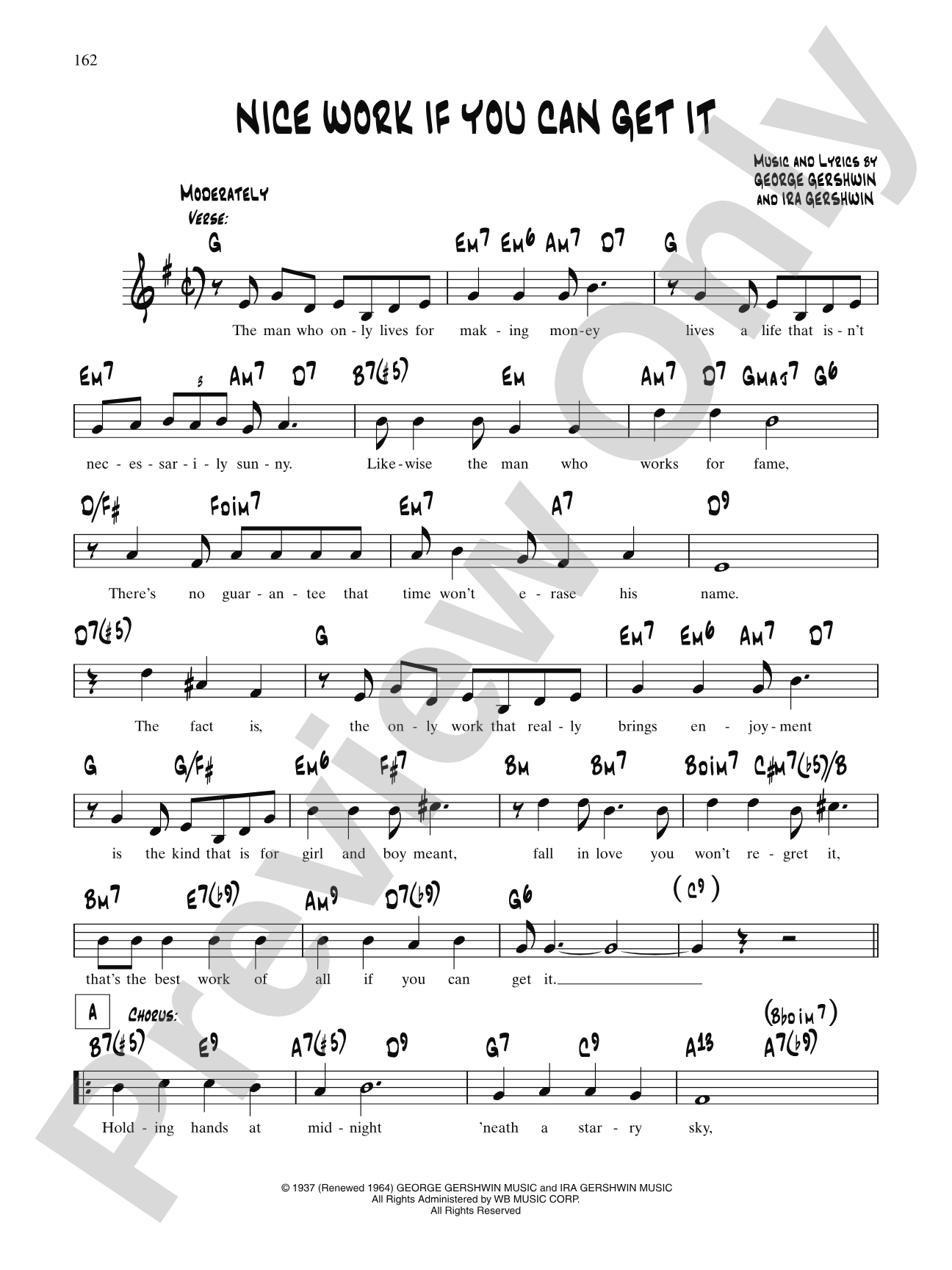

Nice Work If You Can Get It (From "Damsel In Distress"): Lead Sheet
Tony Bennett
Item: 00-PSL-000231
$4.99
One moment…
Related Items
I Wanna Be Around: Lead Sheet |
$4.99
|
View | |
They Can't Take That Away From Me (From "Shall We Dance"): Lead Sheet |
$4.99
|
View | |
The Boulevard Of Broken Dreams (From "Moulin Rouge"): Lead Sheet |
$4.99
|
View | |
People (From "Funny Girl"): Lead Sheet |
$4.99
|
View | |
They All Laughed: Lead Sheet |
$4.99
|
View | |
He Loves And She Loves: Lead Sheet |
$4.99
|
View |
Description
Titles in this 42-song folio include I Left My Heart in San Francisco * Because of You * Nice Work If You Can Get It * Steppin' Out with My Baby * I'll Be Seeing You * Cold, Cold Heart * I Got Rhythm * The Best Is Yet to Come * Rags to Riches * People * Fly Me to the Moon * Call Me Irresponsible * and many more.


Nice Work If You Can Get It (From "Damsel In Distress"): Lead Sheet isn't in MakeMusic Cloud just yet...but it could be. Let us know you'd like to see it, and you'll help shape what comes next. In the meantime, start a free trial and dive into thousands of interactive titles your students can play along with today.
Request This Title
Tell us you want it.
Start Your Free Trial
Explore everything that's ready to play right now.
Sample Audio
No sample audio found.
Sample Video
No sample videos found.
Additional Details
Publisher:
Alfred Music
Page Count:
152
SKU:
00-PSL-000231
More about this title
About the Artist: George Gershwin
George Gershwin (1898-1937) bridged classical composition and American popular song with uncommon sophistication. His melodies, harmonies, and rhythmic innovations shaped the sound of jazz-inflected standards that remain central to vocal and piano repertoire today.
Why we love this
This folio collects some of the most enduring standards in the American songbook, all written or co-written by Gershwin. The lead sheet format lets singers and pianists focus on melody, harmony, and interpretation without being locked into a single arrangement, making it ideal for jazz combos, recital preparation, and classroom exploration of songwriting craft.
What to expect
These standards carry the wit, elegance, and rhythmic vitality of the American songbook at its best. Gershwin's melodies feel both instantly singable and surprisingly sophisticated, balancing accessibility with harmonic depth and an infectious sense of swing.
Who it's for
Pianists and singers preparing for jazz or standards recitals, music theory students analyzing songwriting and harmony, and jazz ensemble performers looking for repertoire that prioritizes melody and lyrical expression. Voice students building a classical or contemporary repertoire will find these pieces essential foundation material.
How to get the most out of it
- Pay attention to the chord changes; Gershwin's harmonic language often moves quickly and expects a pianist to voice these changes musically rather than literally.
- Sing the melody first without the chords to internalize the line, then layer accompaniment; this clarifies phrasing and breath placement.
- Use the lead sheet as a starting point for reharmonization or comping styles; these songs reward personal interpretation and arrangement choices.
How to use it
Use individual selections from this folio to build a standards-focused recital, pairing songs thematically (love songs, rhythmic novelties, introspective ballads). Jazz combos can draw from this repertoire for ensembles that pair voice with piano, bass, and drums. Music theory classes benefit from analyzing multiple examples of Gershwin's approach to form, reharmonization, and melodic construction.
Skills your students will build
- Reading lead sheets and chord symbols
- Analyzing and performing Gershwin's harmonic language
- Phrasing and interpretation of American standards
- Improvising over jazz chord changes
- Singing and playing contemporaneously with independence between hands and voice