
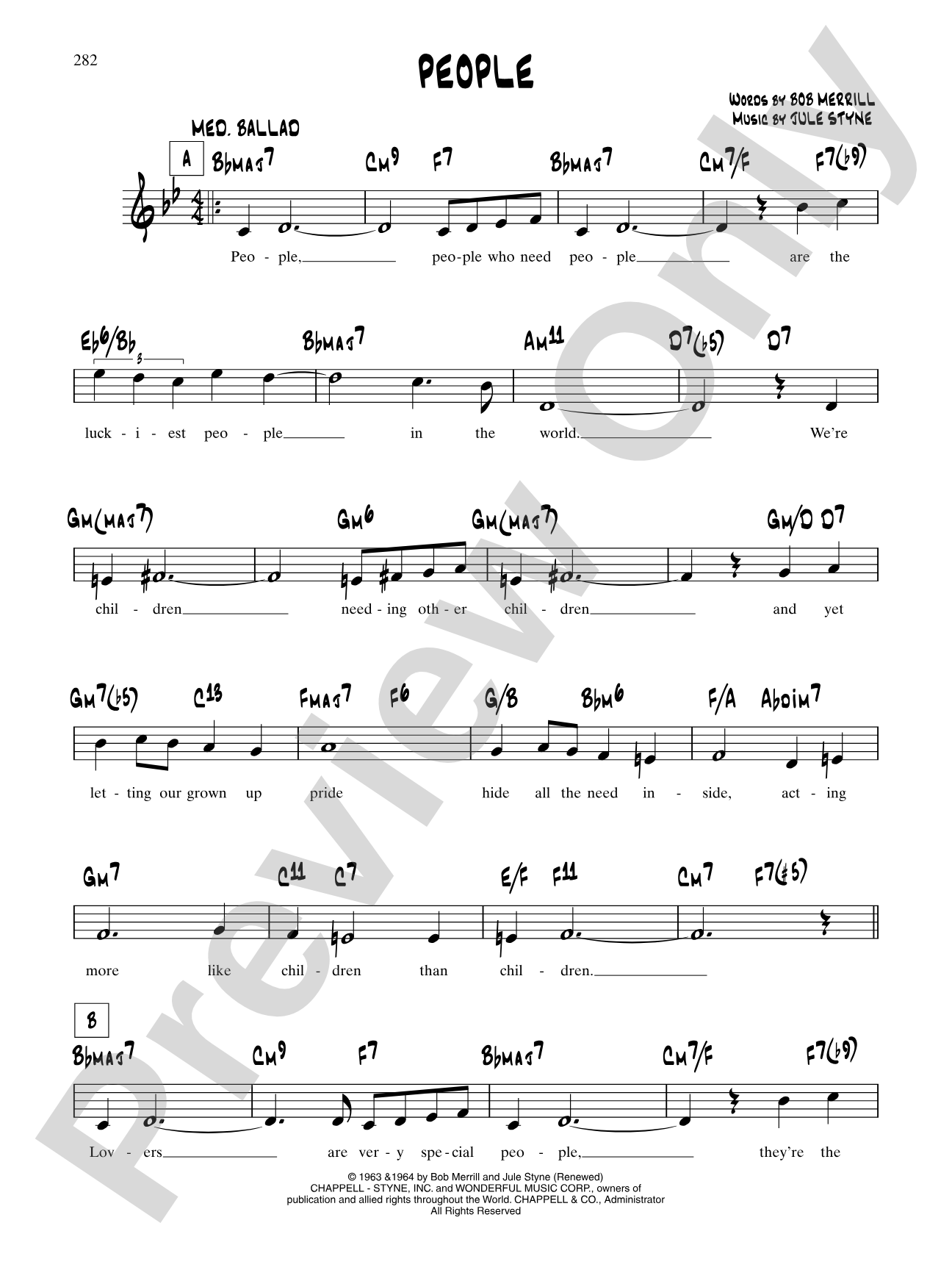

People (From "Funny Girl"): Lead Sheet
Tony Bennett
Item: 00-PSL-000333
$4.99
One moment…
Related Items
I Wanna Be Around: Lead Sheet |
$4.99
|
View | |
Nice Work If You Can Get It (From "Damsel In Distress"): Lead Sheet |
$4.99
|
View | |
They Can't Take That Away From Me (From "Shall We Dance"): Lead Sheet |
$4.99
|
View | |
The Boulevard Of Broken Dreams (From "Moulin Rouge"): Lead Sheet |
$4.99
|
View | |
They All Laughed: Lead Sheet |
$4.99
|
View | |
He Loves And She Loves: Lead Sheet |
$4.99
|
View |
Description
Titles in this 42-song folio include I Left My Heart in San Francisco * Because of You * Nice Work If You Can Get It * Steppin' Out with My Baby * I'll Be Seeing You * Cold, Cold Heart * I Got Rhythm * The Best Is Yet to Come * Rags to Riches * People * Fly Me to the Moon * Call Me Irresponsible * and many more.


People (From "Funny Girl"): Lead Sheet isn't in MakeMusic Cloud just yet...but it could be. Let us know you'd like to see it, and you'll help shape what comes next. In the meantime, start a free trial and dive into thousands of interactive titles your students can play along with today.
Request This Title
Tell us you want it.
Start Your Free Trial
Explore everything that's ready to play right now.
Sample Audio
No sample audio found.
Sample Video
No sample videos found.
Additional Details
Publisher:
Alfred Music
Page Count:
152
SKU:
00-PSL-000333
More about this title
About the Artist: Tony Bennett
Tony Bennett (1926-2023) was an American singer whose career spanned nearly eight decades and helped define the American songbook. Known for his pure tenor voice and interpretive depth, Bennett brought jazz sensibility and emotional authenticity to standards, collaborating with jazz greats and mentoring younger artists throughout his lifetime. His artistry demonstrated that popular song and serious musicianship were not mutually exclusive, influencing generations of jazz and pop vocalists.
Why we love this
This folio captures some of the most enduring standards in the American repertoire, all arranged for singers and pianists working together. The lead sheet format gives vocalists and accompanists room to interpret and respond to each other, rather than locking them into a single arrangement. These songs have already proved their staying power in studios, concert halls, and classrooms for good reason.
What to expect
These songs carry the sophisticated elegance of mid-century American popular music. They inhabit the world of jazz clubs, concert halls, and intimate gatherings, where emotional directness and musical intelligence go hand in hand. Singing them requires both technical control and genuine feeling, inviting performers to find the human story inside each melody.
Who it's for
Vocalists developing their jazz and pop standards repertoire will find essential material here, whether for recitals, auditions, or concert programming. Piano accompanists benefit from the lead sheet format, which allows them to voice and interpret chords while supporting a vocalist's performance. Voice teachers using standards to deepen students' understanding of lyrical interpretation and song phrasing will find a substantial collection of proven material.
How to get the most out of it
- Listen to Bennett's recordings of these standards before rehearsing. Notice how he phrases around the melody and sits slightly behind or ahead of the beat for emotional effect rather than rhythmic rigidity.
- Treat the chords as a foundation for conversation between voice and piano, not as accompaniment instructions. A lead sheet invites the pianist to voice these chords in ways that support the singer's interpretation.
- Work out the lyrical content and emotional arc of each song before focusing on technical elements. These standards reward singers who understand what they're singing about.
- Experiment with vocal dynamics and rubato within the harmonic framework. Many of these melodies gain their power through flexibility rather than strict metronomic accuracy.
How to use it
Build an entire recital or concert program around Bennett's interpretations of these standards. Pair individual selections with other jazz-inflected repertoire to create a program that highlights the connection between pop standards and jazz sensibility. Use these songs in voice lessons as starting points for discussions about phrasing, improvisation within form, and emotional communication through melody.
Skills your students will build
- Interpreting jazz phrasing and rubato within a harmonic framework
- Reading lead sheet notation and understanding chord symbols
- Lyrical storytelling and emotional communication in melody
- Collaborative listening and responsiveness between vocalist and accompanist
- Understanding song form and harmonic progression in standards
- Balancing interpretive freedom with melodic integrity