
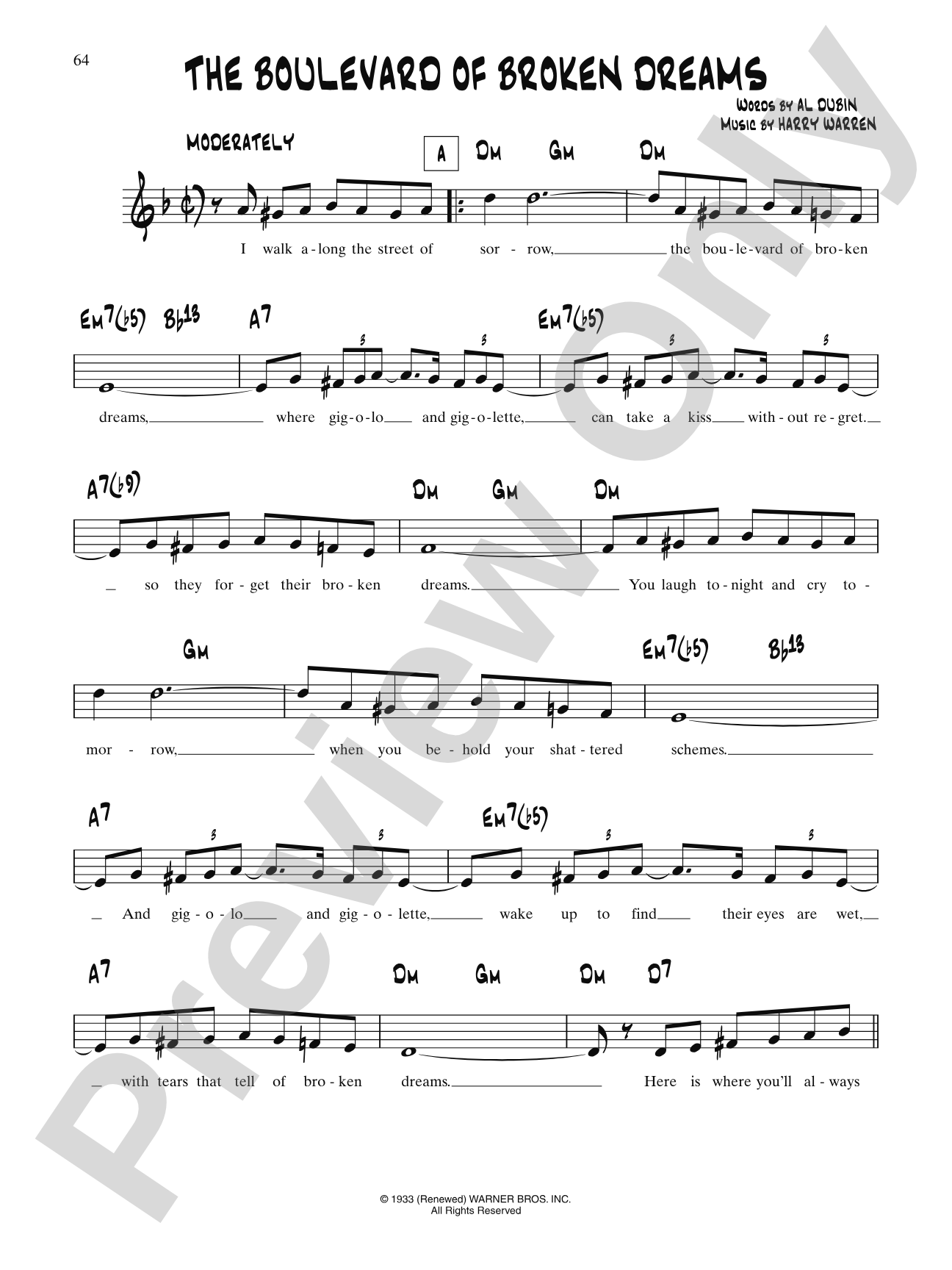

The Boulevard Of Broken Dreams (From "Moulin Rouge"): Lead Sheet
Tony Bennett
Item: 00-PSL-000278
$4.99
One moment…
Related Items
I Wanna Be Around: Lead Sheet |
$4.99
|
View | |
Nice Work If You Can Get It (From "Damsel In Distress"): Lead Sheet |
$4.99
|
View | |
They Can't Take That Away From Me (From "Shall We Dance"): Lead Sheet |
$4.99
|
View | |
People (From "Funny Girl"): Lead Sheet |
$4.99
|
View | |
They All Laughed: Lead Sheet |
$4.99
|
View | |
He Loves And She Loves: Lead Sheet |
$4.99
|
View |
Description
Titles in this 42-song folio include I Left My Heart in San Francisco * Because of You * Nice Work If You Can Get It * Steppin' Out with My Baby * I'll Be Seeing You * Cold, Cold Heart * I Got Rhythm * The Best Is Yet to Come * Rags to Riches * People * Fly Me to the Moon * Call Me Irresponsible * and many more.


The Boulevard Of Broken Dreams (From "Moulin Rouge"): Lead Sheet isn't in MakeMusic Cloud just yet...but it could be. Let us know you'd like to see it, and you'll help shape what comes next. In the meantime, start a free trial and dive into thousands of interactive titles your students can play along with today.
Request This Title
Tell us you want it.
Start Your Free Trial
Explore everything that's ready to play right now.
Sample Audio
No sample audio found.
Sample Video
No sample videos found.
Additional Details
Publisher:
Alfred Music
Page Count:
152
SKU:
00-PSL-000278
More about this title
About the Artist: Tony Bennett
Tony Bennett is an American jazz and pop vocalist whose career spanning seven decades established him as one of the finest interpreters of the Great American Songbook. His phrasing, impeccable musicianship, and genuine affection for classic standards influenced generations of singers and musicians. Bennett's collaborative spirit extended across genres, from duets with contemporary artists to mentorship of younger performers, making him a living bridge between jazz tradition and popular music.
Why we love this
This folio gives singers and pianists access to some of the most enduring standards in the American repertoire, all grounded in the interpretive approach of one of jazz's most respected voices. The collection balances well-known classics with deeper catalog selections, offering both immediate recognition and material worth exploring. For music education, these lead sheets provide authentic harmonic language and melodic shapes that teach phrasing and jazz interpretation organically.
What to expect
These standards evoke sophisticated elegance and emotional honesty. The melodies sit naturally in the voice, the harmonies suggest both innocence and complexity, and the lyrics invite genuine connection rather than mere performance. There is warmth here, a sense that the music itself wants to be sung well.
Who it's for
Singers developing jazz and standards repertoire, pianists building their accompanying skills, and music students learning the harmonic language of mid-century popular song. This collection works equally well for high school jazz choirs, college vocal jazz ensembles, and adult learners exploring the Great American Songbook.
How to get the most out of it
- Study Bennett's recordings of these standards to internalize his approach to rubato and phrasing; his use of space and breath control teaches interpretive restraint that improves any singer's musicality.
- Use the chord symbols to explore jazz voicings on piano; these standards reward rich, unexpected harmonic choices that deepen the emotional landscape.
- Pay attention to lyrical storytelling: Bennett treats every word as essential, and singers should identify the narrative arc before adding interpretive flourishes.
- Lock the melody and harmony together early in preparation; these songs demand singer and pianist to move as a unified voice rather than as soloist plus accompaniment.
How to use it
Feature individual selections in jazz or cabaret-style concerts, pairing them with instrumental standards for full ensemble context. These lead sheets also anchor a unit on song interpretation and jazz history, allowing students to experience how arrangement and personal style shape the same melody across different performances.
Skills your students will build
- Interpreting lead sheet notation and jazz chord symbols
- Phrasing and rubato in jazz and vocal standards
- Harmonic analysis of jazz progressions
- Collaborative communication between vocalist and accompanist
- Lyrical storytelling and emotional communication through song