
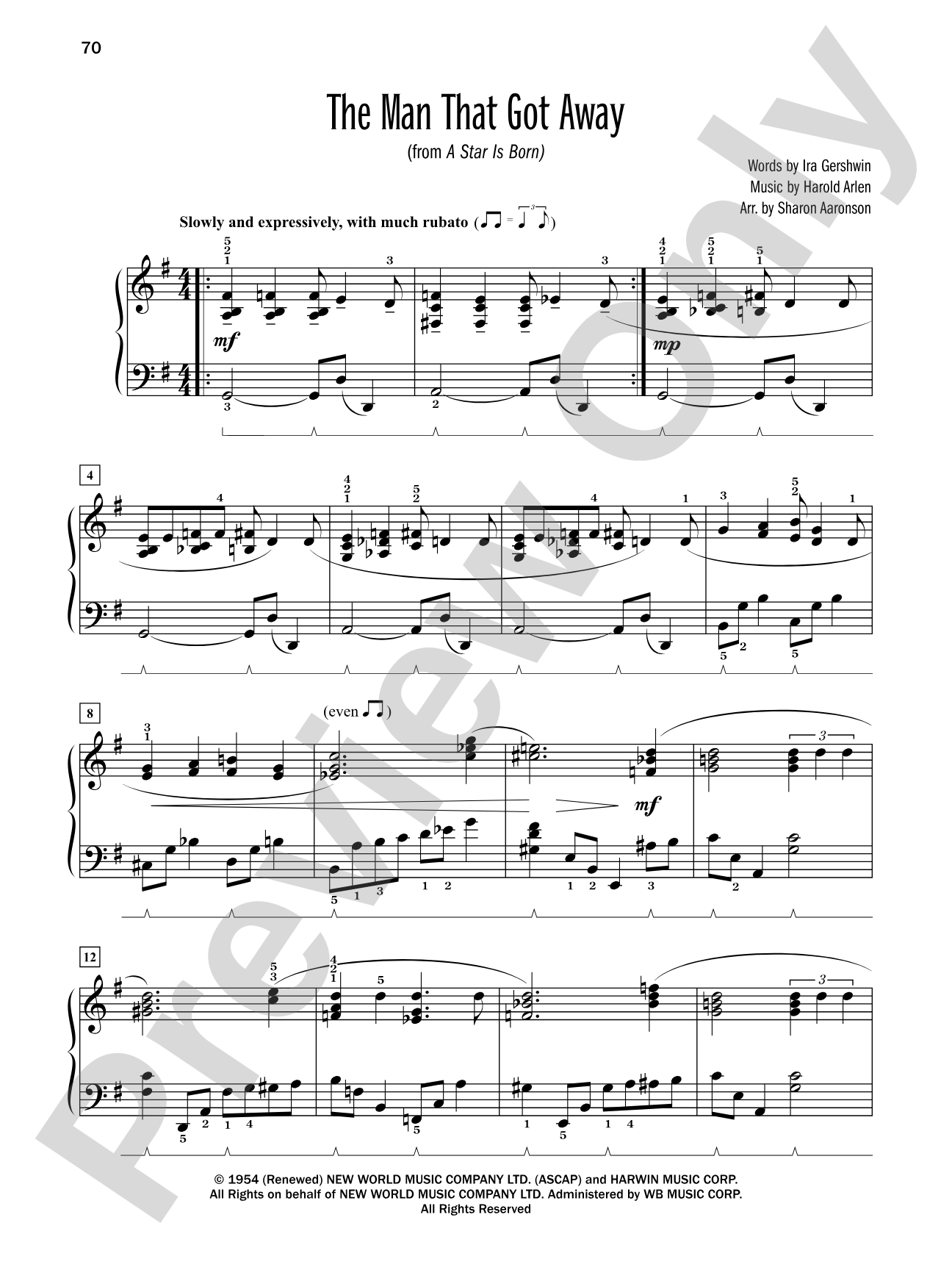

The Man That Got Away (from "A Star Is Born") - Piano Solo: Piano Solo
40 Intermediate to Early Advanced Piano Arrangements
Arranged by Sharon Aaronson
Level: Intermediate / Early Advanced
Item: 00-PS-0017335
$4.99
One moment…
Related Items
A Day in the Life of a Fool (Manha de Carnaval) - Piano Solo: Piano Solo |
$4.99
|
View | |
Allegro (from "Eine kleine Nachtmusik") - Piano Solo: Piano Solo |
$4.99
|
View | |
And All That Jazz (from "Chicago") - Piano Solo: Piano Solo |
$4.99
|
View | |
Anything Goes (from "Anything Goes") - Piano Solo: Piano Solo |
$4.99
|
View | |
As Time Goes By (from "Casablanca") - Piano Solo: Piano Solo |
$4.99
|
View | |
Begin the Beguine (from "Jubilee") - Piano Solo: Piano Solo |
$4.99
|
View | |
Blues in the Night (My Mama Done Tol' Me) - Piano Solo: Piano Solo |
$4.99
|
View | |
Camelot (from "Camelot") - Piano Solo: Piano Solo |
$4.99
|
View | |
Can You Read My Mind? (Love Theme from "Superman") - Piano Solo: Piano Solo |
$4.99
|
View | |
Canon in D - Piano Solo: Piano Solo |
$4.99
|
View | |
Clair de lune (from "Suite Bergamasque") - Piano Solo: Piano Solo |
$4.99
|
View | |
Everything's Coming Up Roses (from "Gypsy") - Piano Solo: Piano Solo |
$4.99
|
View | |
Fascinating Rhythm - Piano Solo: Piano Solo |
$4.99
|
View | |
Home (from "The Wiz") - Piano Solo: Piano Solo |
$4.99
|
View | |
It Had to Be You (as featured in "When Harry Met Sally") - Piano Solo: Piano Solo |
$4.99
|
View | |
Jesu, Joy of Man's Desiring - Piano Solo: Piano Solo |
$4.99
|
View | |
Lullaby of Broadway (from "42nd Street") - Piano Solo: Piano Solo |
$4.99
|
View | |
Marche funèbre - Piano Solo: Piano Solo |
$4.99
|
View | |
Moonligh Sonata (First Movement) - Piano Solo: Piano Solo |
$4.99
|
View | |
Nice Work If You Can Get It (from "Damsel in Distress") - Piano Solo: Piano Solo |
$4.99
|
View | |
Night and Day (from "Gay Divorcee") - Piano Solo: Piano Solo |
$4.99
|
View | |
O mio babbino caro (from "Gianni Schicchi") - Piano Solo: Piano Solo |
$4.99
|
View | |
On the Street Where You Live (from "My Fair Lady") - Piano Solo: Piano Solo |
$4.99
|
View | |
Over the Rainbow (from "The Wizard of Oz") - Piano Solo: Piano Solo |
$4.99
|
View | |
Someone to Watch Over Me (from "Oh, Kay!") - Piano Solo: Piano Solo |
$4.99
|
View | |
Summer Wind - Piano Solo: Piano Solo |
$4.99
|
View | |
Take Five - Piano Solo: Piano Solo |
$4.99
|
View | |
That's All (from "Tootsie") - Piano Solo: Piano Solo |
$4.99
|
View | |
The Pink Panther (from "The Pink Panther") - Piano Solo: Piano Solo |
$4.99
|
View | |
The Wind Beneath My Wings (from "Beaches") - Piano Solo: Piano Solo |
$4.99
|
View | |
Theme from "New York, New York" - Piano Solo: Piano Solo |
$4.99
|
View | |
Top 10 Broadway, Classical, Jazz & Movies: Piano Book |
$19.95
|
View |
Description
This eclectic blend of 40 sophisticated piano arrangements is a must-have for every music lover's collection! By popular demand, all of the arrangements from Aaronson's Top 10 series are now together in this attractive library-quality edition featuring hits from Broadway, movies, jazz legends and the classics. Includes music from the world's best songwriters and composers such as Beethoven, Gershwin, Mancini, Pachelbel, Porter, Puccini, Sondheim, and more! Titles: Allegro (from Eine kleine Nachtmusik) * And All That Jazz * Anything Goes * As Time Goes By * Beauty and the Beast * Begin the Beguine * Blues in the Night (My Mama Done Tol' Me) * Camelot * Can You Feel the Love Tonight * Can You Read My Mind? * Pachelbel's Canon in D * Clair de lune * Cruella De Vil * A Day in the Life of a Fool * The Entertainer * Everything's Coming Up Roses * Fascinating Rhythm * Home * It Had to Be You * Jesu, Joy of Man's Desiring * Lullaby of Broadway * The Man That Got Away * Marche funèbre * Moonlight Sonata (1st mvt.) * Nice Work If You Can Get It * Night and Day * O mio babbino caro * Ode to Joy * On the Street Where You Live * Over the Rainbow * The Pink Panther * Rhapsody on a Theme of Paganini * Send in the Clowns * Someone to Watch Over Me * Summer Wind * Take Five * That's All * Theme from New York, New York * A Whole New World * The Wind Beneath My Wings. 132 pages. A Federation Festivals 2024-2028 selection.


The Man That Got Away (from "A Star Is Born") - Piano Solo: Piano Solo isn't in MakeMusic Cloud just yet...but it could be. Let us know you'd like to see it, and you'll help shape what comes next. In the meantime, start a free trial and dive into thousands of interactive titles your students can play along with today.
Request This Title
Tell us you want it.
Start Your Free Trial
Explore everything that's ready to play right now.
Sample Audio
No sample audio found.
Sample Video
No sample videos found.
Additional Details
Series:
Top 10 Series
Publisher:
Alfred Music
Page Count:
132
SKU:
00-PS-0017335
More about this title
About the Composer: Harold Arlen
Harold Arlen (1905-1986) composed some of the most enduring melodies in American popular music, with a particular gift for writing songs that bridge classical sophistication and mass appeal. His work for film and stage—including "The Wizard of Oz," "A Star Is Born," and numerous Broadway productions—earned him an Academy Award and a legacy as one of the most recorded composers of the twentieth century. Arlen's melodic inventiveness and harmonic richness made his songs natural subjects for arrangement and reinterpretation across every musical genre.
Why we love this
Sharon Aaronson's arrangement of this particular song captures the theatrical warmth and jazz sophistication that made Arlen's original so timeless, while making it accessible for pianists who want to perform sophisticated material without excessive technical demands. The phrasing and harmonic detail reward thoughtful interpretation, and the piece sits comfortably under the hands of an early-advanced pianist ready to explore orchestration within a single instrument.
What to expect
Bittersweet and elegantly crafted, with the tonal warmth of classic Hollywood underscored by jazz harmonies and subtle chromatic movement. The arrangement respects the song's emotional weight—this is a character lamenting lost love—while maintaining the rhythmic vitality and harmonic color that made Arlen's writing so distinctive.
Who it's for
Intermediate to early-advanced pianists who want to explore the American songbook with arrangements that value musicality over technical pyrotechnics. This works equally well for serious students building a recital repertoire, pianists preparing audition material, or teachers seeking sophisticated jazz-influenced repertoire that connects to broader musical history.
How to get the most out of it
- Shape the melody with the dynamic contours of a singer; Arlen's songs are fundamentally vocal in their construction, and the piano arrangement succeeds when you honor that phrasing even on an instrument.
- Pay attention to the balance between the accompanimental figures and the melody line. In jazz-influenced passages, the accompaniment can shift from purely supportive to almost conversational.
- Listen to classic vocal recordings of the tune to absorb its emotional arc and tempo relationships; this will inform how you voice chords and shape transitions between sections.
How to use it
Program this alongside other American songbook standards to create a thematic concert section on twentieth-century popular song, or use it as a bridge between classical repertoire and jazz-influenced contemporary piano literature. It also serves as an excellent audition or recital piece for pianists seeking material that demonstrates both interpretive maturity and stylistic versatility.
Skills your students will build
- Voicing jazz harmonies and interpreting lead-sheet-style accompaniments
- Balancing melody and accompaniment in a single-instrument setting
- Shaping long melodic lines with rubato and dynamic nuance
- Reading and performing swing rhythms and syncopated figures
- Interpreting standards with attention to emotional content and historical context