
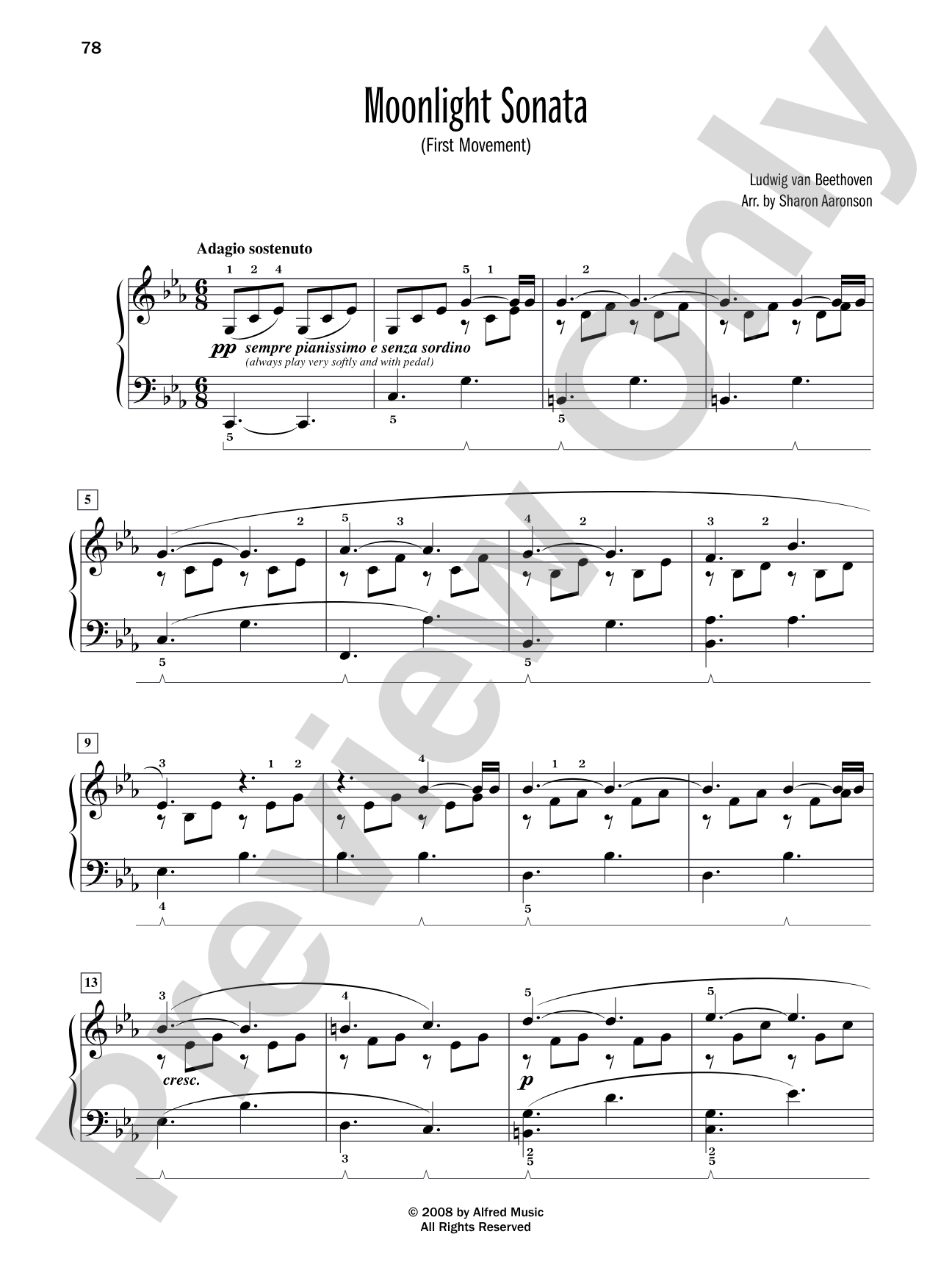

Moonligh Sonata (First Movement) - Piano Solo: Piano Solo
40 Intermediate to Early Advanced Piano Arrangements
Arranged by Sharon Aaronson
Level: Intermediate / Early Advanced
Item: 00-PS-0017325
$4.99
One moment…
Related Items
A Day in the Life of a Fool (Manha de Carnaval) - Piano Solo: Piano Solo |
$4.99
|
View | |
Allegro (from "Eine kleine Nachtmusik") - Piano Solo: Piano Solo |
$4.99
|
View | |
And All That Jazz (from "Chicago") - Piano Solo: Piano Solo |
$4.99
|
View | |
Anything Goes (from "Anything Goes") - Piano Solo: Piano Solo |
$4.99
|
View | |
As Time Goes By (from "Casablanca") - Piano Solo: Piano Solo |
$4.99
|
View | |
Begin the Beguine (from "Jubilee") - Piano Solo: Piano Solo |
$4.99
|
View | |
Blues in the Night (My Mama Done Tol' Me) - Piano Solo: Piano Solo |
$4.99
|
View | |
Camelot (from "Camelot") - Piano Solo: Piano Solo |
$4.99
|
View | |
Can You Read My Mind? (Love Theme from "Superman") - Piano Solo: Piano Solo |
$4.99
|
View | |
Canon in D - Piano Solo: Piano Solo |
$4.99
|
View | |
Clair de lune (from "Suite Bergamasque") - Piano Solo: Piano Solo |
$4.99
|
View | |
Everything's Coming Up Roses (from "Gypsy") - Piano Solo: Piano Solo |
$4.99
|
View | |
Fascinating Rhythm - Piano Solo: Piano Solo |
$4.99
|
View | |
Home (from "The Wiz") - Piano Solo: Piano Solo |
$4.99
|
View | |
It Had to Be You (as featured in "When Harry Met Sally") - Piano Solo: Piano Solo |
$4.99
|
View | |
Jesu, Joy of Man's Desiring - Piano Solo: Piano Solo |
$4.99
|
View | |
Lullaby of Broadway (from "42nd Street") - Piano Solo: Piano Solo |
$4.99
|
View | |
Marche funèbre - Piano Solo: Piano Solo |
$4.99
|
View | |
Nice Work If You Can Get It (from "Damsel in Distress") - Piano Solo: Piano Solo |
$4.99
|
View | |
Night and Day (from "Gay Divorcee") - Piano Solo: Piano Solo |
$4.99
|
View | |
O mio babbino caro (from "Gianni Schicchi") - Piano Solo: Piano Solo |
$4.99
|
View | |
On the Street Where You Live (from "My Fair Lady") - Piano Solo: Piano Solo |
$4.99
|
View | |
Over the Rainbow (from "The Wizard of Oz") - Piano Solo: Piano Solo |
$4.99
|
View | |
Someone to Watch Over Me (from "Oh, Kay!") - Piano Solo: Piano Solo |
$4.99
|
View | |
Summer Wind - Piano Solo: Piano Solo |
$4.99
|
View | |
Take Five - Piano Solo: Piano Solo |
$4.99
|
View | |
That's All (from "Tootsie") - Piano Solo: Piano Solo |
$4.99
|
View | |
The Man That Got Away (from "A Star Is Born") - Piano Solo: Piano Solo |
$4.99
|
View | |
The Pink Panther (from "The Pink Panther") - Piano Solo: Piano Solo |
$4.99
|
View | |
The Wind Beneath My Wings (from "Beaches") - Piano Solo: Piano Solo |
$4.99
|
View | |
Theme from "New York, New York" - Piano Solo: Piano Solo |
$4.99
|
View | |
Top 10 Broadway, Classical, Jazz & Movies: Piano Book |
$19.95
|
View |
Description
This eclectic blend of 40 sophisticated piano arrangements is a must-have for every music lover's collection! By popular demand, all of the arrangements from Aaronson's Top 10 series are now together in this attractive library-quality edition featuring hits from Broadway, movies, jazz legends and the classics. Includes music from the world's best songwriters and composers such as Beethoven, Gershwin, Mancini, Pachelbel, Porter, Puccini, Sondheim, and more! Titles: Allegro (from Eine kleine Nachtmusik) * And All That Jazz * Anything Goes * As Time Goes By * Beauty and the Beast * Begin the Beguine * Blues in the Night (My Mama Done Tol' Me) * Camelot * Can You Feel the Love Tonight * Can You Read My Mind? * Pachelbel's Canon in D * Clair de lune * Cruella De Vil * A Day in the Life of a Fool * The Entertainer * Everything's Coming Up Roses * Fascinating Rhythm * Home * It Had to Be You * Jesu, Joy of Man's Desiring * Lullaby of Broadway * The Man That Got Away * Marche funèbre * Moonlight Sonata (1st mvt.) * Nice Work If You Can Get It * Night and Day * O mio babbino caro * Ode to Joy * On the Street Where You Live * Over the Rainbow * The Pink Panther * Rhapsody on a Theme of Paganini * Send in the Clowns * Someone to Watch Over Me * Summer Wind * Take Five * That's All * Theme from New York, New York * A Whole New World * The Wind Beneath My Wings. 132 pages. A Federation Festivals 2024-2028 selection.


Discover MakeMusic Cloud: thousands of interactive titles your students can play along with today.
Sample Audio
No sample audio found.
Sample Video
No sample videos found.
Additional Details
Series:
Top 10 Series
Publisher:
Alfred Music
Page Count:
132
SKU:
00-PS-0017325
More about this title
About the Composer: Ludwig van Beethoven
Ludwig van Beethoven (1770-1827) stands as one of history's most transformative composers, bridging the Classical and Romantic eras through works of unprecedented emotional depth and structural innovation. His nine symphonies, thirty-two piano sonatas, and chamber works form the backbone of Western music education, and his ability to communicate profound human experience through purely instrumental means shaped how composers approached their craft for generations to come.
Why we love this
Beethoven's First Movement from the Moonlight Sonata appears here in Sharon Aaronson's thoughtful arrangement within a carefully curated collection that spans centuries of musical genius. The arrangement honors the original's introspective character while making this iconic work accessible to pianists developing their interpretive skills, and its inclusion alongside Broadway standards and jazz classics creates programming flexibility for recitals that need sophistication without pretension.
What to expect
The opening moves through moonlit quiet, tender and introspective, with a gentle rocking motion beneath a song-like melody. As it unfolds, subtle emotional layers emerge from the harmony, creating moments of wistfulness and calm reflection that feel both intimate and timeless.
Who it's for
Intermediate to early advanced pianists seeking an accessible entry point into Beethoven's sonata literature, or those building a diverse recital program that pairs classical masterworks with lighter popular material. This arrangement serves pianists who want to develop interpretive maturity without the technical demands of a full virtuosic sonata.
How to get the most out of it
- Shape the arpeggiated accompaniment as a unified voice rather than treating each broken chord as isolated figures; think of it as a gently rolling foundation supporting the melody's emotional arc.
- Resist the urge to rush the opening measures. The sonority breathes when you allow the harmonies space to resonate and decay naturally.
- Balance transparency in the middle sections with the reflective quality of the outer material; avoid letting accompanying voices overwhelm the singing line.
- Explore the pedal carefully through harmonic changes to maintain clarity while sustaining the dreamy atmosphere the movement requires.
How to use it
This arrangement works beautifully as a centerpiece in a recital that mixes periods and styles, especially when you want to acknowledge the classical canon without programming an entire multi-movement sonata. It also pairs naturally with the other Beethoven selections in this collection (Allegro from Eine kleine Nachtmusik, Ode to Joy) if building a thematic program around familiar masterworks.
Skills your students will build
- Voicing independence between melody and accompaniment in Romantic-era textures
- Sustaining lyrical phrasing across broken chord patterns
- Pedal control and harmonic listening in acoustic resonance
- Interpretation of tempo rubato and expressive timing within Classical structures