
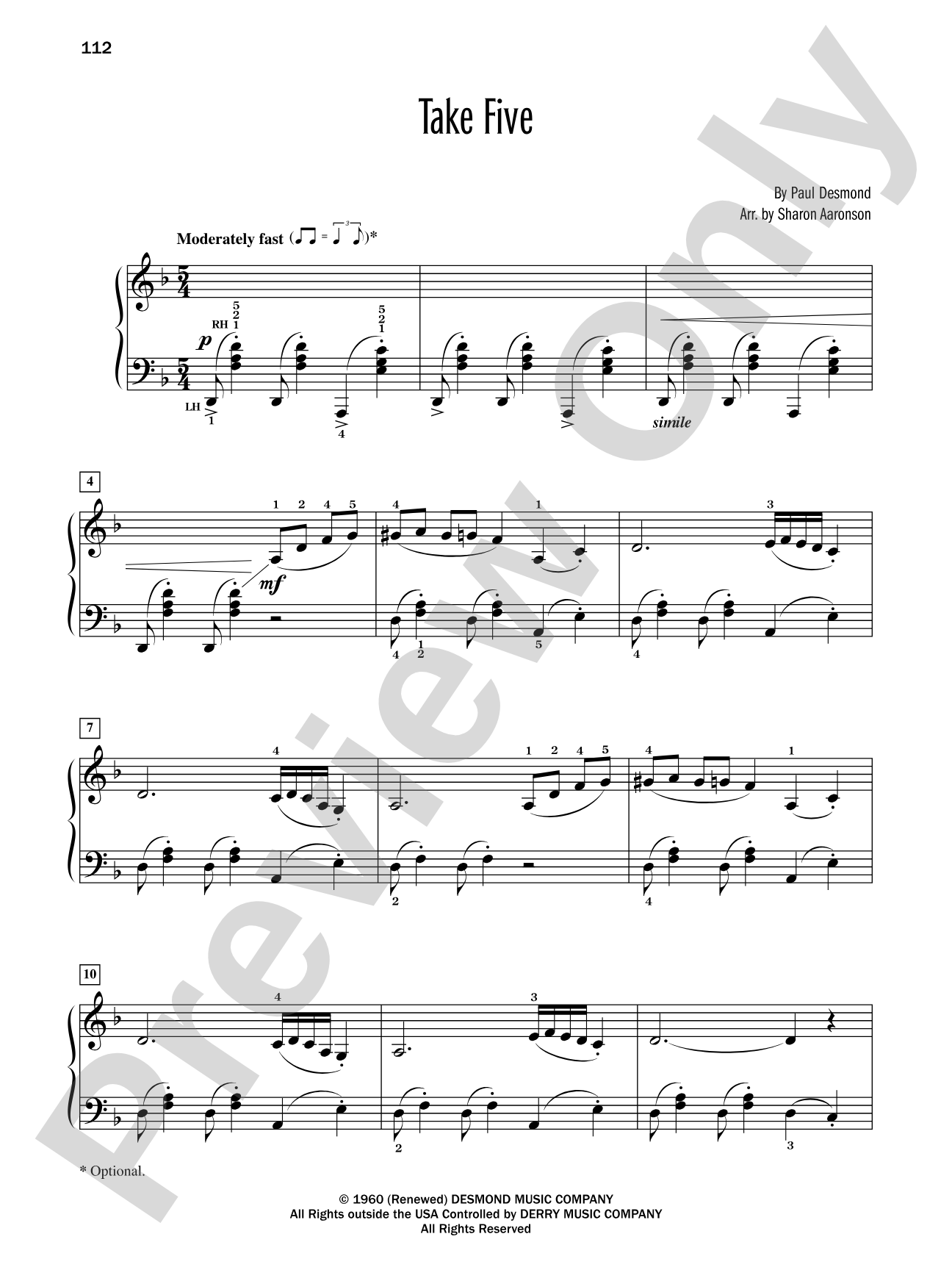

Take Five - Piano Solo: Piano Solo
40 Intermediate to Early Advanced Piano Arrangements
Arranged by Sharon Aaronson
Level: Intermediate / Early Advanced
Item: 00-PS-0017333
$4.99
One moment…
Related Items
A Day in the Life of a Fool (Manha de Carnaval) - Piano Solo: Piano Solo |
$4.99
|
View | |
Allegro (from "Eine kleine Nachtmusik") - Piano Solo: Piano Solo |
$4.99
|
View | |
And All That Jazz (from "Chicago") - Piano Solo: Piano Solo |
$4.99
|
View | |
Anything Goes (from "Anything Goes") - Piano Solo: Piano Solo |
$4.99
|
View | |
As Time Goes By (from "Casablanca") - Piano Solo: Piano Solo |
$4.99
|
View | |
Begin the Beguine (from "Jubilee") - Piano Solo: Piano Solo |
$4.99
|
View | |
Blues in the Night (My Mama Done Tol' Me) - Piano Solo: Piano Solo |
$4.99
|
View | |
Camelot (from "Camelot") - Piano Solo: Piano Solo |
$4.99
|
View | |
Can You Read My Mind? (Love Theme from "Superman") - Piano Solo: Piano Solo |
$4.99
|
View | |
Canon in D - Piano Solo: Piano Solo |
$4.99
|
View | |
Clair de lune (from "Suite Bergamasque") - Piano Solo: Piano Solo |
$4.99
|
View | |
Everything's Coming Up Roses (from "Gypsy") - Piano Solo: Piano Solo |
$4.99
|
View | |
Fascinating Rhythm - Piano Solo: Piano Solo |
$4.99
|
View | |
Home (from "The Wiz") - Piano Solo: Piano Solo |
$4.99
|
View | |
It Had to Be You (as featured in "When Harry Met Sally") - Piano Solo: Piano Solo |
$4.99
|
View | |
Jesu, Joy of Man's Desiring - Piano Solo: Piano Solo |
$4.99
|
View | |
Lullaby of Broadway (from "42nd Street") - Piano Solo: Piano Solo |
$4.99
|
View | |
Marche funèbre - Piano Solo: Piano Solo |
$4.99
|
View | |
Moonligh Sonata (First Movement) - Piano Solo: Piano Solo |
$4.99
|
View | |
Nice Work If You Can Get It (from "Damsel in Distress") - Piano Solo: Piano Solo |
$4.99
|
View | |
Night and Day (from "Gay Divorcee") - Piano Solo: Piano Solo |
$4.99
|
View | |
O mio babbino caro (from "Gianni Schicchi") - Piano Solo: Piano Solo |
$4.99
|
View | |
On the Street Where You Live (from "My Fair Lady") - Piano Solo: Piano Solo |
$4.99
|
View | |
Over the Rainbow (from "The Wizard of Oz") - Piano Solo: Piano Solo |
$4.99
|
View | |
Someone to Watch Over Me (from "Oh, Kay!") - Piano Solo: Piano Solo |
$4.99
|
View | |
Summer Wind - Piano Solo: Piano Solo |
$4.99
|
View | |
That's All (from "Tootsie") - Piano Solo: Piano Solo |
$4.99
|
View | |
The Man That Got Away (from "A Star Is Born") - Piano Solo: Piano Solo |
$4.99
|
View | |
The Pink Panther (from "The Pink Panther") - Piano Solo: Piano Solo |
$4.99
|
View | |
The Wind Beneath My Wings (from "Beaches") - Piano Solo: Piano Solo |
$4.99
|
View | |
Theme from "New York, New York" - Piano Solo: Piano Solo |
$4.99
|
View | |
Top 10 Broadway, Classical, Jazz & Movies: Piano Book |
$19.95
|
View |
Description
This eclectic blend of 40 sophisticated piano arrangements is a must-have for every music lover's collection! By popular demand, all of the arrangements from Aaronson's Top 10 series are now together in this attractive library-quality edition featuring hits from Broadway, movies, jazz legends and the classics. Includes music from the world's best songwriters and composers such as Beethoven, Gershwin, Mancini, Pachelbel, Porter, Puccini, Sondheim, and more! Titles: Allegro (from Eine kleine Nachtmusik) * And All That Jazz * Anything Goes * As Time Goes By * Beauty and the Beast * Begin the Beguine * Blues in the Night (My Mama Done Tol' Me) * Camelot * Can You Feel the Love Tonight * Can You Read My Mind? * Pachelbel's Canon in D * Clair de lune * Cruella De Vil * A Day in the Life of a Fool * The Entertainer * Everything's Coming Up Roses * Fascinating Rhythm * Home * It Had to Be You * Jesu, Joy of Man's Desiring * Lullaby of Broadway * The Man That Got Away * Marche funèbre * Moonlight Sonata (1st mvt.) * Nice Work If You Can Get It * Night and Day * O mio babbino caro * Ode to Joy * On the Street Where You Live * Over the Rainbow * The Pink Panther * Rhapsody on a Theme of Paganini * Send in the Clowns * Someone to Watch Over Me * Summer Wind * Take Five * That's All * Theme from New York, New York * A Whole New World * The Wind Beneath My Wings. 132 pages. A Federation Festivals 2024-2028 selection.


Discover MakeMusic Cloud: thousands of interactive titles your students can play along with today.
Sample Audio
No sample audio found.
Sample Video
No sample videos found.
Additional Details
Series:
Top 10 Series
Publisher:
Alfred Music
Page Count:
132
SKU:
00-PS-0017333
More about this title
About the Composer: Paul Desmond
Paul Desmond (1924–1977) was an alto saxophonist and composer best known for his work with the Dave Brubeck Quartet, where his cool, lyrical tone became a defining voice in cool jazz. He composed "Take Five," one of the most recognizable jazz standards of the 20th century, which became a crossover hit and introduced millions to modal jazz composition. Desmond's gift for melody and sophisticated harmonic thinking influenced generations of jazz musicians and composers.
Why we love this
Sharon Aaronson's arrangements bring together repertoire that spans classical masterworks, Broadway gold, and jazz standards in one cohesive collection. Each arrangement sits comfortably at the intermediate to early advanced level, making this ideal for students who want to explore diverse musical styles without navigating multiple single-piece purchases. The breadth of material serves both recital programming and personal repertoire building, offering genuine variety that holds interest across repeated practice sessions.
What to expect
A sophisticated tour through American popular song, European classical tradition, and jazz idiom, all filtered through the lens of a skilled arranger. These pieces invite you into the storytelling behind each melody, whether you're playing a Gershwin standard, a film theme, or a Pachelbel favorite. The writing feels accessible without being condescending, allowing the elegance of each source material to shine through.
Who it's for
Intermediate and early advanced pianists preparing recital material, festival performances, or building a diverse solo repertoire. Music students who want exposure to multiple musical styles and eras in a single, organized resource.
How to get the most out of it
- Balance rubato with rhythmic clarity in the classical pieces; these arrangements invite expressive phrasing without sacrificing the architectural integrity of the originals.
- Approach the jazz standards with attention to swing feel and syncopation, even in simplified arrangements. The rhythmic sophistication is part of what makes these pieces musically satisfying.
- Use the full dynamic range available to you. With 40 pieces, contrast in touch and tone between selections will keep listeners engaged during longer recitals.
- Pay close attention to any written articulation markings. Aaronson's arrangements often use staccato, legato, and accent choices to guide the character of each piece.
How to use it
Build a themed recital around contrasting styles: open with a classical arrangement (Pachelbel, Beethoven), move through Broadway and film music in the middle section, and close with jazz standards. Alternatively, select 8-10 pieces that suit your student's strengths and interests, using the collection as a menu for festival selections across multiple years. The variety makes it equally valuable for a solo recital or as a personal practice resource for exploring different musical languages.
Skills your students will build
- Navigating stylistic differences between classical, Broadway, and jazz repertoire
- Interpreting swing rhythm and jazz phrasing conventions
- Reading and executing articulation markings that define musical character
- Managing dynamic contrast and touch variation across a large body of work
- Developing fluency with rubato and expressive phrasing in arrangements of well-known melodies