
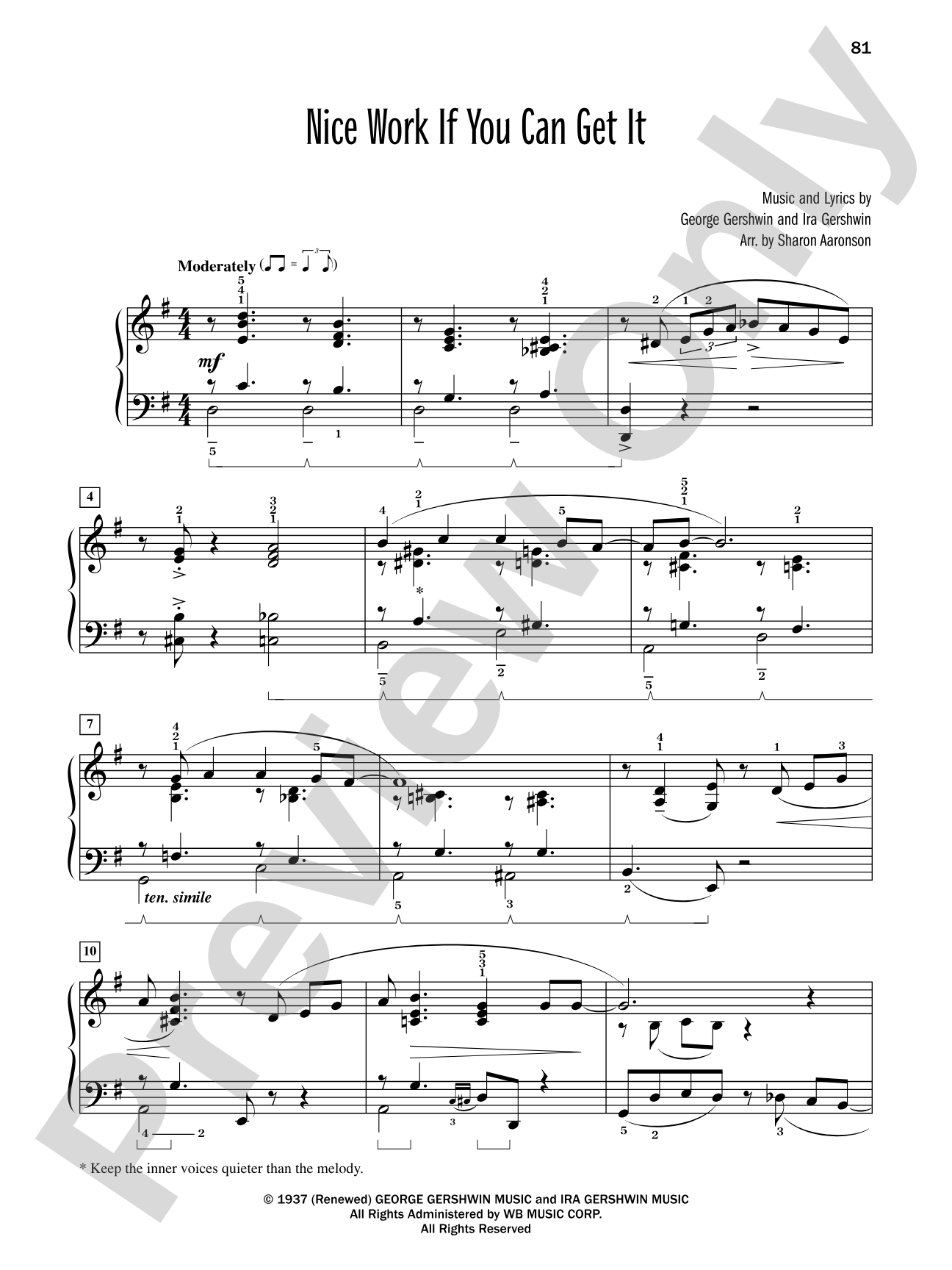

Nice Work If You Can Get It (from "Damsel in Distress") - Piano Solo: Piano Solo
40 Intermediate to Early Advanced Piano Arrangements
Arranged by Sharon Aaronson
Level: Intermediate / Early Advanced
Item: 00-PS-0017326
$4.99
One moment…
Related Items
A Day in the Life of a Fool (Manha de Carnaval) - Piano Solo: Piano Solo |
$4.99
|
View | |
Allegro (from "Eine kleine Nachtmusik") - Piano Solo: Piano Solo |
$4.99
|
View | |
And All That Jazz (from "Chicago") - Piano Solo: Piano Solo |
$4.99
|
View | |
Anything Goes (from "Anything Goes") - Piano Solo: Piano Solo |
$4.99
|
View | |
As Time Goes By (from "Casablanca") - Piano Solo: Piano Solo |
$4.99
|
View | |
Begin the Beguine (from "Jubilee") - Piano Solo: Piano Solo |
$4.99
|
View | |
Blues in the Night (My Mama Done Tol' Me) - Piano Solo: Piano Solo |
$4.99
|
View | |
Camelot (from "Camelot") - Piano Solo: Piano Solo |
$4.99
|
View | |
Can You Read My Mind? (Love Theme from "Superman") - Piano Solo: Piano Solo |
$4.99
|
View | |
Canon in D - Piano Solo: Piano Solo |
$4.99
|
View | |
Clair de lune (from "Suite Bergamasque") - Piano Solo: Piano Solo |
$4.99
|
View | |
Everything's Coming Up Roses (from "Gypsy") - Piano Solo: Piano Solo |
$4.99
|
View | |
Fascinating Rhythm - Piano Solo: Piano Solo |
$4.99
|
View | |
Home (from "The Wiz") - Piano Solo: Piano Solo |
$4.99
|
View | |
It Had to Be You (as featured in "When Harry Met Sally") - Piano Solo: Piano Solo |
$4.99
|
View | |
Jesu, Joy of Man's Desiring - Piano Solo: Piano Solo |
$4.99
|
View | |
Lullaby of Broadway (from "42nd Street") - Piano Solo: Piano Solo |
$4.99
|
View | |
Marche funèbre - Piano Solo: Piano Solo |
$4.99
|
View | |
Moonligh Sonata (First Movement) - Piano Solo: Piano Solo |
$4.99
|
View | |
Night and Day (from "Gay Divorcee") - Piano Solo: Piano Solo |
$4.99
|
View | |
O mio babbino caro (from "Gianni Schicchi") - Piano Solo: Piano Solo |
$4.99
|
View | |
On the Street Where You Live (from "My Fair Lady") - Piano Solo: Piano Solo |
$4.99
|
View | |
Over the Rainbow (from "The Wizard of Oz") - Piano Solo: Piano Solo |
$4.99
|
View | |
Someone to Watch Over Me (from "Oh, Kay!") - Piano Solo: Piano Solo |
$4.99
|
View | |
Summer Wind - Piano Solo: Piano Solo |
$4.99
|
View | |
Take Five - Piano Solo: Piano Solo |
$4.99
|
View | |
That's All (from "Tootsie") - Piano Solo: Piano Solo |
$4.99
|
View | |
The Man That Got Away (from "A Star Is Born") - Piano Solo: Piano Solo |
$4.99
|
View | |
The Pink Panther (from "The Pink Panther") - Piano Solo: Piano Solo |
$4.99
|
View | |
The Wind Beneath My Wings (from "Beaches") - Piano Solo: Piano Solo |
$4.99
|
View | |
Theme from "New York, New York" - Piano Solo: Piano Solo |
$4.99
|
View | |
Top 10 Broadway, Classical, Jazz & Movies: Piano Book |
$19.95
|
View |
Description
This eclectic blend of 40 sophisticated piano arrangements is a must-have for every music lover's collection! By popular demand, all of the arrangements from Aaronson's Top 10 series are now together in this attractive library-quality edition featuring hits from Broadway, movies, jazz legends and the classics. Includes music from the world's best songwriters and composers such as Beethoven, Gershwin, Mancini, Pachelbel, Porter, Puccini, Sondheim, and more! Titles: Allegro (from Eine kleine Nachtmusik) * And All That Jazz * Anything Goes * As Time Goes By * Beauty and the Beast * Begin the Beguine * Blues in the Night (My Mama Done Tol' Me) * Camelot * Can You Feel the Love Tonight * Can You Read My Mind? * Pachelbel's Canon in D * Clair de lune * Cruella De Vil * A Day in the Life of a Fool * The Entertainer * Everything's Coming Up Roses * Fascinating Rhythm * Home * It Had to Be You * Jesu, Joy of Man's Desiring * Lullaby of Broadway * The Man That Got Away * Marche funèbre * Moonlight Sonata (1st mvt.) * Nice Work If You Can Get It * Night and Day * O mio babbino caro * Ode to Joy * On the Street Where You Live * Over the Rainbow * The Pink Panther * Rhapsody on a Theme of Paganini * Send in the Clowns * Someone to Watch Over Me * Summer Wind * Take Five * That's All * Theme from New York, New York * A Whole New World * The Wind Beneath My Wings. 132 pages. A Federation Festivals 2024-2028 selection.


Nice Work If You Can Get It (from "Damsel in Distress") - Piano Solo: Piano Solo isn't in MakeMusic Cloud just yet...but it could be. Let us know you'd like to see it, and you'll help shape what comes next. In the meantime, start a free trial and dive into thousands of interactive titles your students can play along with today.
Request This Title
Tell us you want it.
Start Your Free Trial
Explore everything that's ready to play right now.
Sample Audio
No sample audio found.
Sample Video
No sample videos found.
Additional Details
Series:
Top 10 Series
Publisher:
Alfred Music
Page Count:
132
SKU:
00-PS-0017326
More about this title
About the Composer: George Gershwin
George Gershwin (1898-1937) bridged classical and popular music with a distinctiveness that still defines American song. His command of melody, harmonic sophistication, and rhythmic vitality made him one of the most influential composers of the 20th century, equally at home writing concertos, operatic works, and standards for Broadway and film.
In the classroom and rehearsal room, Gershwin's music teaches jazz vocabulary, blues inflections, and the seamless integration of popular idioms into concert music. His compositions demand both technical clarity and interpretive maturity from performers, making them enduring touchstones for intermediate through advanced musicians.
Why we love this
Sharon Aaronson's arrangements capture Gershwin's melodic brilliance while remaining idiomatically pianistic, respecting the original's harmonic language without overwhelming the player. This single piano solo sits within a carefully curated 40-piece collection, so pianists can program it alongside other jazz standards and classical favorites at recitals or festivals without breaking thematic or stylistic coherence.
What to expect
Optimistic and urbane, this song radiates the jazzy sophistication of 1930s songwriting. The melody floats buoyantly over harmonies that shift and shimmer, inviting the player to deliver both elegance and swing in equal measure.
Who it's for
Intermediate to early advanced pianists developing confidence in jazz and popular song styles will find this arrangement accessible without being simplified. It's ideal for students building a recital program that balances classical standards with 20th-century popular music, and for teachers seeking a single Gershwin piece that showcases both melodic and harmonic sophistication.
How to get the most out of it
- Approach the jazz idioms (swing rhythms, blue notes, chromatic passing tones) with the same precision you'd apply to classical repertoire; rhythmic looseness undermines Gershwin's harmonic wit.
- Balance the lyrical A section with the rhythmic drive of the B section, resisting the urge to slow down during the bridge's more introspective moments.
- Listen to vocal recordings of the song first; understanding the original melody and phrasing will deepen your interpretation and help you voice the accompaniment more idiomatically.
- Let the stride bass patterns and jazz comping figures breathe without mechanical rigidity, but maintain clear articulation so the inner voices remain audible.
How to use it
Program this as a bridge between classical and jazz worlds on a recital mixing standards with art songs or concerto movements. Its moderate length and immediate appeal make it an excellent closer for a student recital or a companion piece alongside other Broadway or film music in a festival program.
Skills your students will build
- Jazz harmony and voice leading (seventh chords, secondary dominants, chromatic substitutions)
- Swing rhythm and syncopation in both melody and accompaniment
- Stride piano and jazz comping patterns
- Interpreting popular music idioms with musical maturity and clarity
- Balancing lyrical phrasing with rhythmic precision