
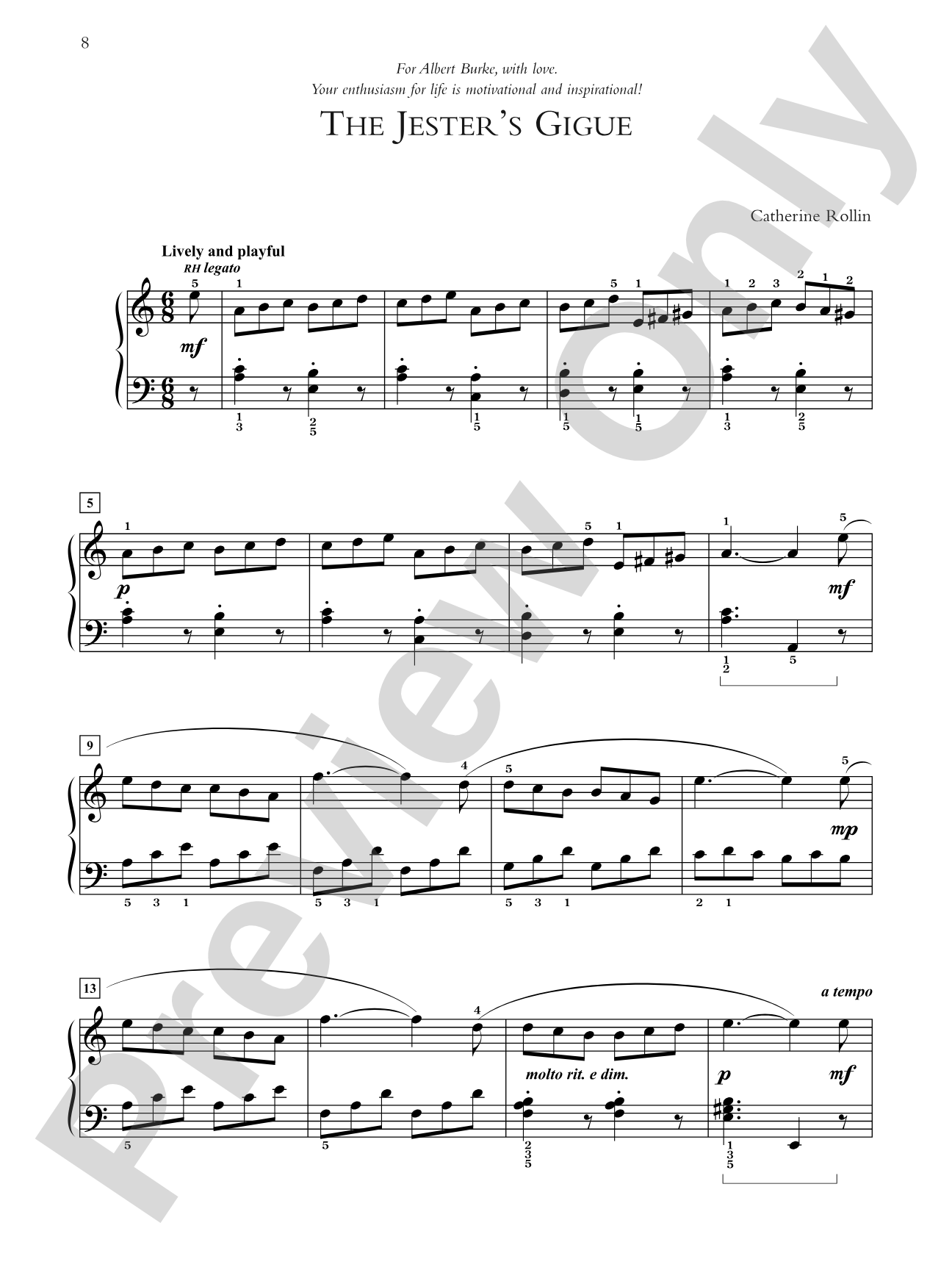

The Jester's Gigue - Piano Solo: Piano Solo
10 Early Intermediate Piano Solos in Dance Styles
By Catherine Rollin
Level: Early Intermediate
Item: 00-PS-0017285
$6.99
Pickup currently not available
Related Items
Conga, Conga, Conga - Piano Solo: Piano Solo |
$4.99
|
View | |
Island Rumba - Piano Solo: Piano Solo |
$4.99
|
View | |
Make Mine Cha-Cha-Cha! - Piano Solo: Piano Solo |
$4.99
|
View | |
Mazurka for Chopin - Piano Solo: Piano Solo |
$4.99
|
View | |
Mediterranean Dance - Piano Solo: Piano Solo |
$4.99
|
View | |
Rock and Roll Slow Dance - Piano Solo: Piano Solo |
$4.99
|
View | |
Spicy Salsa - Piano Solo: Piano Solo |
$4.99
|
View | |
Tantalizing Tango - Piano Solo: Piano Solo |
$4.99
|
View | |
Tap Time Encore - Piano Solo: Piano Solo |
$4.99
|
View | |
Dancing on the Keys, Book 1: Piano Book |
$6.99
|
View |
Description
Teachers and students love Catherine Rollin's duet series Dances for Two, and encouraged her to write all-new solo collections of pieces based on dance rhythms. Book 1 titles: Conga, Conga, Conga * Island Rumba * The Jester's Gigue * Make Mine Cha-Cha-Cha! * Mazurka for Chopin * Mediterranean Dance * Rock and Roll Slow Dance * Spicy Salsa * Tantalizing Tango * Tap Time Encore. A Federation Festivals 2024-2028 selection.


The Jester's Gigue - Piano Solo: Piano Solo isn't in MakeMusic Cloud just yet...but it could be. Let us know you'd like to see it, and you'll help shape what comes next. In the meantime, start a free trial and dive into thousands of interactive titles your students can play along with today.
Request This Title
Tell us you want it.
Start Your Free Trial
Explore everything that's ready to play right now.
Sample Audio
1
Audio File
--:--
0:00
0:00
Sample Video
Additional Details
Publisher:
Alfred Music
Page Count:
24
SKU:
00-PS-0017285
More about this title
About the Composer: Catherine Rollin

Catherine Rollin is a composer and pianist whose dual career spans both the concert stage and the teaching studio. She holds degrees from the University of Michigan and Oakland University School of Performing Arts, and has built a reputation for mentoring students who win major competitions. Her workshop presentations have taken her across the United States, Canada, Japan, and Taiwan.
Rollin's compositions have earned commissions from the Music Teachers National Association, the Michigan Music Teachers Association, and Clavier Companion magazine. Her work appears regularly on National Federation of Music Clubs festival lists, and she has judged major composition competitions at the national level. Recent honors include a commission for the MTNA's From the Pen to the Premiere series and a featured performance by the Steinway Society as both composer and performer.
Why we love this
Rollin's knack for writing accessible yet musically engaging material shines throughout this collection. The gigue, with its sprightly rhythm and clear harmonic structure, gives early intermediate pianists genuine character to interpret rather than just notes to execute. This piece earned its place on the 2024-2028 Federation Festivals list, so your students can prepare repertoire that opens doors to festival competition.
What to expect
The Jester's Gigue captures the playful, slightly mischievous energy of a medieval entertainer. Quick-footed rhythms and buoyant phrasing create forward momentum, while the harmonic language stays grounded enough to let the student focus on capturing character rather than wrestling with complex textures.
Who it's for
Early intermediate pianists ready to move beyond straightforward exercises into repertoire with genuine musical personality. Students preparing for festival competition will find this gigue appeals to adjudicators while remaining within their technical grasp.
How to get the most out of it
- Establish a steady pulse in the gigue's characteristic 6/8 meter before mapping out the piece; let the rhythm drive the articulation rather than the reverse.
- Shape the melodic lines through subtle dynamic breathing rather than heavy pedal work, allowing the underlying dance rhythm to remain clear.
- Listen for opportunities to bring out the humor in the "jester" character through rhythmic precision and crisp articulation in running passages.
How to use it
Program this as a contrasting lighter piece in a student recital, particularly alongside more serious classical or romantic selections. It also works well as an encore or as part of a theme-based concert celebrating dance across musical styles.
Skills your students will build
- Reading and executing 6/8 meter with rhythmic confidence
- Articulating running sixteenth-note passages with clarity and control
- Shaping melodic phrases through dynamic variation rather than pedal dependency
- Interpreting character and style cues from a piece's title and musical gesture