
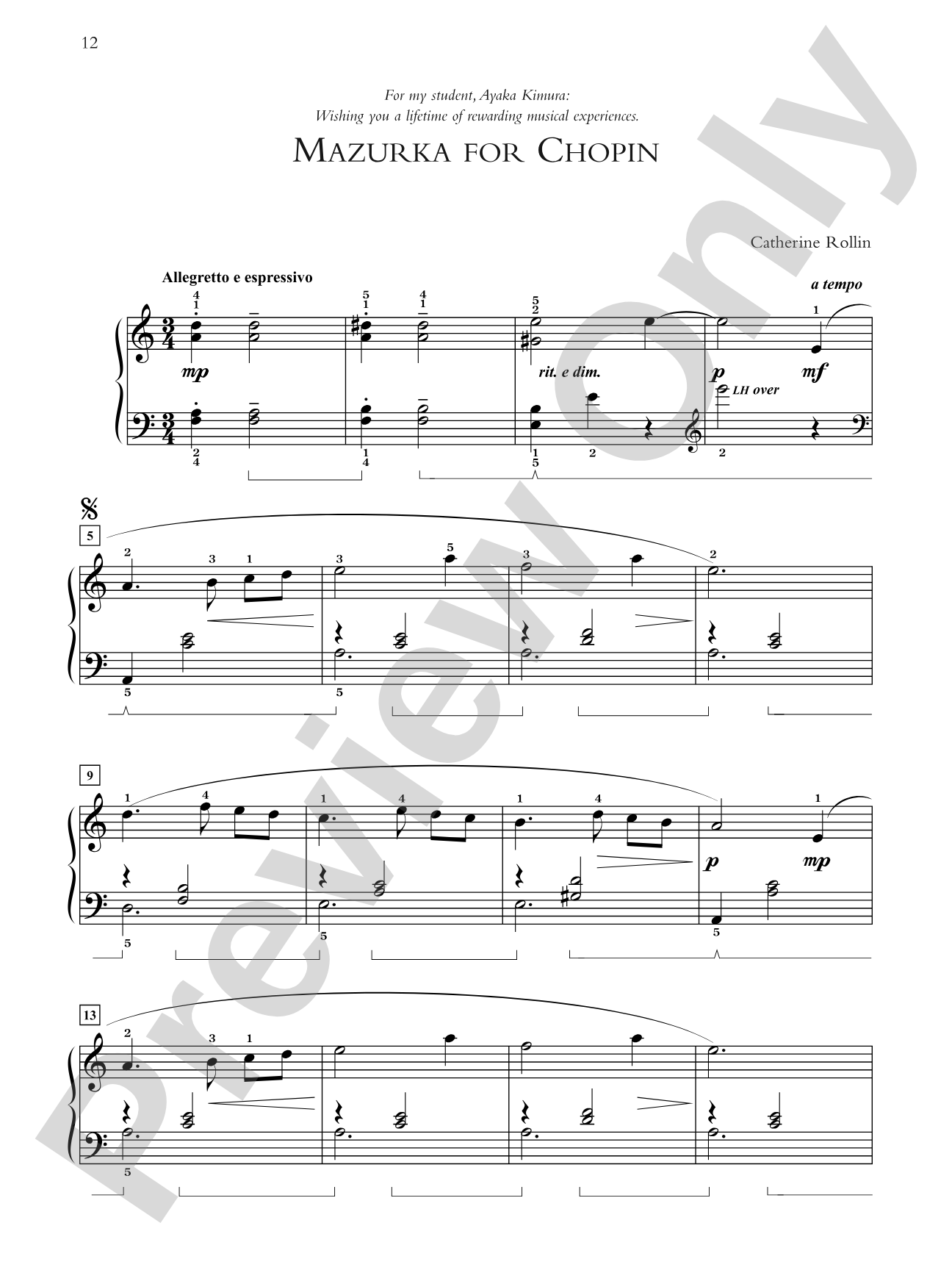

Mazurka for Chopin - Piano Solo: Piano Solo
10 Early Intermediate Piano Solos in Dance Styles
By Catherine Rollin
Level: Early Intermediate
Item: 00-PS-0017279
$4.99
Pickup currently not available
Related Items
Conga, Conga, Conga - Piano Solo: Piano Solo |
$4.99
|
View | |
Island Rumba - Piano Solo: Piano Solo |
$4.99
|
View | |
Make Mine Cha-Cha-Cha! - Piano Solo: Piano Solo |
$4.99
|
View | |
Mediterranean Dance - Piano Solo: Piano Solo |
$4.99
|
View | |
Rock and Roll Slow Dance - Piano Solo: Piano Solo |
$4.99
|
View | |
Spicy Salsa - Piano Solo: Piano Solo |
$4.99
|
View | |
Tantalizing Tango - Piano Solo: Piano Solo |
$4.99
|
View | |
Tap Time Encore - Piano Solo: Piano Solo |
$4.99
|
View | |
The Jester's Gigue - Piano Solo: Piano Solo |
$6.99
|
View | |
Dancing on the Keys, Book 1: Piano Book |
$6.99
|
View |
Description
Teachers and students love Catherine Rollin's duet series Dances for Two, and encouraged her to write all-new solo collections of pieces based on dance rhythms. Book 1 titles: Conga, Conga, Conga * Island Rumba * The Jester's Gigue * Make Mine Cha-Cha-Cha! * Mazurka for Chopin * Mediterranean Dance * Rock and Roll Slow Dance * Spicy Salsa * Tantalizing Tango * Tap Time Encore. A Federation Festivals 2024-2028 selection.


Discover MakeMusic Cloud: thousands of interactive titles your students can play along with today.
Sample Audio
1
Audio File
--:--
0:00
0:00
Sample Video
Additional Details
Publisher:
Alfred Music
Page Count:
24
SKU:
00-PS-0017279
More about this title
About the Composer: Catherine Rollin

Catherine Rollin balances an active composing career with teaching and performing, having conducted workshops and masterclasses across the United States, Canada, Japan, and Taiwan. She holds a Bachelor of Musical Arts degree with distinction from the University of Michigan and a Master of Music degree from Oakland University School of Performing Arts.
Rollin's compositions have earned commissions from Clavier Companion magazine, the Music Teachers National Association (MTNA), and the Michigan Music Teachers Association, with multiple works selected for the National Federation of Music Clubs Festivals Bulletin. Her achievements include serving as a national judge for the MTNA Student Composition Competition and the Lynn Freeman Olson Composition Contest, and she received an MTNA commission for Suite Detroit, a trio for flute, alto saxophone, and piano that premiered at the 2018 MTNA national conference. The Steinway Society featured her in 2018 as both composer and pianist, highlighting her ASCAP award-winning Museum Masterpieces series.
Why we love this
Rollin channels the infectious rhythmic energy of world dances into music that early intermediate pianists actually want to play. The Mazurka for Chopin stands out in this collection for its clever conceptual hook—a contemporary response to Chopin's iconic form—while remaining musically engaging and technically accessible rather than gimmicky. This collection earned a Federation Festivals selection, meaning it meets rigorous standards for both pedagogy and artistry.
What to expect
A nod to Chopin's world filtered through contemporary dance rhythms, this mazurka captures the courtly grace of the traditional form while infusing it with the spontaneity of a modern composer's imagination. The piece sits somewhere between homage and reinvention, giving pianists the satisfaction of playing something instantly recognizable yet distinctly fresh.
Who it's for
Early intermediate pianists ready for pieces with stronger rhythmic character and cultural flavor beyond traditional etudes. Teachers seeking repertoire that connects students to world music traditions while building technical foundation. Students preparing for festival competitions or recitals who respond better to music with narrative or stylistic hooks.
How to get the most out of it
- Anchor the mazurka's characteristic three-beat pulse with clear weight on beat one, resisting the urge to rush the ornamentation that follows.
- Listen to historical Chopin mazurkas to understand the style Rollin references, then find the modern rhythmic color that distinguishes her interpretation.
- Shape the phrases by allowing the dance character to dictate your phrasing rather than treating measure lines as phrase boundaries.
- Maintain evenness in the hand position and finger height during quick passages to preserve clarity without sacrificing the dance's natural lilt.
How to use it
Program this as a bridge piece connecting classical tradition with contemporary composition, or pair it with other selections from Rollin's Dances collection to create a thematic program exploring rhythm and culture. It works well in a festival or recital setting where listeners appreciate both musical substance and stylistic novelty.
Skills your students will build
- Mazurka rhythm and phrasing characteristic to the dance form
- Playing with stylistic maturity in a recognizable traditional genre
- Controlling ornamentation and embellishment at moderate tempos
- Developing musical independence between hands while maintaining clear dance pulse
- Interpretation and character development in contemporary concert works