
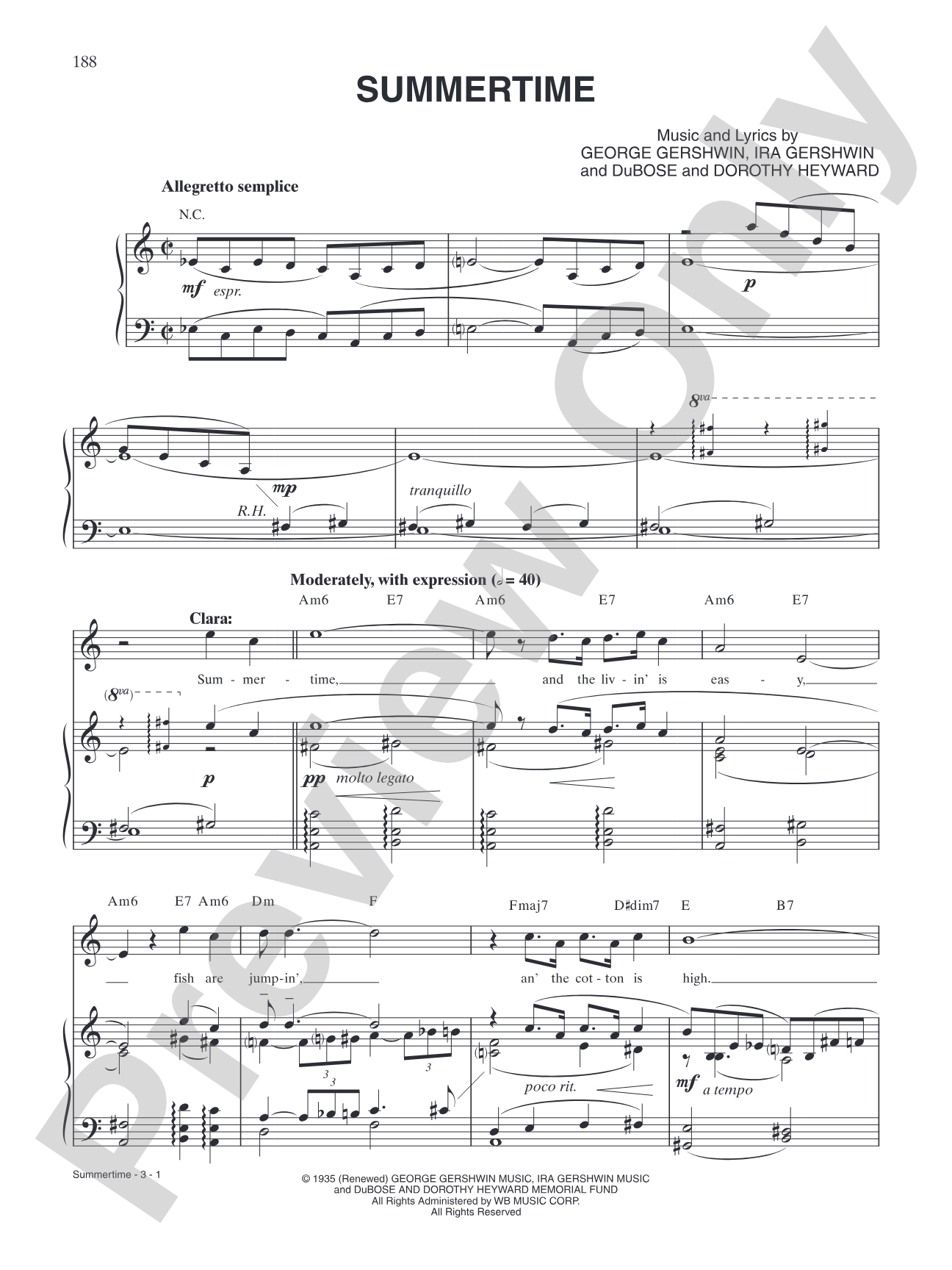

Summertime: Piano/Vocal/Chords
Item: 00-PS-0000069
$4.99
One moment…
Related Items
Theme from New York, New York: Piano/Vocal/Chords |
$4.99
|
View | |
Over the Rainbow: Piano/Vocal/Chords |
$4.99
|
View | |
My Funny Valentine: Piano/Vocal/Chords |
$4.99
|
View | |
What a Wonderful World: Piano/Vocal/Chords |
$4.99
|
View | |
Singin' in the Rain (from"Singin' n the Rain"): Piano/Vocal/Chords |
$4.99
|
View |
Description
Enjoy more than 50 classic standards, all professionally arranged for piano/vocal/chords. Titles: Ain't Misbehavin' * As Time Goes By * At Last * Bewitched, Bothered and Bewildered * Blue Moon * Blues in the Night * But Not for Me * Come Rain or Come Shine * Don't Get Around Much Anymore * Dream a Little Dream of Me * Embraceable You * Evergreen * Fly Me to the Moon * From This Moment On * How Do I Live * How Do You Keep the Music Playing? * How High the Moon * I Get a Kick out of You * If Ever I Would Leave You * I've Got a Crush on You * I've Got You Under My Skin * Just One of Those Things * Killing Me Softly with His Song * La Vie en Rose * Laura * Leaving on a Jet Plane * Mack the Knife * Makin' Whoopie * Misty * Moondance * Night and Day.


Summertime: Piano/Vocal/Chords isn't in MakeMusic Cloud just yet...but it could be. Let us know you'd like to see it, and you'll help shape what comes next. In the meantime, start a free trial and dive into thousands of interactive titles your students can play along with today.
Request This Title
Tell us you want it.
Start Your Free Trial
Explore everything that's ready to play right now.
Sample Audio
No sample audio found.
Sample Video
No sample videos found.
Additional Details
Series:
World's Greatest
Publisher:
Alfred Music
Page Count:
224
SKU:
00-PS-0000069
More about this title
About the Composer: George Gershwin
George Gershwin (1898-1937) fundamentally changed American music by fusing jazz idioms with classical forms at a moment when those worlds seemed separate. His gift for melody was matched by his harmonic sophistication; songs like "Summertime" and "I Got Rhythm" became standards because they were genuinely well-made, not accidental. Gershwin composed for Broadway, concert halls, and films with equal ambition, and his early death cut short a career that was still evolving toward deeper classical aspirations.
For music educators, Gershwin's work offers a teaching goldmine: his pieces sit comfortably in singers' voices, his chord progressions reward close study, and his melodies stick because they're built on strong harmonic logic rather than tricks. He demonstrated that popular song and serious musicianship were not opposites, a lesson that remains urgent in music education.
Why we love this
This collection gathers the standards that actually appear in audition lists, jazz repertoire, and crossover recitals, all in one professional arrangement. The piano/vocal/chords format lets singers own the melody while pianists handle real harmonic voicing rather than simplified block chords. At 224 pages with over 50 titles, it functions as both a performance resource and a curriculum; you'll find yourself reaching for it across years of teaching.
What to expect
These songs carry the sophistication and stylistic assurance of the mid-20th century American songbook, where cleverness in the lyrics matched the harmonic ingenuity underneath. Each arrangement respects the original's architecture while giving performers room to bring their own voice to the interpretation. Whether you're exploring the wistfulness of "Misty" or the swagger of "Mack the Knife," the music itself stays graceful and singable.
Who it's for
Singers preparing audition books, jazz standards repertoire, or crossover recitals will find consistent professional arrangements across dozens of essential titles. Pianists accompanying voice lessons, private studio students, or school musicals can draw from this single folio for years. Music teachers building a standards curriculum for secondary or college singers need this collection on the shelf.
How to get the most out of it
- Read the chord symbols actively rather than literally. These are guides for interpretation, not prescriptions; adjust voicings to suit the room, the singer's range, and your own pianistic comfort.
- Balance the vocal line with intentional accompaniment texture. Some standards work best with lean, conversational piano; others invite fuller harmonic support. Listen to multiple recordings and choose intentionally.
- Pay attention to the lyrical phrasing cues in the vocal staff. Many of these songs were written for legit singers first; the melody often guides where to breathe and shape the line.
- Work out rhythmic flexibility with your singer before rehearsal. Jazz standards especially benefit from conversational rubato, but both parts need to know where you're bending time and where you're locked in.
How to use it
Use this as your primary performance resource for any recital mixing jazz standards with classical repertoire; the consistency of the arrangement style across genres makes transitions feel natural. In a secondary school setting, sequence three or four of these standards across a concert year as your singers grow more comfortable with jazz phrasing and harmonic sophistication. For voice lesson studios, it serves as both a repertoire library and a pedagogical tool, since the chord symbols invite conversations about harmonic function and jazz voicing.
Skills your students will build
- Reading and interpreting chord symbols in jazz and popular contexts
- Balancing vocal line against harmonic accompaniment
- Identifying and performing standard jazz phrasing conventions
- Transposing and adapting songs to suit individual vocal ranges
- Communicating interpretation and rubato between singer and pianist
- Recognizing harmonic patterns across the American songbook