
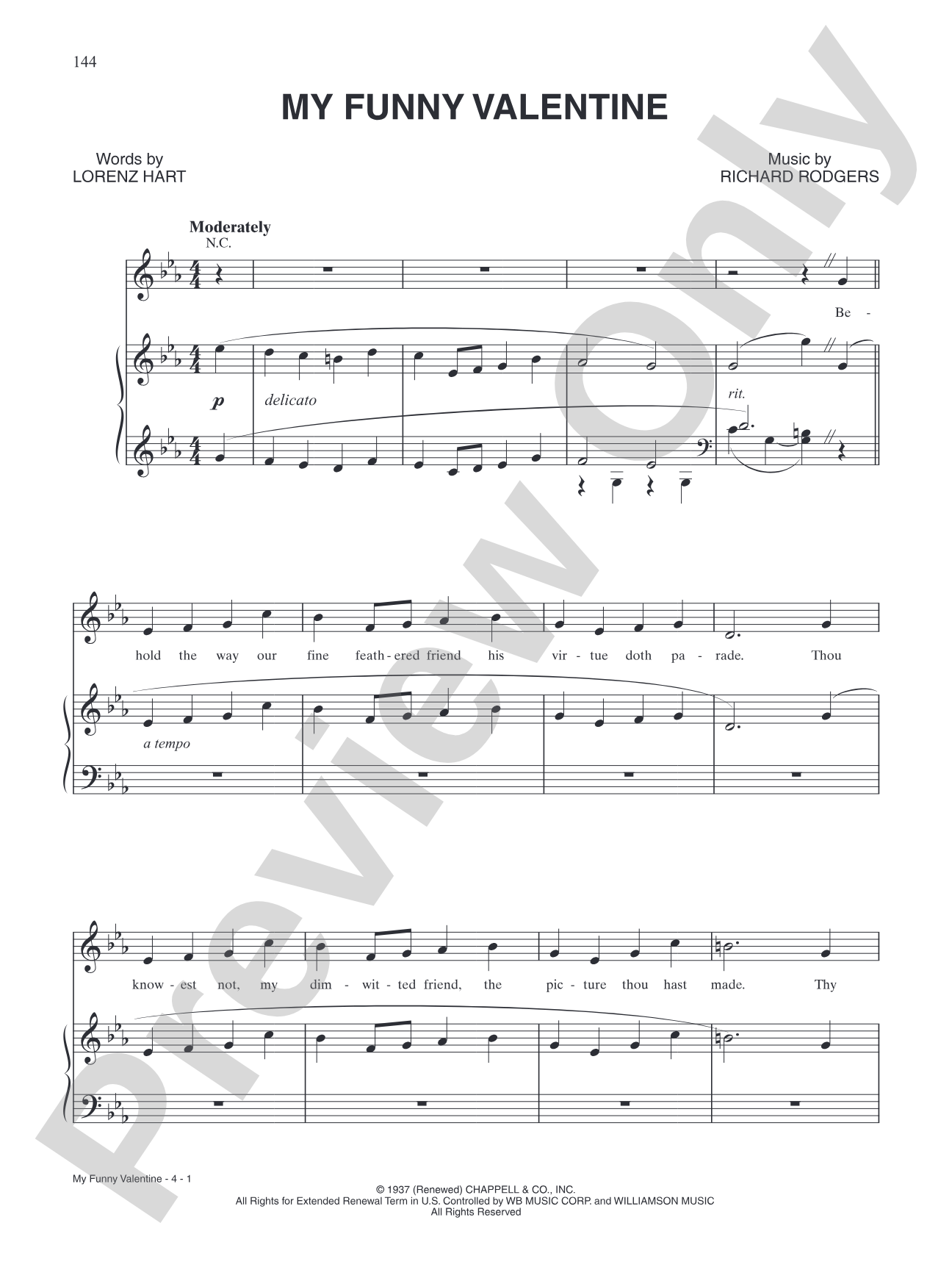

My Funny Valentine: Piano/Vocal/Chords
Item: 00-PS-0000068
$4.99
One moment…
Description
Enjoy more than 50 classic standards, all professionally arranged for piano/vocal/chords. Titles: Ain't Misbehavin' * As Time Goes By * At Last * Bewitched, Bothered and Bewildered * Blue Moon * Blues in the Night * But Not for Me * Come Rain or Come Shine * Don't Get Around Much Anymore * Dream a Little Dream of Me * Embraceable You * Evergreen * Fly Me to the Moon * From This Moment On * How Do I Live * How Do You Keep the Music Playing? * How High the Moon * I Get a Kick out of You * If Ever I Would Leave You * I've Got a Crush on You * I've Got You Under My Skin * Just One of Those Things * Killing Me Softly with His Song * La Vie en Rose * Laura * Leaving on a Jet Plane * Mack the Knife * Makin' Whoopie * Misty * Moondance * Night and Day.


My Funny Valentine: Piano/Vocal/Chords isn't in MakeMusic Cloud just yet...but it could be. Let us know you'd like to see it, and you'll help shape what comes next. In the meantime, start a free trial and dive into thousands of interactive titles your students can play along with today.
Request This Title
Tell us you want it.
Start Your Free Trial
Explore everything that's ready to play right now.
Sample Audio
No sample audio found.
Sample Video
No sample videos found.
Additional Details
Series:
World's Greatest
Publisher:
Alfred Music
Page Count:
224
SKU:
00-PS-0000068
More about this title
About the Composer: Richard Rodgers
Richard Rodgers (1902-1979) shaped American musical theater through six decades of prolific composition. His partnership with lyricist Lorenz Hart produced jazz-inflected standards that defined the Great American Songbook, while his later collaboration with Oscar Hammerstein II created the modern musical theater repertoire (The Sound of Music, South Pacific, The King and I). Rodgers' melodic gifts and harmonic sophistication set the standard for generations of composers and continue to anchor vocal repertoire across jazz, pop, and classical contexts.
In music education, Rodgers' songs serve as essential teaching tools for understanding voice leading, harmonic progression, and the relationship between lyric and melody. His melodies reward careful phrasing and interpretation, making them invaluable for developing singers and pianists alike.
Why we love this
This collection spans Rodgers' entire creative arc, from his early wit and rhythmic sophistication ("I've Got a Crush on You," "Just One of Those Things") through his more lush balladic voice ("If Ever I Would Leave You," "Evergreen"). The piano/vocal/chords format gives singers control over tempo and phrasing while offering pianists harmonic specificity, making it equally valuable for jazz education, musical theater training, and classical vocal coaching.
What to expect
These songs carry the sophistication of 1920s-1940s songwriting: witty, urbane lyrics paired with melodies that sit naturally in the voice yet contain surprising harmonic turns. The result feels both instantly familiar and endlessly discoverable, with the piano part offering enough harmonic interest to keep accompanists engaged across repeated performances.
Who it's for
Pianists and singers preparing standards for recital, audition, or performance contexts will find reliable arrangements of the most essential Rodgers material. This collection serves vocal students, jazz musicians, musical theater performers, and anyone building a classical-to-pop repertoire bridge.
How to get the most out of it
- Study the chord symbols as carefully as the melody. Rodgers' harmonies often move by chromatic voice leading or unexpected root movements; understanding this progression helps the pianist support vocal interpretation rather than simply accompanying it.
- Pay attention to the lyrical rhythm within measures. Rodgers frequently places important words on unexpected beats; let the text guide your rhythmic feel rather than imposing metronomic regularity.
- Balance transparency in the piano voicing. These songs were written for intimate settings and studio recordings, not large orchestras. Voice the chords to complement rather than overshadow the singer's line.
How to use it
Feature individual standards in vocal recitals, jazz ensemble concerts, or musical theater showcases. The breadth of material allows you to program a Rodgers-focused evening, create thematic programs (torch songs, comedy standards, love songs), or select individual titles for studio recitals and student performance opportunities throughout the year.
Skills your students will build
- Interpreting jazz harmony symbols and voicing chords in contemporary style
- Phrasing lyrical melody across longer harmonic structures
- Sight-reading lead sheet notation and adapting arrangements to fit vocal range
- Understanding the relationship between lyric stress and musical accent
- Accompanying singers with independence and flexibility in tempo