
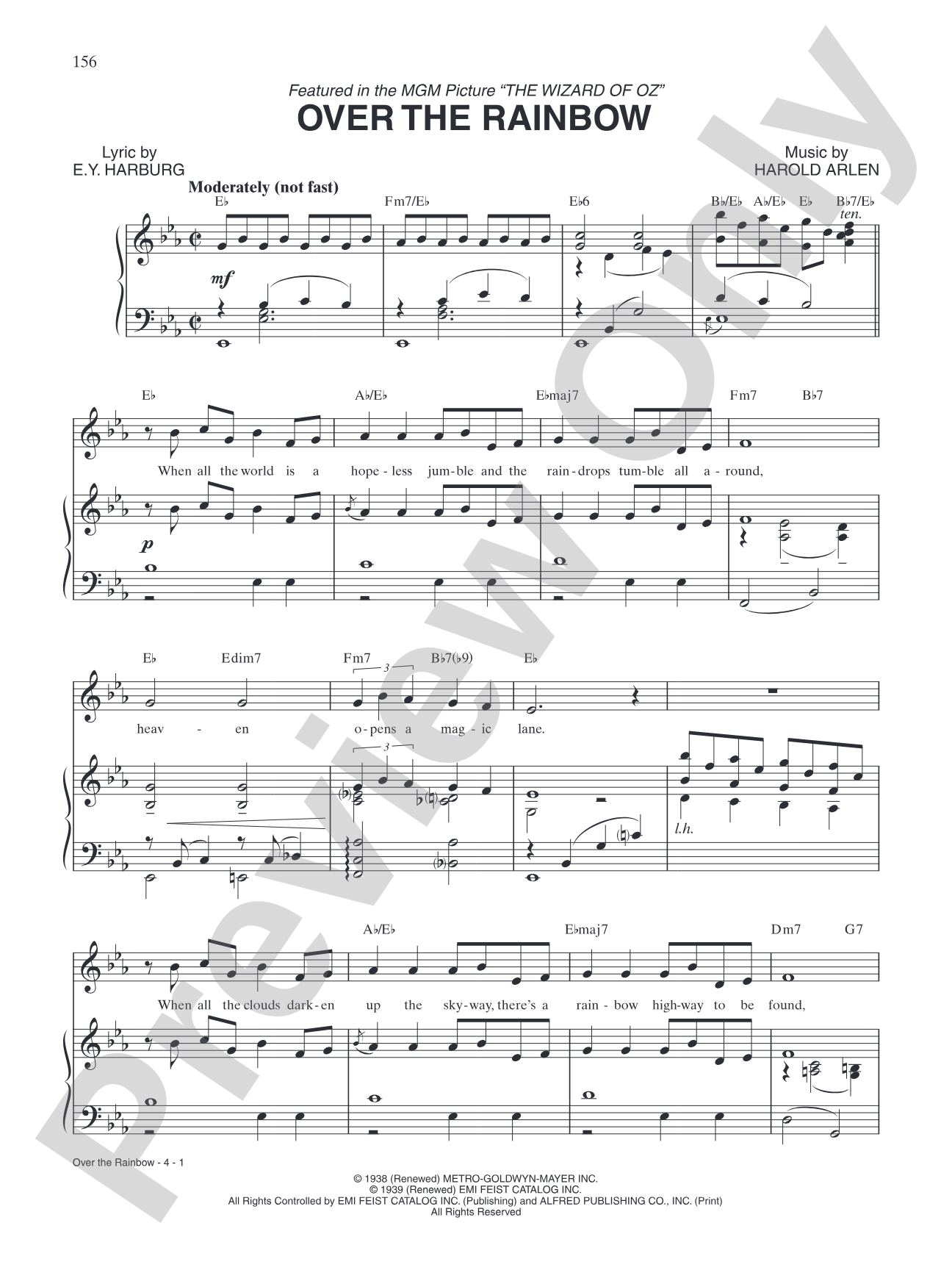

Over the Rainbow: Piano/Vocal/Chords
Item: 00-PS-0000065
$4.99
One moment…
Description
Enjoy more than 50 classic standards, all professionally arranged for piano/vocal/chords. Titles: Ain't Misbehavin' * As Time Goes By * At Last * Bewitched, Bothered and Bewildered * Blue Moon * Blues in the Night * But Not for Me * Come Rain or Come Shine * Don't Get Around Much Anymore * Dream a Little Dream of Me * Embraceable You * Evergreen * Fly Me to the Moon * From This Moment On * How Do I Live * How Do You Keep the Music Playing? * How High the Moon * I Get a Kick out of You * If Ever I Would Leave You * I've Got a Crush on You * I've Got You Under My Skin * Just One of Those Things * Killing Me Softly with His Song * La Vie en Rose * Laura * Leaving on a Jet Plane * Mack the Knife * Makin' Whoopie * Misty * Moondance * Night and Day.


Over the Rainbow: Piano/Vocal/Chords isn't in MakeMusic Cloud just yet...but it could be. Let us know you'd like to see it, and you'll help shape what comes next. In the meantime, start a free trial and dive into thousands of interactive titles your students can play along with today.
Request This Title
Tell us you want it.
Start Your Free Trial
Explore everything that's ready to play right now.
Sample Audio
No sample audio found.
Sample Video
No sample videos found.
Additional Details
Series:
World's Greatest
Publisher:
Alfred Music
Page Count:
224
SKU:
00-PS-0000065
More about this title
About the Composer: Harold Arlen
Harold Arlen (1905-1986) composed some of the most enduring melodies in American popular music, creating standards that have outlasted their original contexts by decades. His gift for writing singable, emotionally direct melodies paired with sophisticated harmonies made him a favorite of both jazz singers and classical musicians. Arlen's work spans Broadway, film, and popular song, but his legacy in music education rests on the sheer teachability and emotional honesty of his compositions, which reward both careful study and instinctive performance.
Why we love this
This collection gives you 50+ of the most essential standards in one download, all arranged with the piano-vocal format that works equally well for jazz combos, voice lessons, and piano recitals. The writing is clean enough for students to read and rich enough for professionals to interpret. You get repertoire that singers actually want to perform and pianists enjoy accompanying.
What to expect
These are songs born from the golden age of American songwriting, written when melody was considered paramount and lyric clarity mattered. They carry a sophisticated romanticism and wry humor simultaneously, whether you're playing a love ballad or a comic number. The harmonic language feels both classic and emotionally direct, never overwrought, inviting performers to inhabit the songs rather than decorate them.
Who it's for
Pianists accompanying vocalists in recitals, jazz classes, or studio lessons will find reliable, elegant arrangements. Singers preparing a standards repertoire course will appreciate having 50 classics in one accessible resource. Music directors programming pops concerts or variety shows can draw from this collection for both solo and ensemble features.
How to get the most out of it
- Find the natural speech rhythm in the lyric first. These melodies follow conversational phrasing more than strict meter, so listen to classic recordings to hear where singers breathe and shape the line.
- Treat the chord symbols as a floor, not a ceiling. The piano part is fully notated, so use it as written, but understand that jazz voicings in the accompaniment invite interpretation once you master the printed arrangement.
- Balance vocal prominence with harmonic depth. These songs work because the melody and the accompaniment support each other equally, so resist the urge to overshadow the singer with piano flourish.
- Slow standards down slightly if you're working on text clarity. Arlen's melodies are conversational, and rushing obscures the lyrical intention that makes these songs memorable.
How to use it
Feature one as a solo piano interlude in a concert, or pair a few as a themed set exploring different moods within the American songbook. Many directors use this collection as the curriculum for a semester-long standards elective, assigning students 3-4 songs to master and perform. A pops concert built entirely from this folio needs no additional material.
Skills your students will build
- Jazz chord reading and voicing recognition
- Interpreting lyric-driven phrasing in melody
- Accompanying singers with appropriate dynamic balance
- Sight-reading piano arrangements with chord-based notation
- Understanding the relationship between lyric prosody and melodic shape