
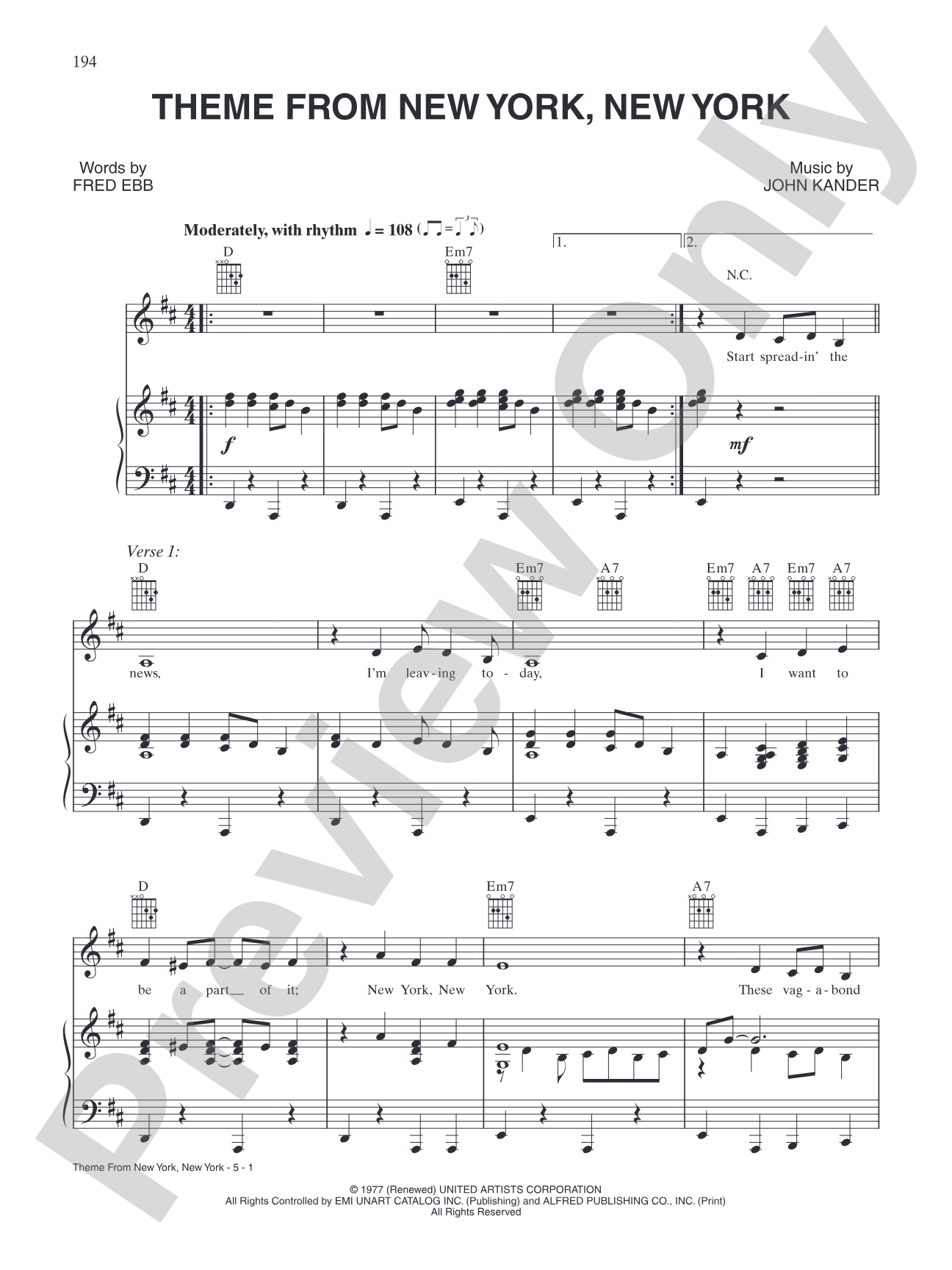

Theme from New York, New York: Piano/Vocal/Chords
Item: 00-PS-0000063
$4.99
One moment…
Description
Enjoy more than 50 classic standards, all professionally arranged for piano/vocal/chords. Titles: Ain't Misbehavin' * As Time Goes By * At Last * Bewitched, Bothered and Bewildered * Blue Moon * Blues in the Night * But Not for Me * Come Rain or Come Shine * Don't Get Around Much Anymore * Dream a Little Dream of Me * Embraceable You * Evergreen * Fly Me to the Moon * From This Moment On * How Do I Live * How Do You Keep the Music Playing? * How High the Moon * I Get a Kick out of You * If Ever I Would Leave You * I've Got a Crush on You * I've Got You Under My Skin * Just One of Those Things * Killing Me Softly with His Song * La Vie en Rose * Laura * Leaving on a Jet Plane * Mack the Knife * Makin' Whoopie * Misty * Moondance * Night and Day.


Discover MakeMusic Cloud: thousands of interactive titles your students can play along with today.
Sample Audio
No sample audio found.
Sample Video
No sample videos found.
Additional Details
Series:
World's Greatest
Publisher:
Alfred Music
Page Count:
224
SKU:
00-PS-0000063
More about this title
About the Composer: John Kander
John Kander has shaped American musical theater since the 1960s, composing scores for some of Broadway's most celebrated productions including Cabaret, Chicago, and Kiss of the Spider Woman. His gift for melody and emotional directness has made his work a cornerstone of both stage and popular music.
Why we love this
This collection gives pianists and vocalists immediate access to 50 standards in one purchase, eliminating the need to hunt down individual sheet music. The piano/vocal/chord layout works equally well for classical singers preparing audition repertoire, jazz pianists building their standards vocabulary, or music theater students learning foundational repertoire. Having this much essential material in digital form means your students can start learning on the first rehearsal.
What to expect
These are songs that live in the cultural memory of American music. Whether swinging with urban sophistication or aching with intimate vulnerability, they carry the weight of their history while remaining fresh and singable. The piano/vocal/chord format honors both the intimacy of the original performances and the tradition of musicians making these songs their own.
Who it's for
Piano/vocal/chord folios serve singers preparing classical recitals or auditions, music theater performers, jazz pianists building standards repertoire, and accompanists who need reliable, professionally-arranged standards quickly. This collection is equally valuable for piano students exploring what lies beyond the classical method books and for ensembles programming concert material that spans multiple genres.
How to get the most out of it
- Pay attention to the chord symbols even if you read the full piano part; they clarify the harmonic movement and help you listen for underlying changes during vocal phrasing.
- Use these arrangements to understand how standards were recorded and interpreted by canonical artists; listen to multiple versions to inform your own interpretive choices.
- Practice the vocal line and piano part separately before combining them, especially in passages where the melody sits in a register that overlaps with your typical hand position.
- Adjust the piano voicings based on your own technique and the acoustic of your space; the printed chords offer flexibility without requiring you to follow them exactly.
How to use it
Pull individual titles from this collection for pops or variety concert segments that call for sophisticated, recognizable repertoire without needing a full band. Use selections as warm-up material in voice lessons or piano studio sessions to expose students to standards they should know. Program one or two titles alongside more formal concert pieces to create a stylistic bridge between classical and contemporary contexts.
Skills your students will build
- Reading chord symbols and implied harmonic progressions
- Balancing independence between vocal line and piano accompaniment
- Interpreting swing rhythms, rubato, and jazz-inflected phrasing notation
- Transposing material to suit vocal range without losing the arrangement's character
- Building fluency with standards repertoire that forms the foundation of multiple musical genres