
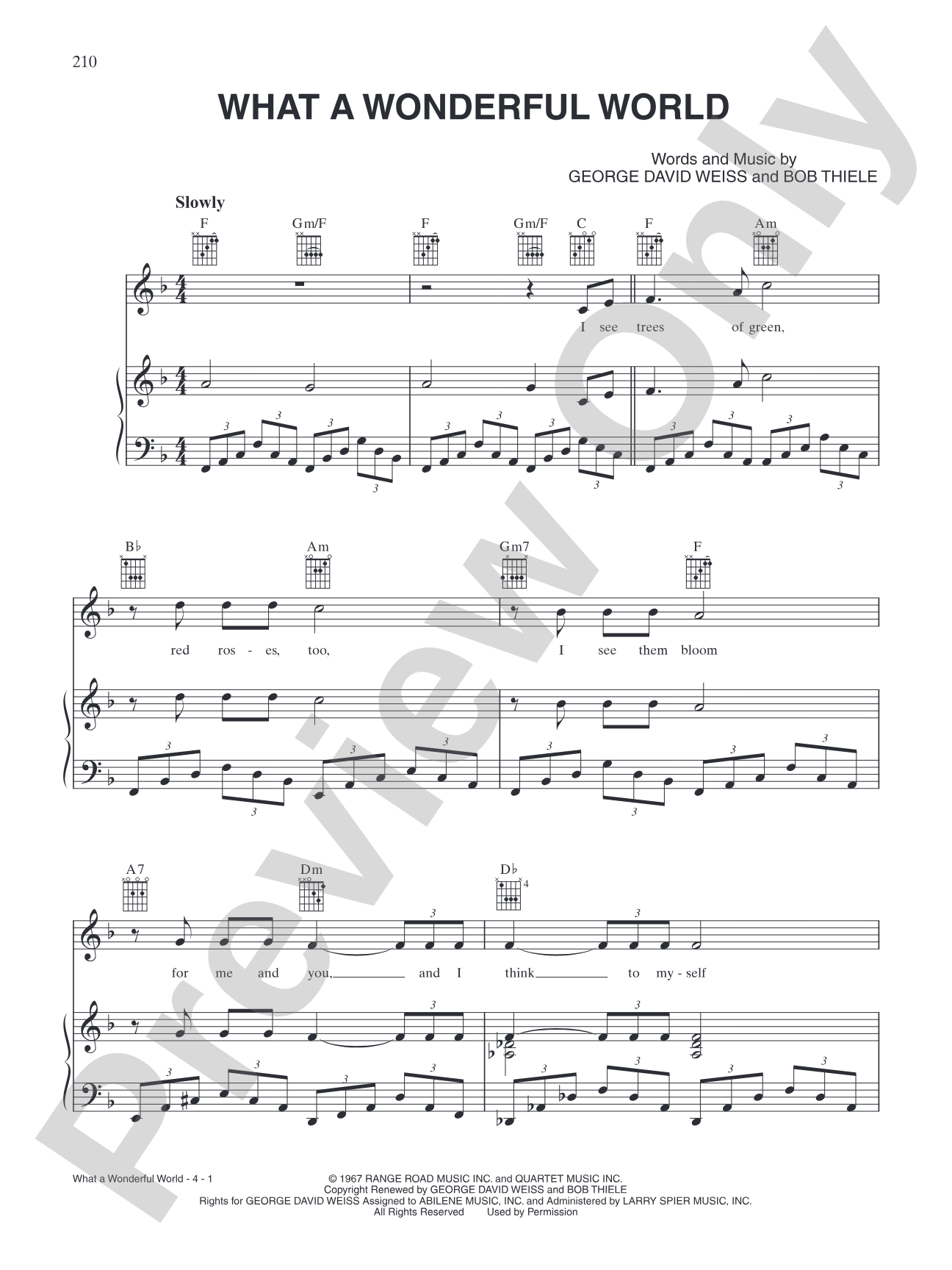

What a Wonderful World: Piano/Vocal/Chords
Item: 00-PS-0000077
$4.99
One moment…
Description
Enjoy more than 50 classic standards, all professionally arranged for piano/vocal/chords. Titles: Ain't Misbehavin' * As Time Goes By * At Last * Bewitched, Bothered and Bewildered * Blue Moon * Blues in the Night * But Not for Me * Come Rain or Come Shine * Don't Get Around Much Anymore * Dream a Little Dream of Me * Embraceable You * Evergreen * Fly Me to the Moon * From This Moment On * How Do I Live * How Do You Keep the Music Playing? * How High the Moon * I Get a Kick out of You * If Ever I Would Leave You * I've Got a Crush on You * I've Got You Under My Skin * Just One of Those Things * Killing Me Softly with His Song * La Vie en Rose * Laura * Leaving on a Jet Plane * Mack the Knife * Makin' Whoopie * Misty * Moondance * Night and Day.


What a Wonderful World: Piano/Vocal/Chords isn't in MakeMusic Cloud just yet...but it could be. Let us know you'd like to see it, and you'll help shape what comes next. In the meantime, start a free trial and dive into thousands of interactive titles your students can play along with today.
Request This Title
Tell us you want it.
Start Your Free Trial
Explore everything that's ready to play right now.
Sample Audio
No sample audio found.
Sample Video
No sample videos found.
Additional Details
Series:
World's Greatest
Publisher:
Alfred Music
Page Count:
224
SKU:
00-PS-0000077
More about this title
About the Composer: George David Weiss
George David Weiss (1921-2010) was a prolific composer and lyricist whose catalog spans jazz standards, pop hits, and theatrical works. He collaborated with some of the 20th century's most celebrated artists and songwriters, crafting melodies that became synonymous with the American songbook. His compositions remain staples in vocal performance and jazz repertoire, valued for their singability and harmonic sophistication.
Weiss's gift for writing memorable, emotionally direct melodies made his work accessible to performers across genres. Songs like "What a Wonderful World" and "Can't Help Falling in Love" demonstrate his ability to balance lyrical simplicity with genuine musical depth. For educators, his work exemplifies the standard repertoire that teaches vocalists how to shape a phrase and interpret with restraint and elegance.
Why we love this
This collection delivers genuine standards in clean, musician-friendly arrangements that respect the integrity of the original melodies while remaining practical for rehearsal and performance. At 224 pages with over 50 titles, it's a comprehensive resource for pianists accompanying vocalists, eliminating the need to hunt down individual sheet music. The chord symbols are clear, and the piano parts sit at a level that allows accompanists to focus on supporting the singer rather than wrestling with technical demands.
What to expect
Opening this book is like stepping into a well-appointed jazz club where every song is familiar yet somehow new again. The melodies speak directly—there's no irony, no complexity for its own sake, just the clean emotional directness that made these standards timeless. You'll hear the history of American song, from sophisticated theater music to intimate ballads, all arranged with respect for what made these pieces matter.
Who it's for
Vocalists performing in jazz lounges, cabarets, weddings, and recitals will find dependable arrangements of beloved standards. Pianists looking for a portable library of accompaniment-ready scores benefit from having multiple keys and styles in one collection. This is essential repertoire for studio musicians, community theater productions, and anyone building a standard-song foundation.
How to get the most out of it
- Let the singer lead the phrase contour; your piano part follows rather than drives. Many of these standards reward a conversational, unhurried approach.
- Pay attention to the chord symbols for jazz voicings and substitutions. These arrangements often incorporate richer harmonies than the lead sheet alone suggests.
- Balance transparency in your comping. The piano should anchor the harmony and rhythm without overshadowing the vocal line, especially in intimate standards.
- Adjust tempo and rubato based on the vocalist's phrasing. These songs were written to breathe, and your accompaniment should breathe with them.
How to use it
Program these standards in variety shows, cabaret-style performances, or vintage-themed concerts where their appeal spans generations. Mix selections from this collection with other period repertoire to build a jazz or American songbook recital. Use individual numbers as seasonal additions to concert programs when you need a piece that audiences will recognize and singers will enjoy interpreting.
Skills your students will build
- Phrasing and breath management in extended vocal lines
- Interpretation of jazz harmonies and chord substitutions
- Accompanying skills: supporting a vocal line while maintaining harmonic independence
- Reading chord symbols and realizing them on keyboard
- Stylistic awareness across different eras of American song (1920s-1990s)