
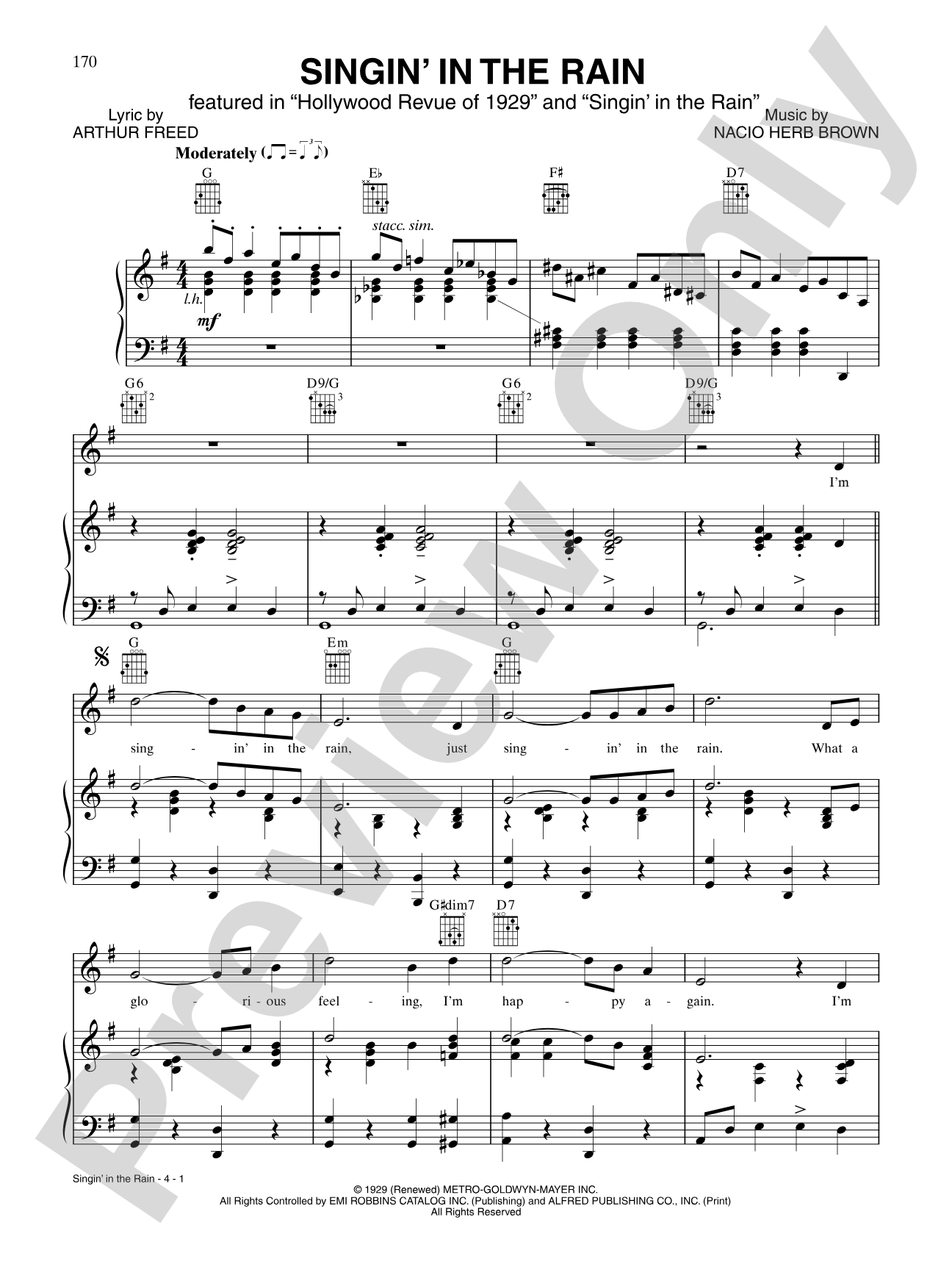

Singin' in the Rain (from"Singin' n the Rain"): Piano/Vocal/Chords
Item: 00-XS-0000059
$4.99
One moment…
Description
Enjoy more than 50 classic standards, all professionally arranged for piano/vocal/chords. Titles: Ain't Misbehavin' * As Time Goes By * At Last * Bewitched, Bothered and Bewildered * Blue Moon * Blues in the Night * But Not for Me * Come Rain or Come Shine * Don't Get Around Much Anymore * Dream a Little Dream of Me * Embraceable You * Evergreen * Fly Me to the Moon * From This Moment On * How Do I Live * How Do You Keep the Music Playing? * How High the Moon * I Get a Kick out of You * If Ever I Would Leave You * I've Got a Crush on You * I've Got You Under My Skin * Just One of Those Things * Killing Me Softly with His Song * La Vie en Rose * Laura * Leaving on a Jet Plane * Mack the Knife * Makin' Whoopie * Misty * Moondance * Night and Day.


Singin' in the Rain (from"Singin' n the Rain"): Piano/Vocal/Chords isn't in MakeMusic Cloud just yet...but it could be. Let us know you'd like to see it, and you'll help shape what comes next. In the meantime, start a free trial and dive into thousands of interactive titles your students can play along with today.
Request This Title
Tell us you want it.
Start Your Free Trial
Explore everything that's ready to play right now.
Sample Audio
No sample audio found.
Sample Video
No sample videos found.
Additional Details
Series:
World's Greatest
Publisher:
Alfred Music
Page Count:
224
SKU:
00-XS-0000059
More about this title
About the Composer: Nacio Herb Brown
Nacio Herb Brown (1896-1964) was a prolific composer who shaped the sound of early Hollywood musicals. Working primarily in the 1920s and 1930s, he collaborated with lyricist Arthur Freed to create some of cinema's most enduring standards, including the title track of "Singin' in the Rain." His melodies were crafted for singability and theatrical impact, balancing accessibility with sophisticated harmonic movement.
Brown's legacy extends far beyond film. His songs have become staples of jazz standards repertoire, covered by countless vocalists across genres. For music educators, his catalog offers a masterclass in melodic construction and arrangement for singers with piano accompaniment, making his work invaluable for teaching both classical and popular vocal literature.
Why we love this
This folio brings together the cream of the American songbook in a single, professionally arranged volume. The piano/vocal/chords format lets singers and pianists work together seamlessly, with chord symbols clear enough for jazz reharmonization or simplified comping. Each arrangement respects the integrity of the original while remaining practical for rehearsal and performance.
What to expect
These songs breathe with the elegance and emotional directness of the 1920s-1940s American songbook. The piano writing supports rather than overshadows, letting lyrics and melody take center stage while providing harmonic depth. You'll encounter sophisticated chord progressions, sweeping melodic lines, and the particular romantic sensibility that defined an era of songwriting.
Who it's for
This collection serves singers preparing for recitals, auditions, or jazz standards repertoire, as well as pianist-vocalist pairs looking for authentic, performance-ready arrangements. Music teachers building a standards curriculum will find it invaluable for introducing students to the golden age of American popular song. Pianists accompanying singers in studio or performance settings benefit from the clear chord symbols and well-balanced voice leading.
How to get the most out of it
- Balance the vocal line with the piano part so the melody reads clearly to the audience; these songs rely on lyrical warmth, not instrumental dominance.
- Use the chord symbols to explore jazz interpretations or stylistic variations once you've learned the written melody and harmony.
- Treat the piano accompaniment as a guide rather than a strict blueprint; rubato and phrasing adjustments will deepen the emotional arc of each standard.
- Pay attention to the range of each piece before assigning it; these standards span multiple octaves and may need transposition for your vocalist's tessatura.
How to use it
Program selections from this folio to build a standards-focused recital or concert segment, mixing tempos and moods to maintain listener engagement. Pair standards with contemporary or classical repertoire to demonstrate how American popular song connects to larger musical traditions. Use individual selections as teaching pieces for students exploring vocal jazz, art song interpretation, or pianist-vocalist collaboration.
Skills your students will build
- Interpreting chord symbols and understanding functional harmony in jazz and popular music contexts
- Balancing vocal phrasing with piano accompaniment in ensemble settings
- Reading and performing from lead sheet notation
- Transposing and adapting standards to suit individual vocal ranges
- Singing with stylistic awareness of the American songbook tradition