
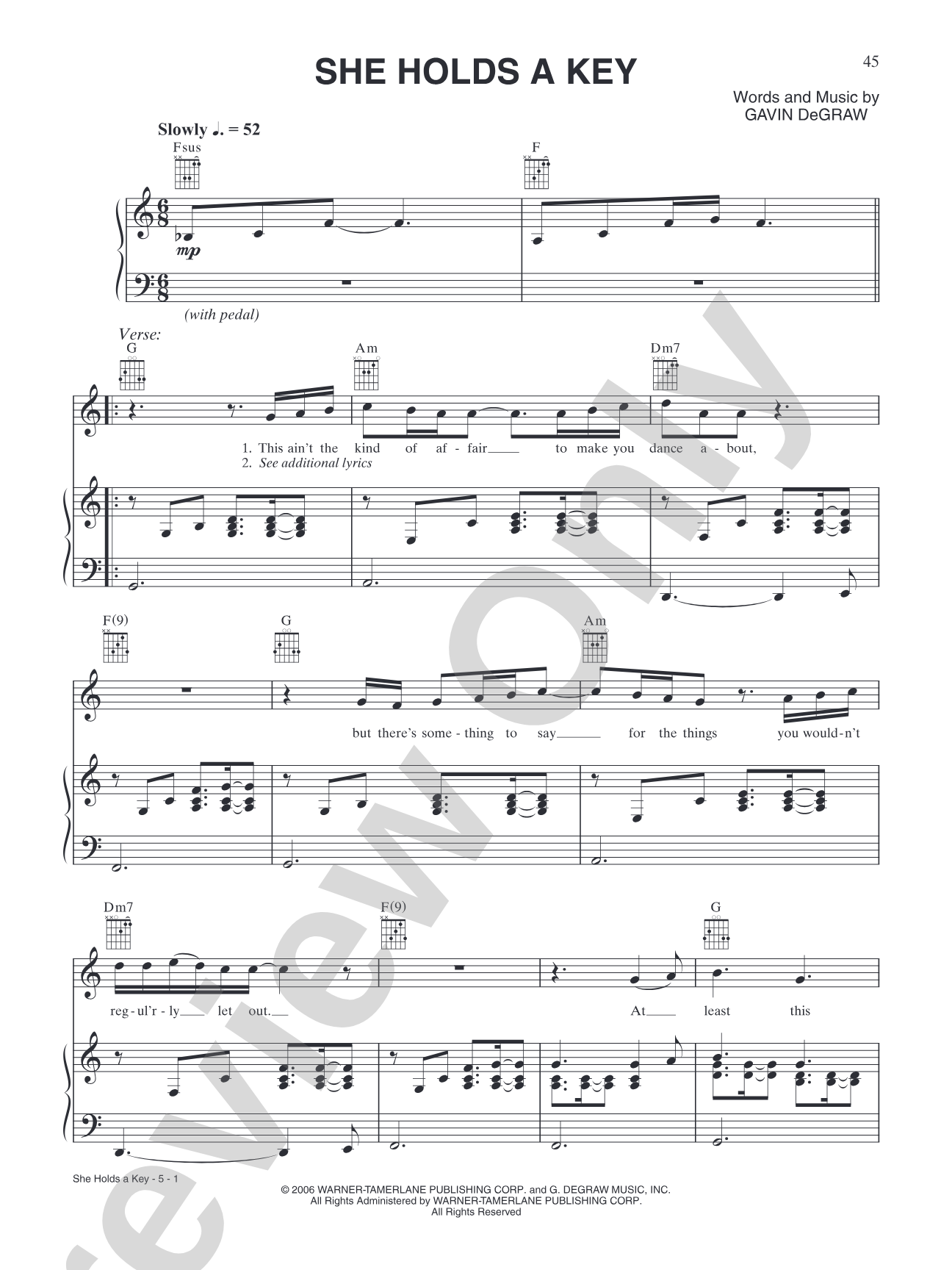

She Holds a Key: Piano/Vocal/Chords
Gavin DeGraw
Item: 00-PS-0013466
$4.99
One moment…
Related Items
In Love With a Girl: Piano/Vocal/Chords |
$5.99
|
View | |
Dancing Shoes: Piano/Vocal/Chords |
$5.99
|
View | |
More Than Anyone: Piano/Vocal/Chords |
$4.99
|
View | |
Just Friends: Piano/Vocal/Chords |
$4.99
|
View | |
Cheated On Me: Piano/Vocal/Chords |
$4.99
|
View | |
I Have You to Thank: Piano/Vocal/Chords |
$5.99
|
View | |
Free: Piano/Vocal/Chords |
$5.99
|
View | |
Run Every Time: Piano/Vocal/Chords |
$5.99
|
View | |
Spell It Out: Piano/Vocal/Chords |
$4.99
|
View | |
Sweeter: Piano/Vocal/Chords |
$4.99
|
View | |
Soldier: Piano/Vocal/Chords |
$5.99
|
View | |
You Know Where I'm at: Piano/Vocal/Chords |
$4.99
|
View | |
Follow Through: Piano/Vocal/Chords |
$5.99
|
View | |
Not Over You: Piano/Vocal/Chords |
$5.99
|
View |
Description
For Gavin DeGraw fans who play piano or guitar, this is the ultimate gift! This collectible songbook contains sheet music for 18 songs selected from DeGraw's first four studio albums, including two songs from Free and six from Sweeter that were not previously available in print. Titles: * Chariot * Follow Through * I Don't Want to Be * Just Friends * More Than Anyone * Cheated on Me * I Have You to Thank * In Love with a Girl * She Holds a Key * We Belong Together * Dancing Shoes * Free * Not Over You * Run Every Time * Soldier * Spell It Out * Sweeter * You Know Where I'm At.


She Holds a Key: Piano/Vocal/Chords isn't in MakeMusic Cloud just yet...but it could be. Let us know you'd like to see it, and you'll help shape what comes next. In the meantime, start a free trial and dive into thousands of interactive titles your students can play along with today.
Request This Title
Tell us you want it.
Start Your Free Trial
Explore everything that's ready to play right now.
Sample Audio
No sample audio found.
Sample Video
No sample videos found.
Additional Details
Series:
Sheet Music Collection
Publisher:
Alfred Music
Page Count:
108
SKU:
00-PS-0013466
More about this title
About the Composer: Gavin DeGraw
Gavin DeGraw emerged as a distinctive voice in 2000s pop-rock, crafting songs that blend introspective lyrics with accessible melodies and layered production. His work emphasizes emotional directness and strong melodic hooks, earning him a devoted following among both listeners and musicians who appreciate his songwriting craft.
For music students and teachers, DeGraw's catalog offers contemporary material that rewards careful listening and arrangement study. His songs balance pop sensibility with substantive harmonic and rhythmic ideas, making them valuable repertoire for exploring how modern songwriting structures work on the piano and in ensemble settings.
Why we love this
This collection assembles 18 of DeGraw's most engaging songs in one accessible package, with several cuts from Sweeter and Free appearing in print for the first time. Students find real motivation in learning contemporary material from an artist they already know, while pianists and guitarists benefit from having chord charts and vocal lines clearly laid out alongside each other. The range of song styles within the collection gives pianists and guitarists plenty of interpretive variety to explore.
What to expect
These songs combine pop directness with emotional weight. Melodies feel singable and memorable, yet the chord changes often surprise; the production sensibility is polished without being slick, and DeGraw's storytelling approach gives each song a sense of genuine vulnerability beneath its accessible surface.
Who it's for
This book speaks directly to pianists and guitarists who already connect with DeGraw's music and want to learn it on their own instrument. It's equally useful for music teachers seeking contemporary pop-rock repertoire that students will actually want to practice, as well as for accompanists preparing to support vocalists tackling this material.
How to get the most out of it
- Study the vocal melody and rhythmic phrasing first, even if you're playing accompaniment. DeGraw's vocal lines often work against the beat in ways that clarify the emotional intent of each phrase.
- Pay attention to chord voicings on the piano part. The arrangements often suggest specific voicings that create the song's character; stick with them rather than simplifying.
- If accompanying a vocalist, lock in on the harmonic rhythm rather than playing busier left-hand patterns. Many of these songs benefit from a cleaner, more restrained approach to comping.
- For guitar players working from the chord charts, experiment with both strumming patterns and fingerpicking approaches. The same chords can feel quite different depending on how you voice and articulate them.
How to use it
This collection works well for student recitals, coffeehouse performances, or solo jazz trio settings where pianists can arrange the material more freely. Teachers can program individual songs in student showcases or use them as repertoire studies in song interpretation classes. For ensemble directors, several of these tracks offer strong starting points for student arrangement projects.
Skills your students will build
- Reading piano/vocal/guitar lead sheets with chord symbols
- Interpreting vocal phrasing from written notation and adapting accompaniment patterns to support it
- Understanding and performing contemporary pop-rock harmonic progressions
- Coordinating melody, harmony, and chord voicing across different instruments
- Applying rhythmic flexibility in accompaniment (varying left-hand patterns while maintaining harmonic integrity)