
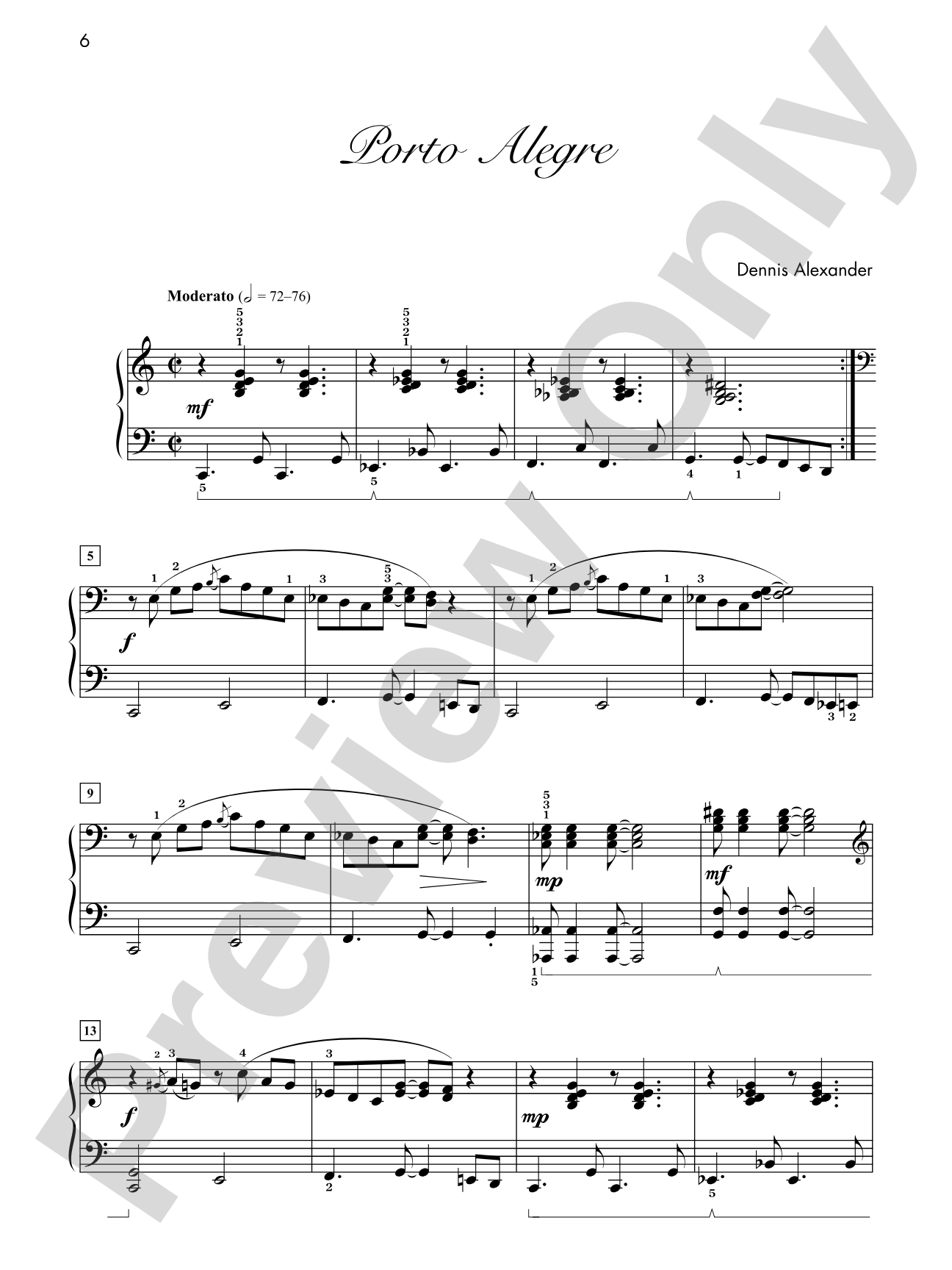

Porto Alegre - Piano Solo: Piano Solo
7 Stylized Solos for Late Intermediate Pianists
By Dennis Alexander
Level: Late Intermediate
Item: 00-PS-0017573
$6.99
Pickup currently not available
Related Items
A Million Miles Away - Piano Solo: Piano Solo |
$4.99
|
View | |
Always and Forever - Piano Solo: Piano Solo |
$4.99
|
View | |
Barclay Street Blues - Piano Solo: Piano Solo |
$4.99
|
View | |
Double Duty - Piano Solo: Piano Solo |
$4.99
|
View | |
In My Own Space - Piano Solo: Piano Solo |
$4.99
|
View | |
Jazz at Five - Piano Solo: Piano Solo |
$4.99
|
View | |
Especially in Jazzy Style, Book 3: Piano Book |
$6.99
|
View |
Description
The goal of this series is to introduce students to the rhythms, harmonies and other unique characteristics of jazz. Students will be motivated by the variety of styles and sounds that have that special Dennis Alexander sound. From lyrical melodies to infectious rhythms and harmonies, playing jazz styles has never been more fun! Titles: Always and Forever * Barclay Street Blues * Double Duty * In My Own Space * Jazz at Five * A Million Miles Away * Porto Alegre. A Federation Festivals 2024-2028 selection.


Porto Alegre - Piano Solo: Piano Solo isn't in MakeMusic Cloud just yet...but it could be. Let us know you'd like to see it, and you'll help shape what comes next. In the meantime, start a free trial and dive into thousands of interactive titles your students can play along with today.
Request This Title
Tell us you want it.
Start Your Free Trial
Explore everything that's ready to play right now.
Sample Audio
No sample audio found.
Sample Video
No sample videos found.
Additional Details
Series:
Especially
Publisher:
Alfred Music
Page Count:
24
SKU:
00-PS-0017573
More about this title
About the Composer: Dennis Alexander

Dennis Alexander has been composing educational piano music since 1986, building a catalog of over 400 published works that reach students across all levels. His thirty-year teaching career included positions at the University of Montana (where he chaired the piano department), Cal State Fullerton, and Cal State Northridge, giving him deep insight into what motivates young pianists and what actually works in the practice room.
Beyond the page, Alexander maintains an active performance schedule as soloist, accompanist, and chamber musician. He has appeared at Carnegie Recital Hall, collaborated with internationally recognized artists, and conducted master classes at the MTNA national convention. His work has earned commissions from music organizations nationwide, and his touring has taken him across Asia and beyond, where he continues to share his approach to accessible, engaging music-making.
Why we love this
Alexander strips away the intimidation factor from jazz piano without oversimplifying the music itself. These pieces teach genuine jazz vocabulary, swing feels, blues changes, walking bass implications, through melodies and textures that students actually want to play repeatedly. For a festival season or spring concert, Porto Alegre sits in that sweet spot where late-intermediate students sound confident and musical without needing years of jazz combo experience.
What to expect
These pieces breathe with the casual sophistication of a musician who has spent decades listening to and playing jazz. The melodies sit comfortably under the hand, the harmonies surprise without confusing, and the rhythmic grooves make your body want to move. There's a lightness here, an absence of pretense, that makes jazz feel accessible rather than arcane.
Who it's for
Late-intermediate pianists ready to engage with jazz language and style without needing extensive improvisation skills. Students preparing for festival performances, students seeking repertoire that builds technical facility alongside musical interpretation, and pianists curious about styles beyond classical tradition.
How to get the most out of it
- Lock in the swing eighth-note subdivision early. Alexander's notation guides it, but the groove only breathes when you commit to that triplet feel underneath the written rhythms.
- Honor the rhythmic rests as much as the notes. Jazz phrasing lives in the space, and restraint here creates the perception of ease and sophistication.
- Explore the dynamic range within each section. Alexander's writing often clusters high and low register material; use contrast to draw listeners into the texture rather than playing everything at one volume.
How to use it
Pair Porto Alegre alongside a classical or romantic selection to show range and stylistic versatility in a festival or recital setting. Use the entire collection across a season to gradually immerse students in different jazz contexts and moods, from blues-inflected pieces to more lyrical explorations. These sit well in a spring concert celebrating American music and contemporary piano voices.
Skills your students will build
- Swing eighth-note interpretation and triplet-feel phrasing
- Jazz harmony and voice leading awareness
- Blues changes and harmonic progressions common to jazz
- Rhythmic independence in the hands (syncopation and comping patterns)
- Stylistic interpretation beyond classical notation
- Dynamic control for expressive, idiomatic phrasing