
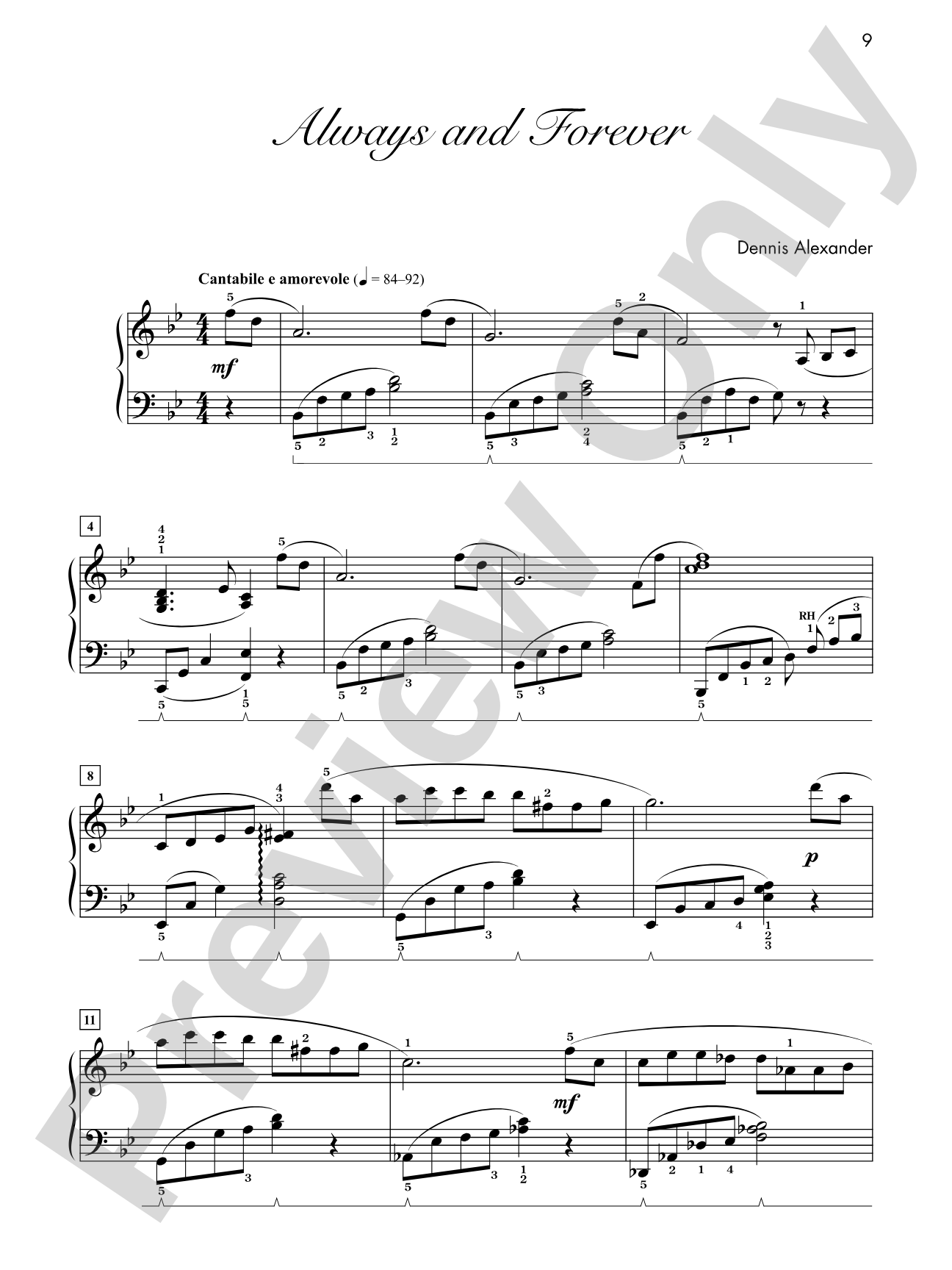

Always and Forever - Piano Solo: Piano Solo
7 Stylized Solos for Late Intermediate Pianists
By Dennis Alexander
Level: Late Intermediate
Item: 00-PS-0017568
$4.99
Pickup currently not available
Related Items
A Million Miles Away - Piano Solo: Piano Solo |
$4.99
|
View | |
Barclay Street Blues - Piano Solo: Piano Solo |
$4.99
|
View | |
Double Duty - Piano Solo: Piano Solo |
$4.99
|
View | |
In My Own Space - Piano Solo: Piano Solo |
$4.99
|
View | |
Jazz at Five - Piano Solo: Piano Solo |
$4.99
|
View | |
Porto Alegre - Piano Solo: Piano Solo |
$6.99
|
View | |
Especially in Jazzy Style, Book 3: Piano Book |
$6.99
|
View |
Description
The goal of this series is to introduce students to the rhythms, harmonies and other unique characteristics of jazz. Students will be motivated by the variety of styles and sounds that have that special Dennis Alexander sound. From lyrical melodies to infectious rhythms and harmonies, playing jazz styles has never been more fun! Titles: Always and Forever * Barclay Street Blues * Double Duty * In My Own Space * Jazz at Five * A Million Miles Away * Porto Alegre. A Federation Festivals 2024-2028 selection.


Always and Forever - Piano Solo: Piano Solo isn't in MakeMusic Cloud just yet...but it could be. Let us know you'd like to see it, and you'll help shape what comes next. In the meantime, start a free trial and dive into thousands of interactive titles your students can play along with today.
Request This Title
Tell us you want it.
Start Your Free Trial
Explore everything that's ready to play right now.
Sample Audio
No sample audio found.
Sample Video
No sample videos found.
Additional Details
Series:
Especially
Publisher:
Alfred Music
Page Count:
24
SKU:
00-PS-0017568
More about this title
About the Composer: Dennis Alexander

Dennis Alexander has shaped music education for decades through his prolific output at Alfred Music Publishing, where he has authored over 400 compositions and recordings since 1986. His career spans leadership roles at the University of Montana (where he directed piano pedagogy for two decades), faculty positions at California State universities, and a performing schedule that includes Carnegie Recital Hall debuts and international touring throughout Asia and beyond. Alexander's work as a clinician, adjudicator, and commissioned composer reflects his deep commitment to making music accessible and joyful for students at every level.
Based in Albuquerque, he continues an active composing and touring schedule while drawing on decades of experience as both a soloist and collaborative artist. His Kansas roots and classical training at the University of Kansas inform his approach to accessible, musically sophisticated educational repertoire.
Why we love this
Alexander has an uncanny gift for making jazz idioms feel natural rather than imposed. This collection introduces essential jazz vocabulary, swing rhythms, blues changes, jazz harmonies, through pieces that students actually want to play, with melodies that stick in your head long after rehearsal ends. The variety within these seven selections means you can pick the right mood for any concert context without sacrificing musical substance.
What to expect
These pieces breathe with the ease of a musician who loves the piano. You'll find lyrical passages that sit comfortably under the fingers alongside rhythmic sections with real swing and playfulness. The collection balances accessibility with genuine stylistic authenticity.
Who it's for
Late intermediate pianists ready to expand beyond classical and popular styles into jazz language. This works equally well for solo recital programming, festival preparation, or a jazz unit within a broader piano curriculum.
How to get the most out of it
- Lock into the swing feel early in rehearsal; listen to how the eighth notes sit behind the beat rather than landing on it, especially in pieces like Barclay Street Blues.
- Layer in the rhythmic accompaniment patterns before adding the melody line so students hear the foundation they're building on.
- Experiment with touch and dynamics to bring out the character of each piece; Porto Alegre calls for a different sound world than Jazz at Five.
- Pay attention to the chord symbols and encourage students to understand the harmonic movement, not just play the written notes.
How to use it
Slot individual selections into recitals to show stylistic range and meet the Federation Festivals 2024-2028 requirements. The mix of moods and tempos also makes this collection ideal for a concert section devoted to American jazz traditions or as supplementary repertoire alongside a student's classical studies.
Skills your students will build
- Reading and performing swing rhythms and jazz eighth-note phrasing
- Understanding jazz harmonic progressions and chord symbols
- Interpreting blues forms and related harmonic structures
- Building touch flexibility across multiple jazz styles and textures
- Developing independence between melodic and accompaniment voices