
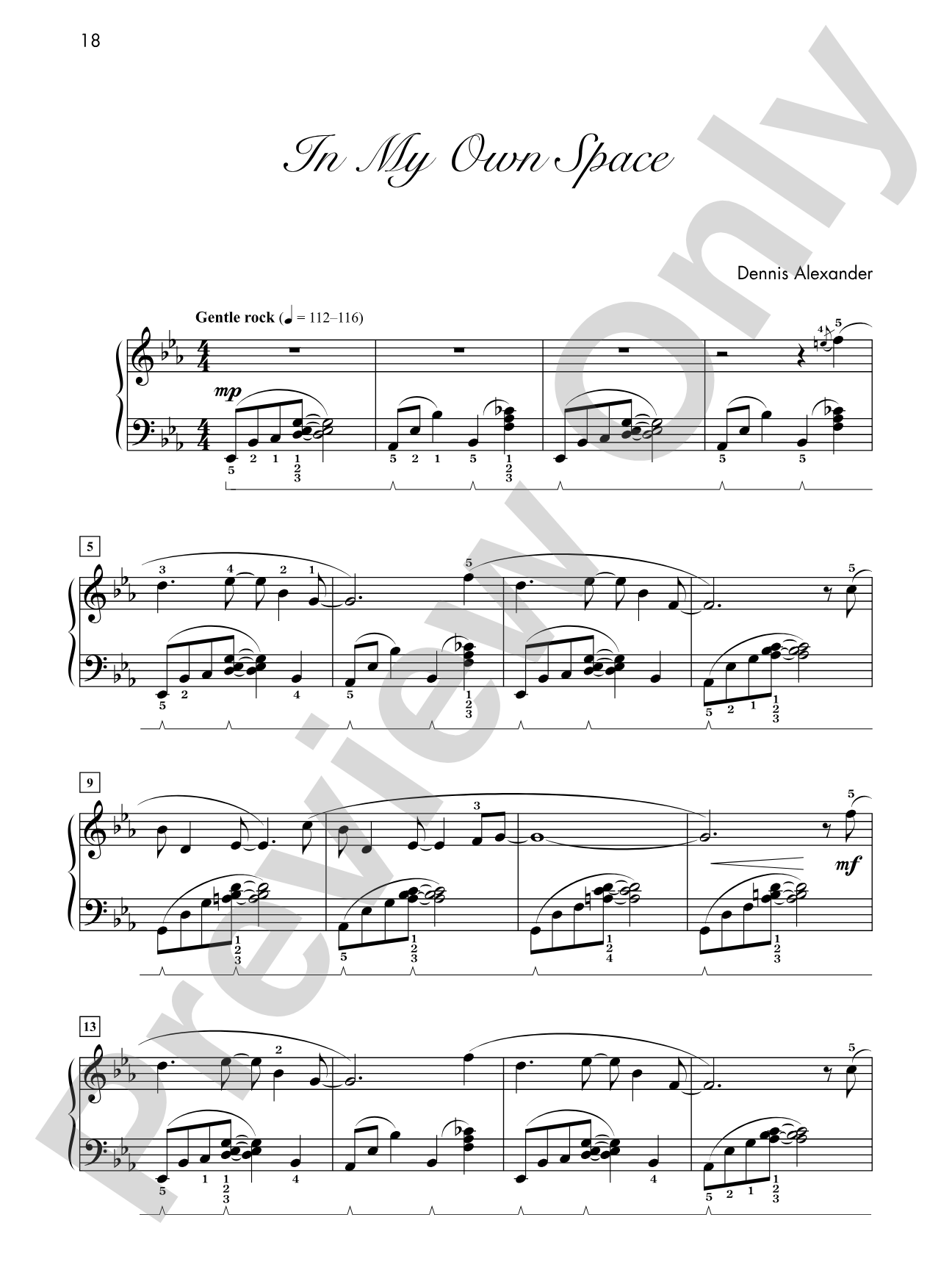

In My Own Space - Piano Solo: Piano Solo
7 Stylized Solos for Late Intermediate Pianists
By Dennis Alexander
Level: Late Intermediate
Item: 00-PS-0017571
$4.99
Pickup currently not available
Related Items
A Million Miles Away - Piano Solo: Piano Solo |
$4.99
|
View | |
Always and Forever - Piano Solo: Piano Solo |
$4.99
|
View | |
Barclay Street Blues - Piano Solo: Piano Solo |
$4.99
|
View | |
Double Duty - Piano Solo: Piano Solo |
$4.99
|
View | |
Jazz at Five - Piano Solo: Piano Solo |
$4.99
|
View | |
Porto Alegre - Piano Solo: Piano Solo |
$6.99
|
View | |
Especially in Jazzy Style, Book 3: Piano Book |
$6.99
|
View |
Description
The goal of this series is to introduce students to the rhythms, harmonies and other unique characteristics of jazz. Students will be motivated by the variety of styles and sounds that have that special Dennis Alexander sound. From lyrical melodies to infectious rhythms and harmonies, playing jazz styles has never been more fun! Titles: Always and Forever * Barclay Street Blues * Double Duty * In My Own Space * Jazz at Five * A Million Miles Away * Porto Alegre. A Federation Festivals 2024-2028 selection.


In My Own Space - Piano Solo: Piano Solo isn't in MakeMusic Cloud just yet...but it could be. Let us know you'd like to see it, and you'll help shape what comes next. In the meantime, start a free trial and dive into thousands of interactive titles your students can play along with today.
Request This Title
Tell us you want it.
Start Your Free Trial
Explore everything that's ready to play right now.
Sample Audio
No sample audio found.
Sample Video
No sample videos found.
Additional Details
Series:
Especially
Publisher:
Alfred Music
Page Count:
24
SKU:
00-PS-0017571
More about this title
About the Composer: Dennis Alexander

Dennis Alexander has been composing educational piano music since joining Alfred Music Publishing in 1986, building a catalog of more than 400 works that reach students worldwide. A University of Montana faculty member for 24 years, he taught piano pedagogy, applied piano, and class piano before relocating to California, where he continued teaching at Cal State Fullerton and Cal State Northridge. His work as a soloist, chamber musician, and collaborative artist has taken him across North America and throughout Asia, performing recitals and leading workshops in Singapore, Hong Kong, Malaysia, Indonesia, and South Korea.
Alexander's reputation rests on his ability to write music that challenges students without overwhelming them. A former president of the Montana State Music Teachers Association and a frequent clinician at state and national conventions, he has been commissioned by numerous organizations to create new works. His compositions consistently appear on festival lists and competition programs, a testament to their musical substance and pedagogical value.
Why we love this
Alexander's jazz collection succeeds because it treats the idiom seriously rather than as a novelty. Each piece develops genuine jazz vocabulary, blues changes, swing rhythms, syncopated lines, in textures that remain accessible to late intermediate students without condescending to them. Your students will sound like they're actually playing jazz, not just performing pieces labeled 'jazz.'
What to expect
Conversational and groove-oriented. Alexander balances lyricism with infectious rhythms, giving each piece enough melodic personality that students actually want to play them. The harmonic palette feels sophisticated without requiring advanced harmonic theory.
Who it's for
Late intermediate pianists ready to explore jazz language without sacrificing musical substance. This collection works equally well for students pursuing jazz studies and for classical pianists who want to expand their stylistic range.
How to get the most out of it
- Lock in the swing feel early in rehearsal by counting triplet subdivisions even when the notation shows straight eighths; students often rush when first learning these pieces.
- Have students identify the harmonic framework in each piece before adding stylistic ornamentation, so they understand the underlying structure that supports the jazz flavor.
- Record short practice sessions where they play along with their own tempo settings, letting them build confidence before attempting performance speed.
- Emphasize release articulation on off-beat accents; these rhythms sit differently than classical phrasing and need deliberate attention to sound relaxed rather than choppy.
How to use it
Include a single selection on a spring recital to showcase jazz repertoire in a classical-heavy program, or perform multiple pieces as a suite in a jazz or contemporary music concert. The collection also serves as a semester-long exploration if you're introducing jazz concepts to intermediate piano students.
Skills your students will build
- Reading and executing swing eighth-note rhythms
- Recognizing and playing blues changes and jazz chord progressions
- Understanding jazz articulation and phrasing conventions
- Interpreting syncopated melodic lines with stylistic accuracy
- Developing left-hand comping patterns and accompaniment textures
- Building sight-reading fluency across multiple jazz idioms