
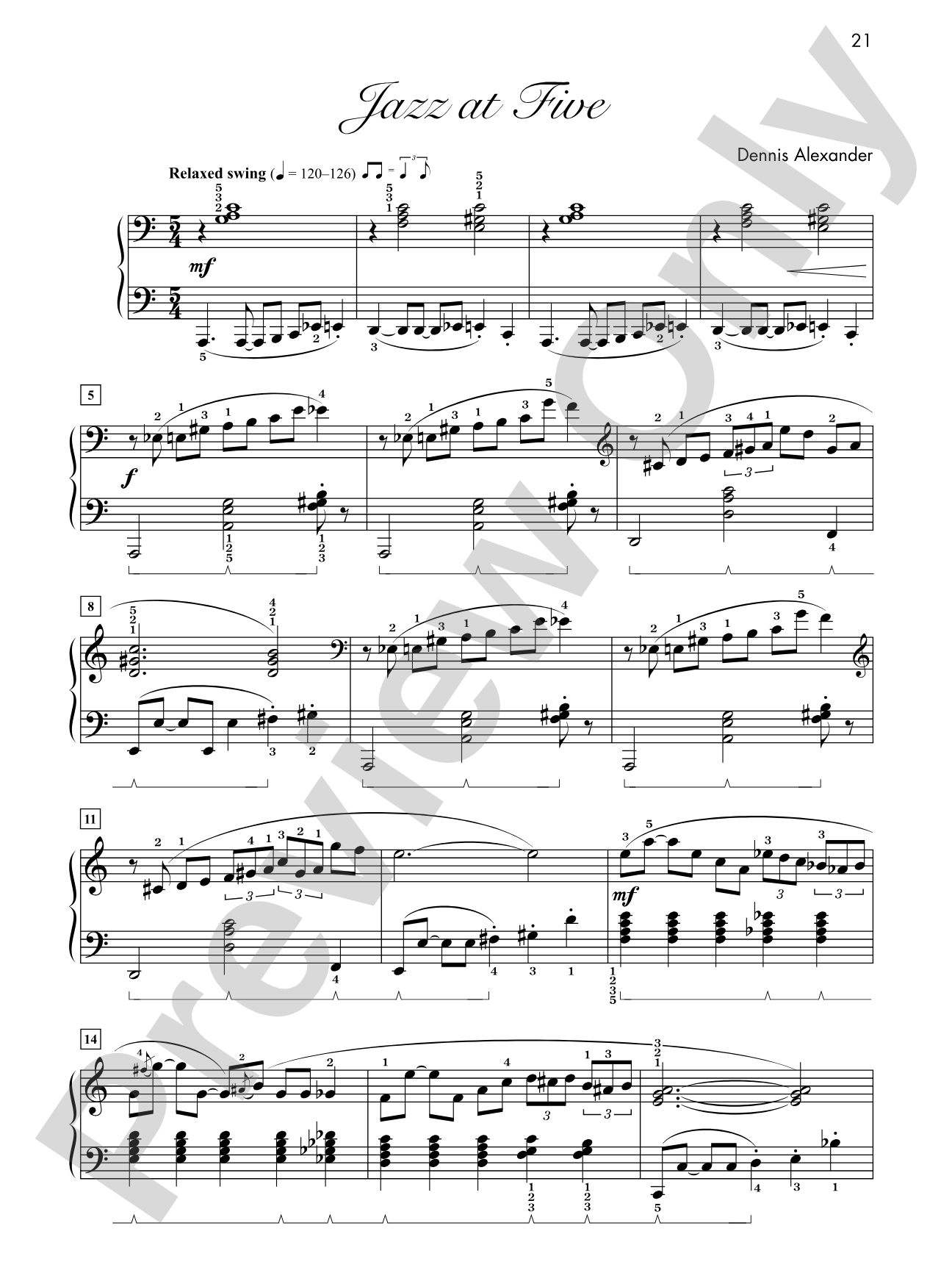

Jazz at Five - Piano Solo: Piano Solo
7 Stylized Solos for Late Intermediate Pianists
By Dennis Alexander
Level: Late Intermediate
Item: 00-PS-0017572
$4.99
Pickup currently not available
Related Items
A Million Miles Away - Piano Solo: Piano Solo |
$4.99
|
View | |
Always and Forever - Piano Solo: Piano Solo |
$4.99
|
View | |
Barclay Street Blues - Piano Solo: Piano Solo |
$4.99
|
View | |
Double Duty - Piano Solo: Piano Solo |
$4.99
|
View | |
In My Own Space - Piano Solo: Piano Solo |
$4.99
|
View | |
Porto Alegre - Piano Solo: Piano Solo |
$6.99
|
View | |
Especially in Jazzy Style, Book 3: Piano Book |
$6.99
|
View |
Description
The goal of this series is to introduce students to the rhythms, harmonies and other unique characteristics of jazz. Students will be motivated by the variety of styles and sounds that have that special Dennis Alexander sound. From lyrical melodies to infectious rhythms and harmonies, playing jazz styles has never been more fun! Titles: Always and Forever * Barclay Street Blues * Double Duty * In My Own Space * Jazz at Five * A Million Miles Away * Porto Alegre. A Federation Festivals 2024-2028 selection.


Discover MakeMusic Cloud: thousands of interactive titles your students can play along with today.
Sample Audio
No sample audio found.
Sample Video
No sample videos found.
Additional Details
Series:
Especially
Publisher:
Alfred Music
Page Count:
24
SKU:
00-PS-0017572
More about this title
About the Composer: Dennis Alexander

Dennis Alexander has shaped jazz education for countless pianists through over 400 compositions published by Alfred Music. His 24-year tenure teaching piano pedagogy at the University of Montana, followed by faculty positions at Cal State Fullerton and Cal State Northridge, gave him deep insight into what motivates student musicians and what actually works in the practice room.
Beyond his prolific output as a composer, Alexander maintains an active performance schedule as soloist, chamber musician, and collaborative artist. He has served as a clinician at state and national conventions, judged international competitions, and toured throughout Asia conducting workshops. His work consistently balances musical substance with genuine accessibility, earning him recognition as one of the most respected voices in educational piano composition.
Why we love this
Alexander writes jazz that actually sounds like jazz. These pieces don't dumb down the harmonic language or rhythmic complexity; instead, they frame authentic jazz vocabulary in ways late-intermediate pianists can master without years of additional study. The Federation Festivals selection signals that these arrangements hold up alongside serious repertoire while remaining genuinely fun to play.
What to expect
Seven distinct musical conversations, each with its own color. You'll move between bluesy grooves and impressionistic floating passages, lyrical introspection and driving rhythmic energy. The collection feels less like a workbook and more like discovering a curated set of jazz standards written specifically for your hands.
Who it's for
Late-intermediate pianists ready to engage serious jazz vocabulary without needing an improvisation background. Teachers seeking Festival-worthy material that motivates students with genuine musical variety and the unmistakable craftsmanship of a master pedagogue.
How to get the most out of it
- Internalize the swing feel before worrying about note accuracy. Listen to the rhythm section work as a unit and let that groove anchor your phrasing.
- Treat each piece as a study in a specific jazz style. "Barclay Street Blues" demands different interpretive choices than "Porto Alegre," and that variety sharpens your stylistic awareness.
- Don't race through the harmonic changes. Jazz harmony rewards deliberate listening; take time in practice to hear how each chord connects, especially in the lyrical pieces.
- Use the collection's range to build stamina across different moods and tempos. Playing them in sequence builds endurance that serves both jazz and classical rep.
How to use it
Select individual pieces for winter or spring recitals where you want to signal musical sophistication and stylistic range. The collection also serves as a bridge repertoire unit, introducing jazz language in a formal concert context before students tackle deeper improvisational work or college auditions. Programming one piece alongside classical selections demonstrates how jazz fits into serious musical study.
Skills your students will build
- Reading and executing swing rhythms and syncopation
- Interpreting jazz harmonic language (seventh chords, chromatic alterations, reharmonization)
- Developing sensitivity to jazz articulation and phrasing
- Building independence between hands in rhythmically complex textures
- Recognizing and performing within distinct jazz styles and idioms