
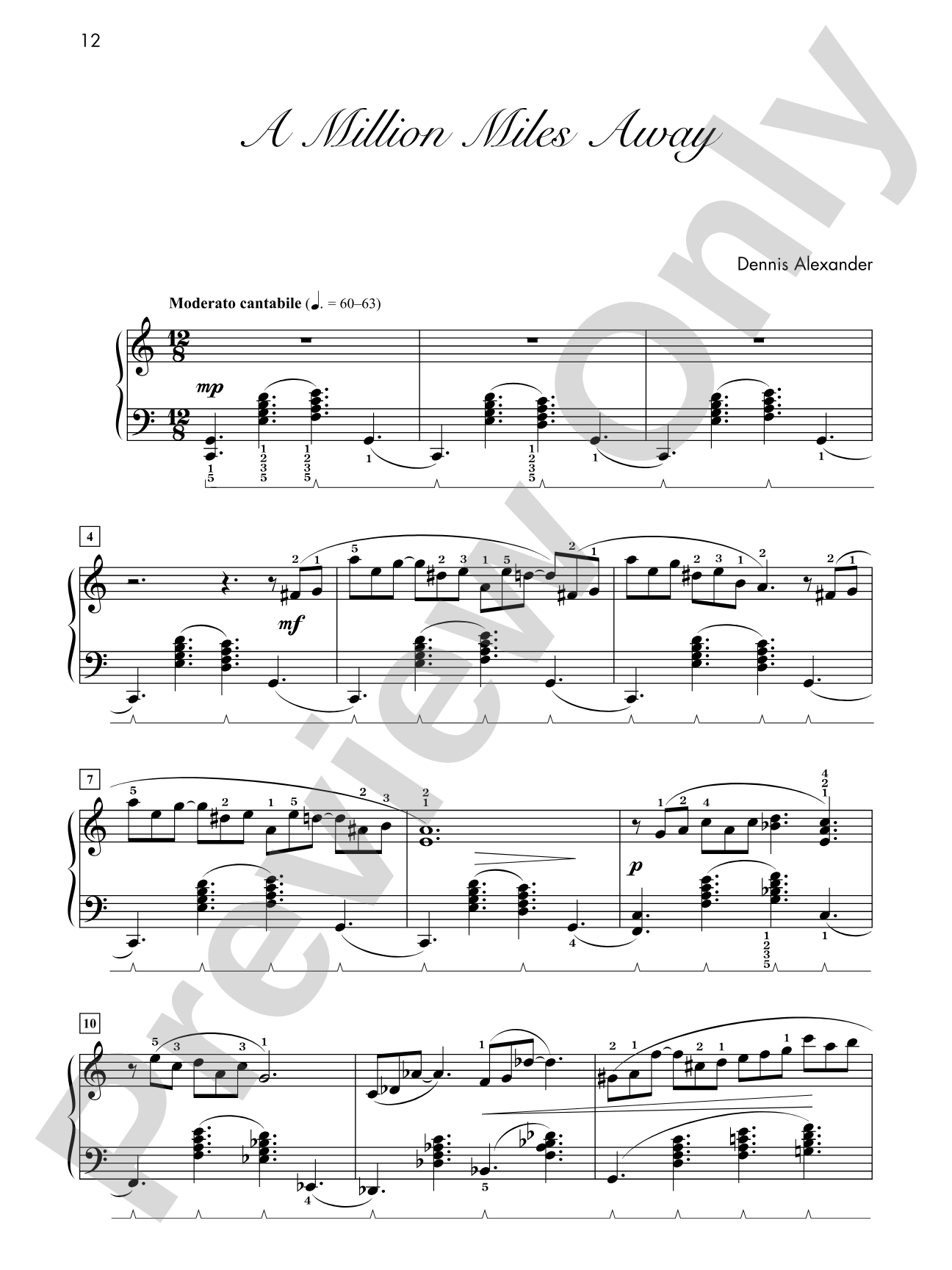

A Million Miles Away - Piano Solo: Piano Solo
7 Stylized Solos for Late Intermediate Pianists
By Dennis Alexander
Level: Late Intermediate
Item: 00-PS-0017567
$4.99
Pickup currently not available
Related Items
Always and Forever - Piano Solo: Piano Solo |
$4.99
|
View | |
Barclay Street Blues - Piano Solo: Piano Solo |
$4.99
|
View | |
Double Duty - Piano Solo: Piano Solo |
$4.99
|
View | |
In My Own Space - Piano Solo: Piano Solo |
$4.99
|
View | |
Jazz at Five - Piano Solo: Piano Solo |
$4.99
|
View | |
Porto Alegre - Piano Solo: Piano Solo |
$6.99
|
View | |
Especially in Jazzy Style, Book 3: Piano Book |
$6.99
|
View |
Description
The goal of this series is to introduce students to the rhythms, harmonies and other unique characteristics of jazz. Students will be motivated by the variety of styles and sounds that have that special Dennis Alexander sound. From lyrical melodies to infectious rhythms and harmonies, playing jazz styles has never been more fun! Titles: Always and Forever * Barclay Street Blues * Double Duty * In My Own Space * Jazz at Five * A Million Miles Away * Porto Alegre. A Federation Festivals 2024-2028 selection.


A Million Miles Away - Piano Solo: Piano Solo isn't in MakeMusic Cloud just yet...but it could be. Let us know you'd like to see it, and you'll help shape what comes next. In the meantime, start a free trial and dive into thousands of interactive titles your students can play along with today.
Request This Title
Tell us you want it.
Start Your Free Trial
Explore everything that's ready to play right now.
Sample Audio
No sample audio found.
Sample Video
No sample videos found.
Additional Details
Series:
Especially
Publisher:
Alfred Music
Page Count:
24
SKU:
00-PS-0017567
More about this title
About the Composer: Dennis Alexander

Dennis Alexander has shaped music education for decades through his prolific output of over 400 published works and recordings. Since 1986, his compositions with Alfred Music have become standards in studios and classrooms worldwide, earning him recognition as a leading voice in educational piano literature across all levels. Alexander's teaching career spans multiple universities, including 24 years at the University of Montana where he directed the piano program and taught pedagogy. He has maintained an active international presence as a clinician, adjudicator, and performing artist, appearing at state and national conventions and touring Asia multiple times to conduct master classes and recitals.
A University of Kansas graduate, Alexander has collaborated with internationally acclaimed soloists and ensembles throughout his career. He has accepted commissions from numerous music organizations and continues to compose and tour from his home in Albuquerque, New Mexico, remaining dedicated to making music accessible and engaging for students at every stage of their development.
Why we love this
Alexander writes jazz that respects what makes the genre compelling while keeping technique accessible. The melodies stick without feeling simplistic, and the rhythmic vocabulary opens doors to styles many late intermediate students haven't encountered before. Your students will actually want to practice these pieces.
What to expect
These pieces balance sophistication with accessibility. You get real jazz textures, walking bass lines, blues progressions, syncopated melodies, but the technical demands stay in the late intermediate zone. There's an ease to how Alexander phrases things that makes jazz feel natural rather than imposed.
Who it's for
Late intermediate pianists ready to explore jazz idioms with writing that sounds professional without requiring advanced technical facility. This collection suits students preparing for jazz festivals, those deepening their stylistic range, or anyone looking to make practicing feel less like work.
How to get the most out of it
- Study the rhythmic placement of syncopation in each piece; Alexander often shifts accents just enough to feel authentic without overwhelming the student.
- Let the harmony breathe. These aren't classical pieces, so don't rush through chord changes. Listen to how the colors land.
- Mark the style changes between pieces. Moving from "Barclay Street Blues" to "Porto Alegre" requires different touches and attitudes at the keyboard.
How to use it
Insert individual pieces into recitals to show off your students' stylistic versatility or program several together as a jazz-focused segment. The collection works equally well as supplementary repertoire for students already deep in classical study or as a complete unit for exploring jazz piano.
Skills your students will build
- Jazz improvisation fundamentals and stylistic vocabulary
- Syncopated rhythm reading and execution
- Blues progressions and chord-based harmony
- Swing eighth notes and jazz articulation
- Left-hand independence in walking bass patterns
- Jazz comping techniques and voicing awareness