
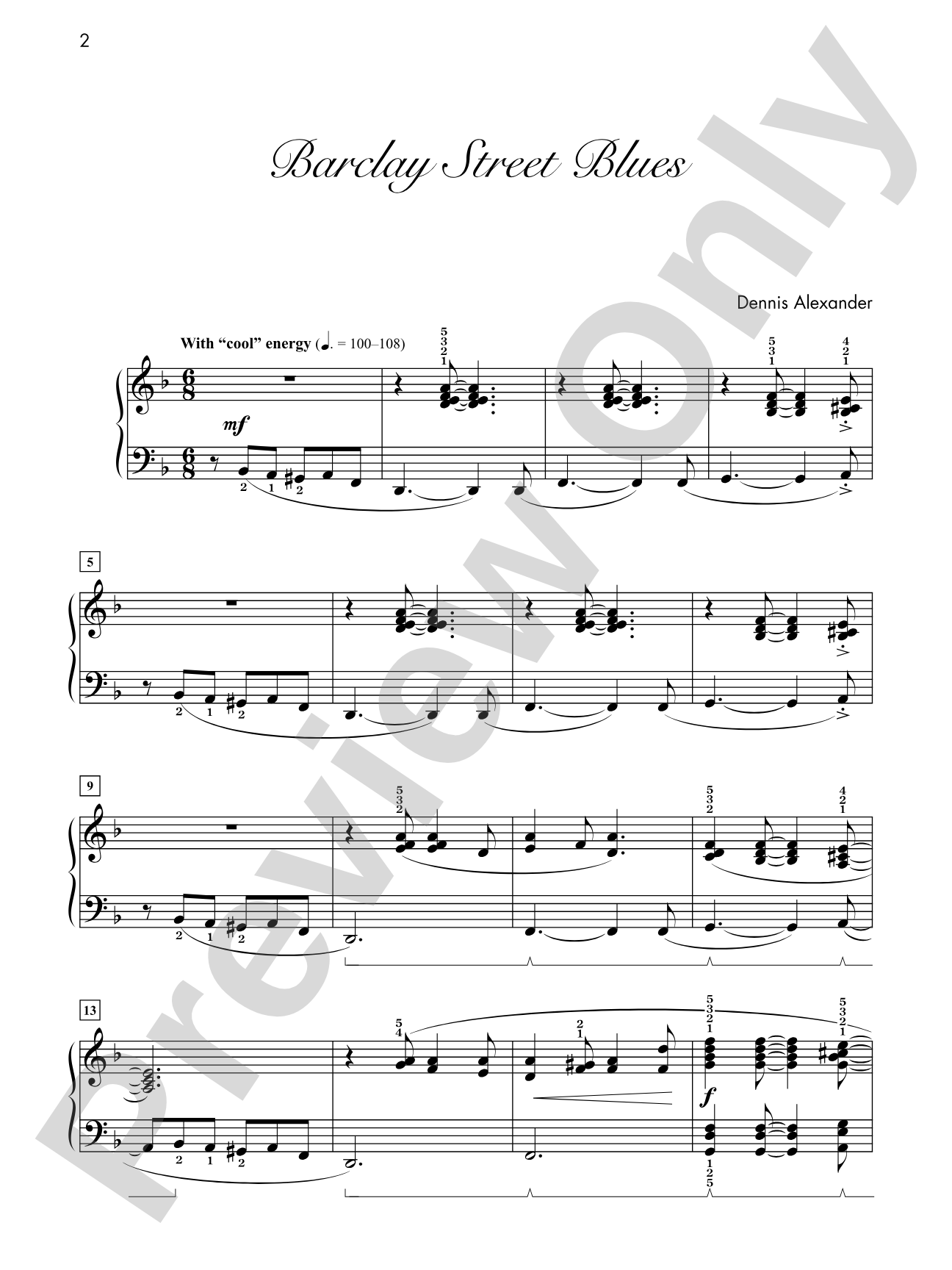

Barclay Street Blues - Piano Solo: Piano Solo
7 Stylized Solos for Late Intermediate Pianists
By Dennis Alexander
Level: Late Intermediate
Item: 00-PS-0017569
$4.99
Pickup currently not available
Related Items
A Million Miles Away - Piano Solo: Piano Solo |
$4.99
|
View | |
Always and Forever - Piano Solo: Piano Solo |
$4.99
|
View | |
Double Duty - Piano Solo: Piano Solo |
$4.99
|
View | |
In My Own Space - Piano Solo: Piano Solo |
$4.99
|
View | |
Jazz at Five - Piano Solo: Piano Solo |
$4.99
|
View | |
Porto Alegre - Piano Solo: Piano Solo |
$6.99
|
View | |
Especially in Jazzy Style, Book 3: Piano Book |
$6.99
|
View |
Description
The goal of this series is to introduce students to the rhythms, harmonies and other unique characteristics of jazz. Students will be motivated by the variety of styles and sounds that have that special Dennis Alexander sound. From lyrical melodies to infectious rhythms and harmonies, playing jazz styles has never been more fun! Titles: Always and Forever * Barclay Street Blues * Double Duty * In My Own Space * Jazz at Five * A Million Miles Away * Porto Alegre. A Federation Festivals 2024-2028 selection.


Barclay Street Blues - Piano Solo: Piano Solo isn't in MakeMusic Cloud just yet...but it could be. Let us know you'd like to see it, and you'll help shape what comes next. In the meantime, start a free trial and dive into thousands of interactive titles your students can play along with today.
Request This Title
Tell us you want it.
Start Your Free Trial
Explore everything that's ready to play right now.
Sample Audio
No sample audio found.
Sample Video
No sample videos found.
Additional Details
Series:
Especially
Publisher:
Alfred Music
Page Count:
24
SKU:
00-PS-0017569
More about this title
About the Composer: Dennis Alexander

Dennis Alexander has been Alfred Music's cornerstone composer for educational piano since 1986, amassing over 400 published works that have shaped how millions of students experience the keyboard. His career spans four decades of university teaching (including 24 years at the University of Montana as piano pedagogy faculty and department chair), international performance and master classes, commissions from prestigious organizations, and continuous touring as a clinician at state and national conventions.
Beyond the studio and classroom, Alexander maintains an active composing schedule from his base in Albuquerque while having performed as soloist, accompanist, and chamber musician across multiple continents. His 1987 Carnegie Recital Hall debut launched a performing career that has intersected with internationally recognized soloists, and his reach extends to judging major competitions abroad and conducting master classes at MTNA's national convention.
Why we love this
Alexander's jazz writing strips away intimidation by building real harmonic and rhythmic vocabulary without sacrificing musicality. These pieces genuinely sound like jazz, not classroom approximations, which means your students are learning the real thing from the first measure.
What to expect
These pieces capture the conversational ease of jazz while respecting the late-intermediate pianist's still-developing technical toolkit. There's a warmth to Alexander's voice here, a sense that jazz belongs to every student willing to listen closely and play with intention.
Who it's for
Late-intermediate pianists ready to explore jazz idioms with harmonic depth and rhythmic authenticity. Students preparing for jazz festival performances or teachers building a jazz curriculum will find both technical challenge and genuine musical reward.
How to get the most out of it
- Find the swing feel by listening to the recorded accompaniment first without playing along; let your ear absorb where the pocket sits before you add your hands.
- Shape the lyrical passages with the same care you'd give a classical melody, even as the harmonies get more sophisticated around you.
- When rhythms feel awkward on the page, isolate those measures and speak the rhythm aloud before returning to the keys.
- Balance clarity in the left hand comping patterns with forward momentum in the melody; neither should overpower the other.
How to use it
Build a recital set entirely from this collection, or program individual pieces alongside classical and contemporary works to show students how jazz integrates into a balanced concert. The Federation Festivals 2024-2028 selection status also makes this ideal for spring competition preparation.
Skills your students will build
- Reading swing rhythms and understanding their notation
- Comping with jazz chord symbols and voice-leading
- Improvisation within structured harmonic progressions
- Interpreting jazz articulation and phrasing
- Building independence between melody and accompaniment patterns