

On the Pulse of Morning: TTBB Choral Octavo
From Like Dust I Rise (A Choral Song Cycle)
Text by Maya Angelou, music by Mark Hayes
Item: 00-PO-0005652
$1.90
Minimum order quantity: 20 copies
Pickup currently not available
Related Items
On the Pulse of Morning: SoundTrax Digital Audio Download |
$29.99
|
View | |
On the Pulse of Morning: SATB Choral Octavo |
$1.90
|
View | |
On the Pulse of Morning: SSAA Choral Octavo |
$1.90
|
View | |
On the Pulse of Morning: Choral SoundPax |
$50.00
|
View | |
On the Pulse of Morning: SATB Choral Octavo |
$1.90
|
View | |
On the Pulse of Morning: SSAA Choral Octavo |
$1.90
|
View | |
On the Pulse of Morning: TTBB Choral Octavo |
$1.90
|
View | |
On the Pulse of Morning: Choral Octavo SoundTrax CD |
$29.99
|
View | |
On the Pulse of Morning: Choral SoundPax |
$50.00
|
View |
Description
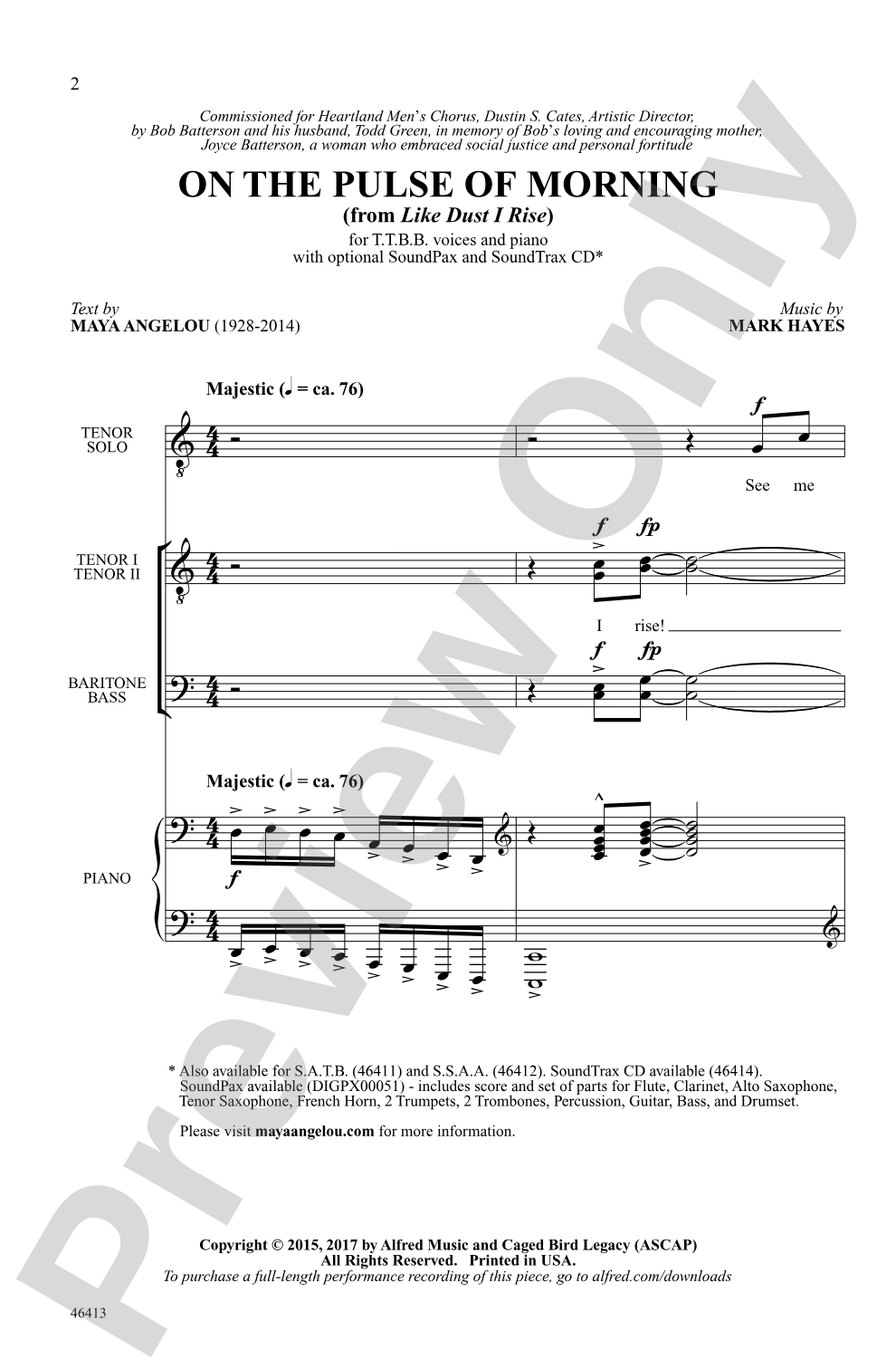
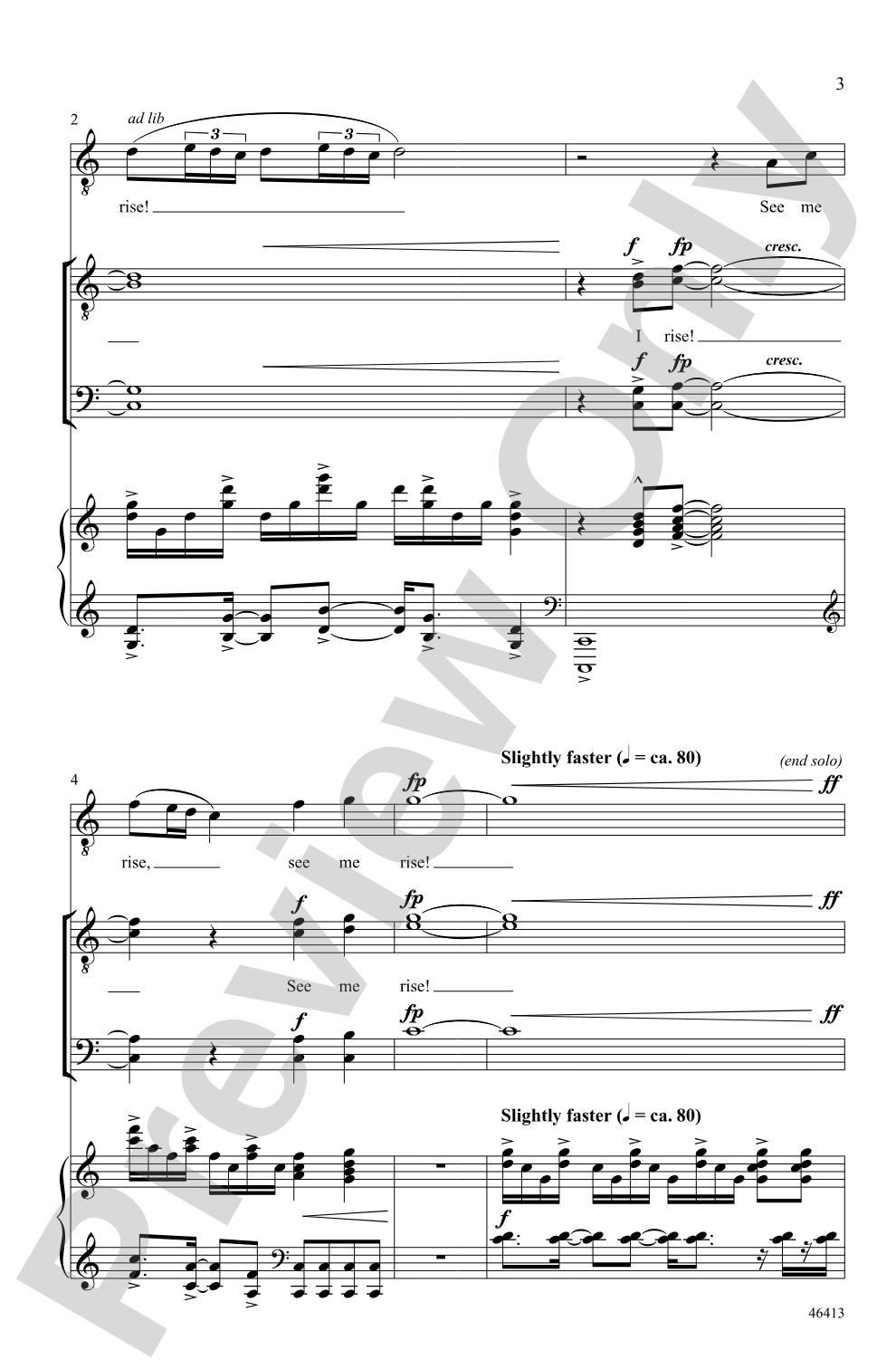
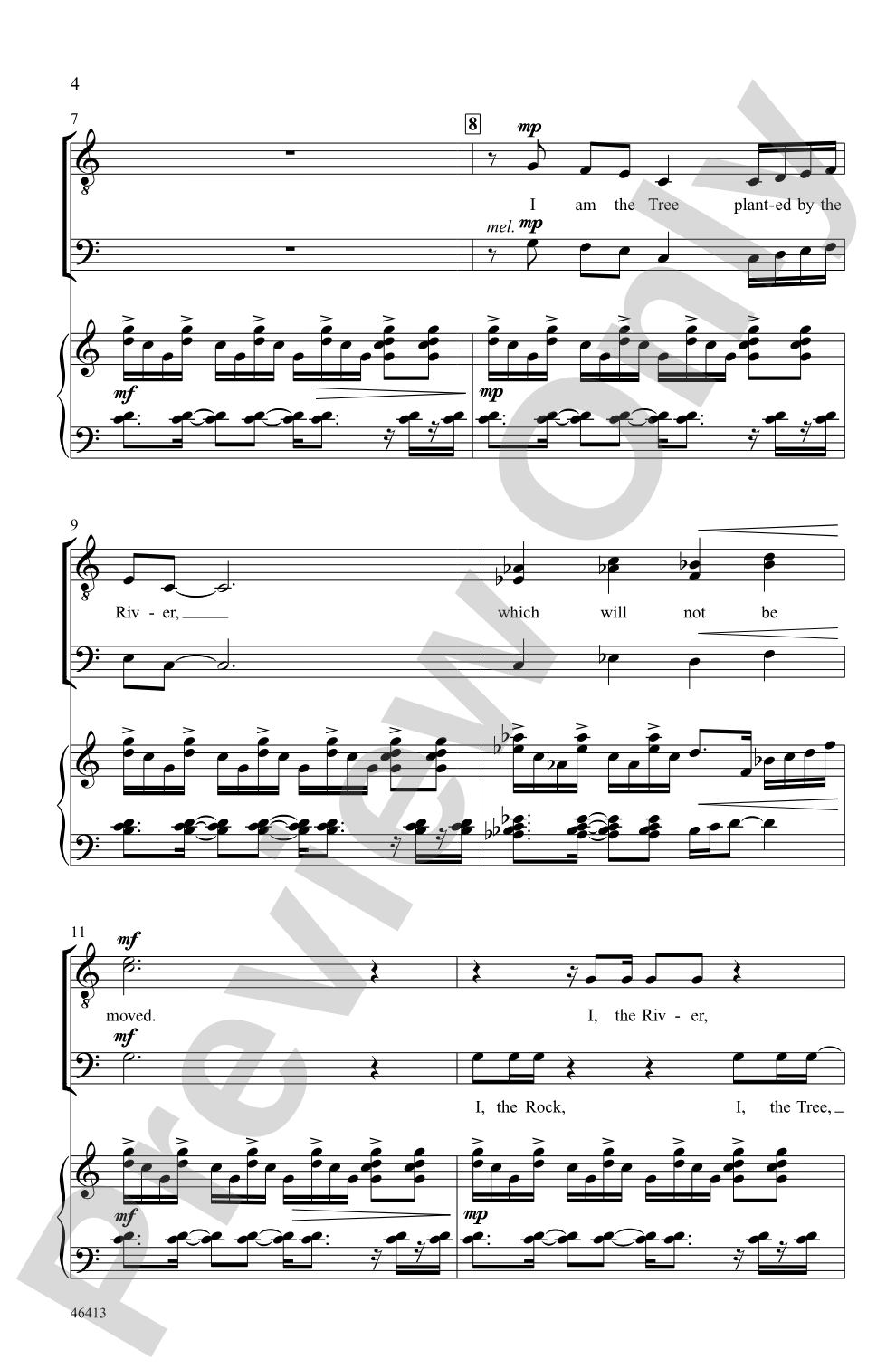
In 1993, Maya Angelou recited this poem at the inauguration of President Bill Clinton, making her the first African American and the first female poet to deliver an inaugural recitation. Subsequently, Angelou's audio recording of "On the Pulse of Morning" won a Grammy Award® for "Best Spoken Word" in 1994. Mark Hayes opens with a resounding "See Me Rise" choral fanfare before presenting the hope-filled latter half of the poem with rhythmic exuberance. This is the opening movement from the song cycle Like Dust I Rise.


On the Pulse of Morning: TTBB Choral Octavo isn't in MakeMusic Cloud just yet...but it could be. Let us know you'd like to see it, and you'll help shape what comes next. In the meantime, start a free trial and dive into thousands of interactive titles your students can play along with today.
Request This Title
Tell us you want it.
Start Your Free Trial
Explore everything that's ready to play right now.
Sample Audio
1
Audio File
--:--
2
SATB Recording
--:--
Audio File
0:00
0:00
Sample Video
Additional Details
Series:
Alfred Choral Designs
Publisher:
Alfred Music
Page Count:
12
SKU:
00-PO-0005652
More about this title
About the Composer: Mark Hayes
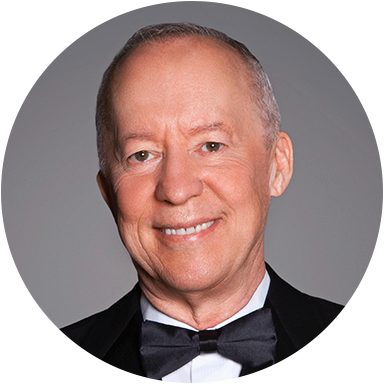
Mark Hayes has established himself as a prolific composer and arranger with over 1,750 published works across concert, choral, theatrical, and sacred genres. A summa cum laude graduate in Piano Performance from Baylor University, he has guest conducted at major venues including Lincoln Center, the National Cathedral, and Carnegie Hall, leading performances of his large-scale works such as Te Deum, Magnificat, and Gloria. In 2010, Baylor University's Center for Christian Music Studies recognized him with the Award for Exemplary Leadership in Christian Music.
Beyond the concert stage, Hayes has shaped musical theater and multimedia projects: he composed the score for Civil War Voices (which won six awards at the Midtown International Theatre Festival in 2010) and orchestrated the musical Madame Buttermilk. His St. Paul's Co-educational College commission for Hong Kong's centennial featured treble voices, mixed voices, and orchestra, with Hayes conducting the world premiere in December 2015. He conducted his Requiem's world premiere at Lincoln Center in 2013 and led its performance at St. Ignatius Basilica in Rome as part of the Vatican-sponsored Festival Pro Musica E Arte Sacra. Known equally for his piano compositions spanning gospel, classical, jazz, and Broadway styles, Hayes maintains a catalog of over 100 piano books in print.
Why we love this
Hayes brings theatrical confidence to this octavo without sacrificing the poem's gravity. The opening "See Me Rise" fanfare immediately signals that this is a statement piece, yet the rhythmic treatment of the hope-filled section stays grounded in the text rather than overshadowing it. Programming this gives your men's voices a chance to explore both power and nuance within a single, cohesive work.
What to expect
The piece opens with declarative force, a choral fanfare that commands attention and respect. As the text turns toward hope and rising, the rhythmic energy becomes almost celebratory, yet never trivializing the weight of what precedes it. There is both dignity and genuine uplift.
Who it's for
This octavo serves TTBB ensembles seeking repertoire with cultural and historical weight. Men's choirs building programs around themes of resilience, hope, or social significance will find immediate relevance in Angelou's text and Hayes's compositional approach.
How to get the most out of it
- Establish the opening fanfare with unified articulation and clear vowel formation across all parts; this sets the grandeur that frames everything that follows.
- Balance the rhythmic exuberance in the latter half with textual clarity; the complexity of Hayes's layering can obscure words if diction isn't precise.
- Use the recorded accompaniment to lock ensemble entrances, especially where parts overlap or where rhythm drives the musical argument.
- Shape phrasing around Angelou's original line breaks and breath points rather than strictly at bar lines; the poetry must remain the structural anchor.
How to use it
Position this as a centerpiece work in a concert exploring themes of social justice, resilience, or American voices. Its ceremonial quality and moderate length (12 pages) make it suitable for both a standalone concert and as part of a larger thematic program. The piece's connection to a historic inaugural moment gives it natural appeal for patriotic programs or those marking significant anniversaries.
Skills your students will build
- Balancing transparent rhythmic complexity with textual clarity in modern choral writing
- Maintaining ensemble precision across multiple rhythmic layers
- Connecting historical and cultural context to musical interpretation
- Executing dynamic control from fanfare-like opening through more lyrical middle sections