
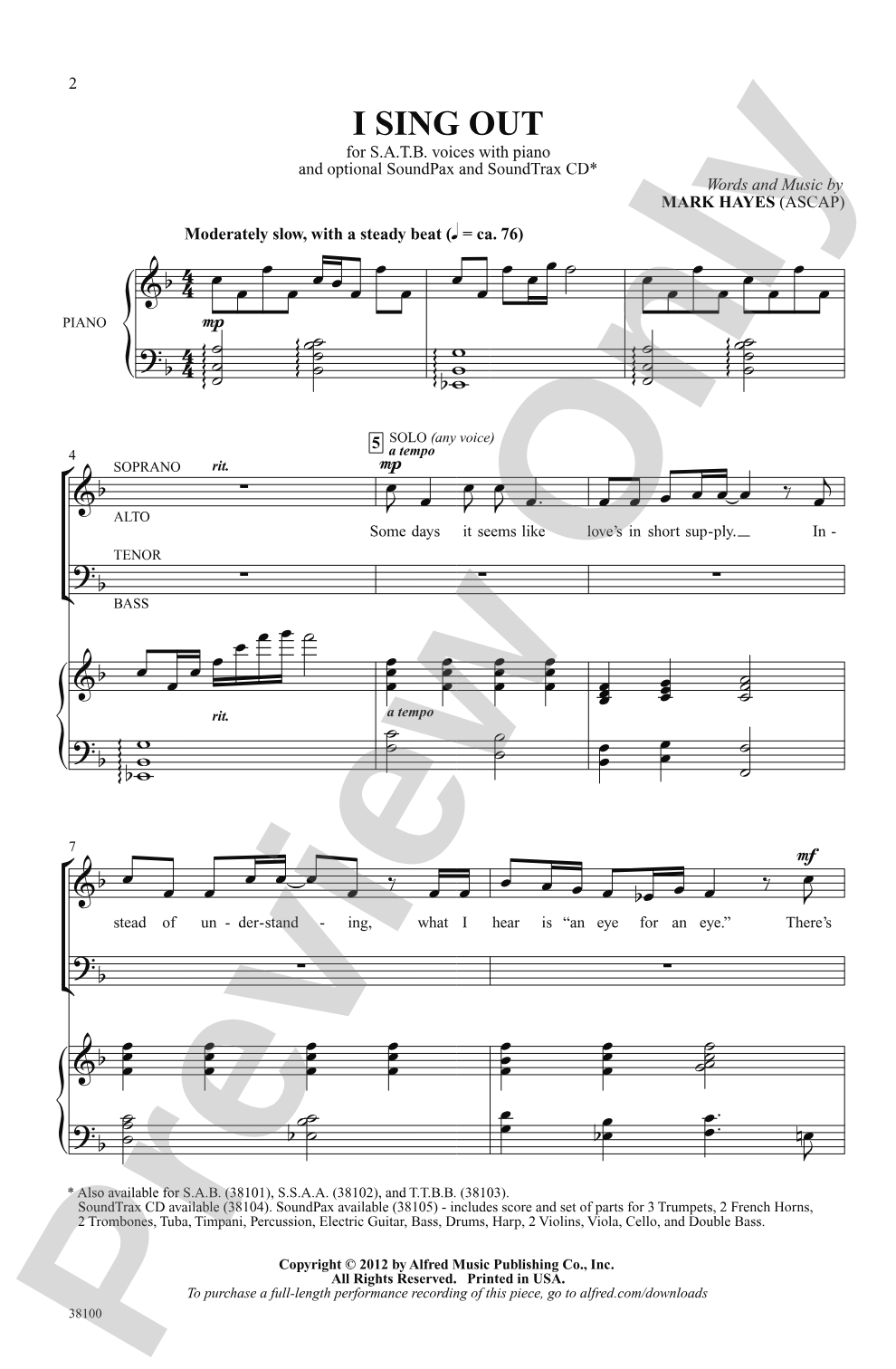
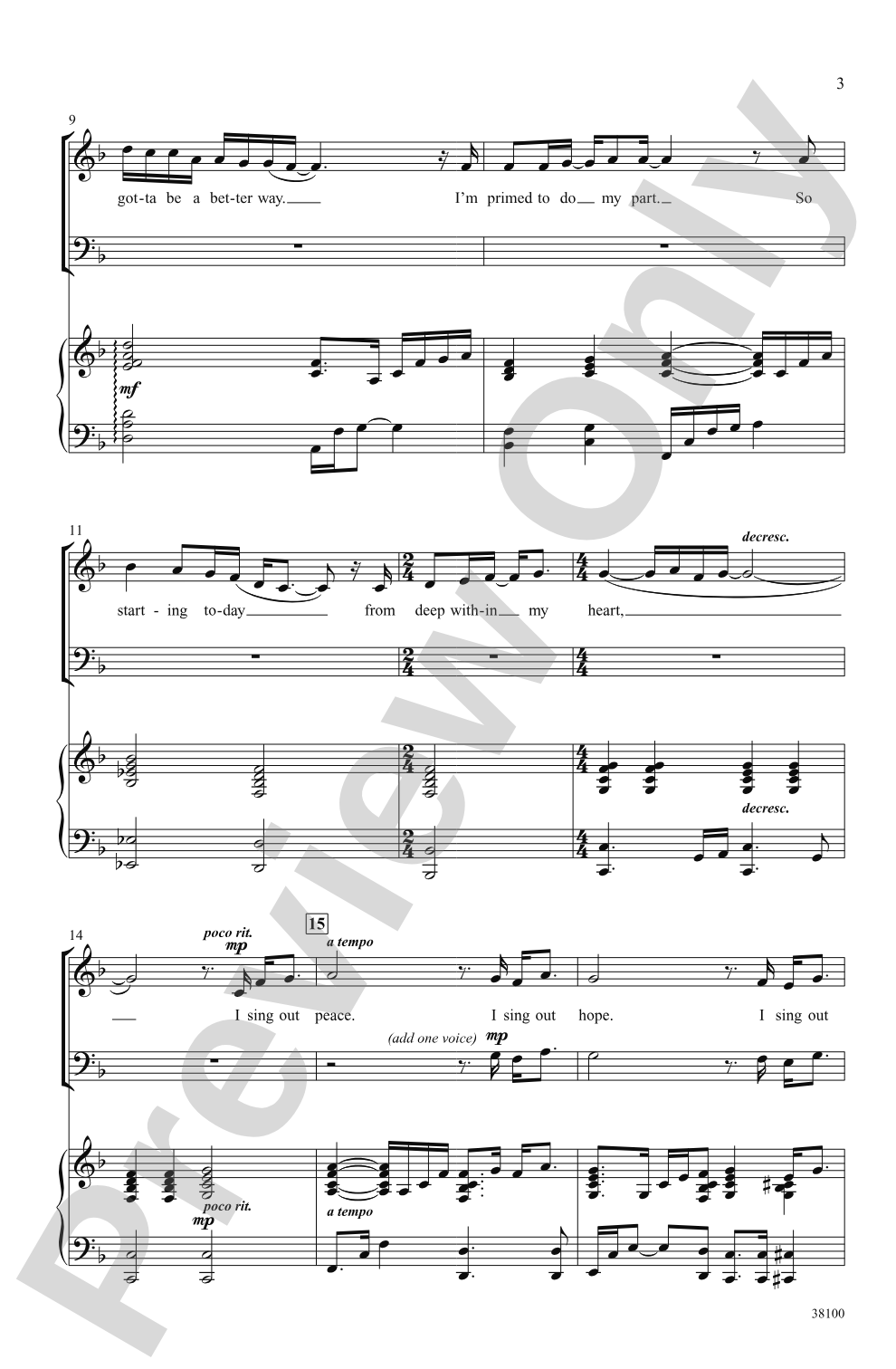
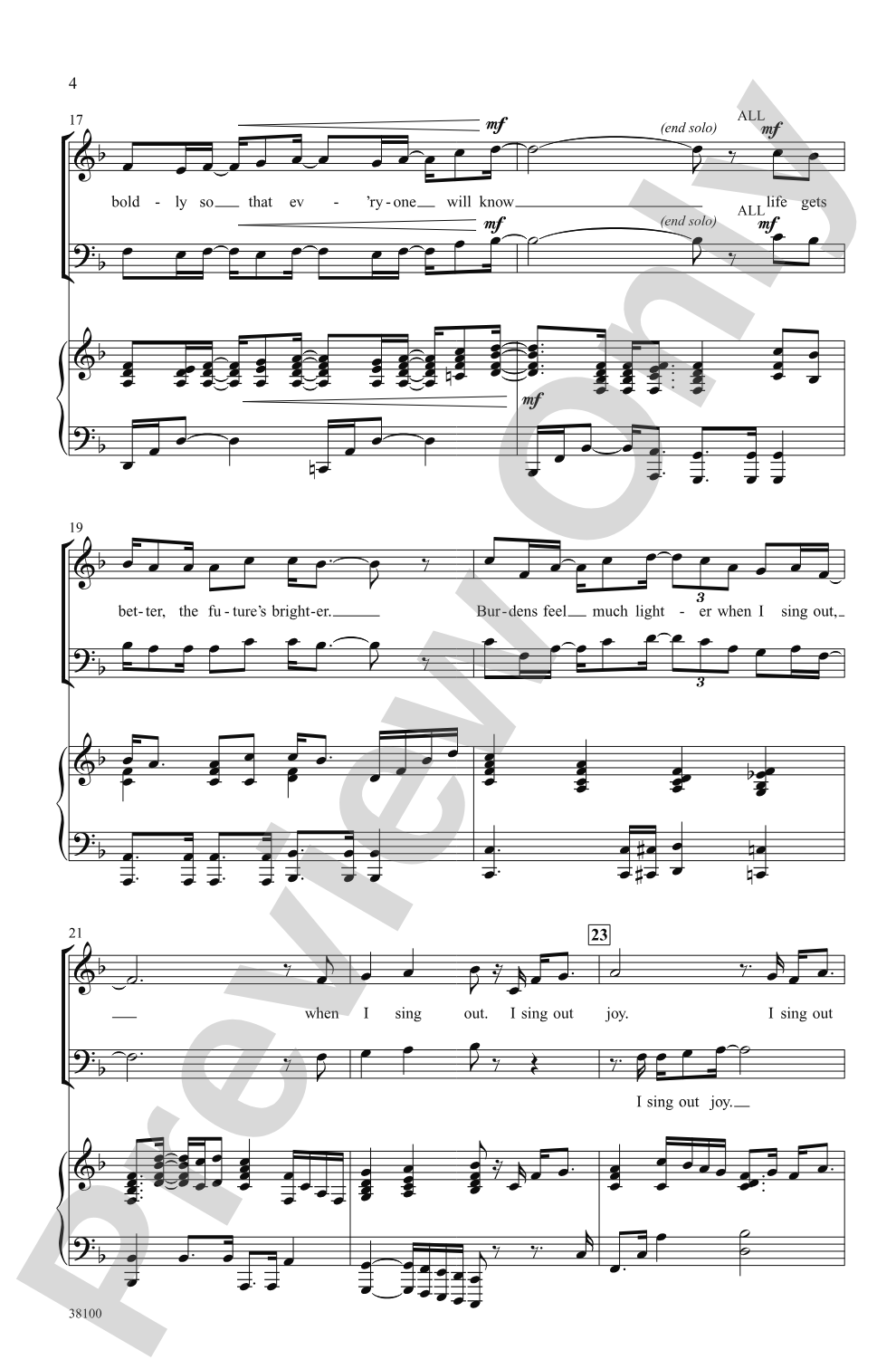

I Sing Out: SATB Choral Octavo
Words and music by Mark Hayes
Item: 00-PO-0001386
$2.20
Minimum order quantity: 20 copies
Pickup currently not available
Related Items
I Sing Out: SoundTrax Digital Audio Download |
$29.99
|
View | |
I Sing Out: SAB Choral Octavo |
$2.95
|
View | |
I Sing Out: SSAA Choral Octavo |
$1.95
|
View | |
I Sing Out: TTBB Choral Octavo |
$1.95
|
View | |
I Sing Out: Choral SoundPax |
$55.00
|
View | |
I Sing Out: SATB Choral Octavo |
$2.20
|
View | |
I Sing Out: SAB Choral Octavo |
$2.95
|
View | |
I Sing Out: SSAA Choral Octavo |
$1.95
|
View | |
I Sing Out: TTBB Choral Octavo |
$1.95
|
View | |
I Sing Out: Choral Octavo SoundTrax CD |
$29.99
|
View | |
I Sing Out: Choral SoundPax |
$55.00
|
View |
Description
From the sensitive opening solo, through the captivating textured polyphony, to the final choral refrain, this contemporary powerhouse teaches an inspiring lesson about the strength of song. "From the very best part of who I am, I sing out!"


I Sing Out: SATB Choral Octavo isn't in MakeMusic Cloud just yet...but it could be. Let us know you'd like to see it, and you'll help shape what comes next. In the meantime, start a free trial and dive into thousands of interactive titles your students can play along with today.
Request This Title
Tell us you want it.
Start Your Free Trial
Explore everything that's ready to play right now.
Sample Audio
1
Audio File
--:--
0:00
0:00
Sample Video
No sample videos found.
Additional Details
Series:
Alfred Choral Designs
Publisher:
Alfred Music
Page Count:
16
SKU:
00-PO-0001386
More about this title
About the Composer: Mark Hayes
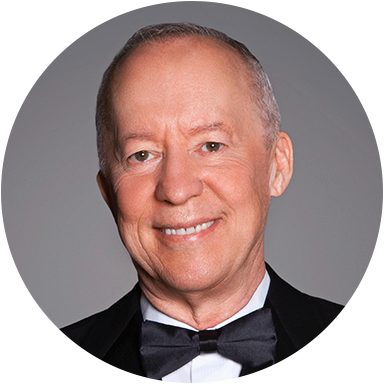
Mark Hayes brings the credentials of a concert pianist and conductor to his work as a prolific composer and arranger. His catalog exceeds 1,750 published works across sacred and secular genres, piano literature, orchestration, and musical theater. He holds a summa cum laude degree in Piano Performance from Baylor University and has guest conducted at Lincoln Center, the National Cathedral, and Carnegie Hall, premiering major works including his Requiem at Lincoln Center in 2013 and again at St. Ignatius Basilica in Rome as part of a Vatican-sponsored festival.
Beyond the concert hall, Hayes has left his mark on musical theater, orchestrating the hit musical Madame Buttermilk and arranging music for stage productions. His passion for composing for piano has resulted in over 100 published piano books spanning gospel, classical, jazz, and Broadway idioms. In 2010, Baylor University honored him with the Award for Exemplary Leadership in Christian Music, recognizing his sustained contributions to both sacred and secular choral music.
Why we love this
Hayes crafts this piece with genuine architectural skill, moving from a contemplative solo opening through richly layered polyphony before arriving at a unified choral statement. The text about singing from one's truest self carries weight without sentimentality, and the musical setting rewards careful ensemble work with genuine emotional payoff. A director can program this as a centerpiece moment that shows off textural control and voices blending at their best.
What to expect
The piece opens with intimate vulnerability, then grows into something both intricate and unified. Singing the textured middle section requires focus and trust in your section mates; by the final refrain, that effort crystallizes into a statement of genuine conviction and strength.
Who it's for
This octavo suits choirs with solid fundamentals in rhythm and melodic reading who are ready to balance independence with blend. Both high school and adult community choirs will find it singable and deeply rewarding; it does not require soloists with operatic training, but the opening voice should be secure and musically mature.
How to get the most out of it
- Shape the opening solo with generosity; it sets the emotional landscape for everything that follows and deserves space to breathe.
- Balance the polyphonic sections by coaching each voice line to maintain its independence while listening across the ensemble for vertical alignment.
- Approach the final refrain as a natural consequence of what came before rather than a dramatic turn; the strength builds from clarity of part-singing, not volume.
- Use the recorded accompaniment to help singers internalize the harmonic foundation, then pull back the track gradually to build ensemble confidence in independent singing.
How to use it
Position this as a powerful standalone moment in a concert program, or pair it with other contemporary choral works that explore similar themes of identity and voice. Its moderate length and emotional arc make it an excellent closer to a concert first half, or as the final piece of an evening dedicated to secular choral repertoire.
Skills your students will build
- Singing independent melodic lines within polyphonic textures
- Balancing solo and ensemble roles within a single work
- Achieving vertical harmonic alignment across four voice parts
- Sustaining musical focus through textural variety
- Bringing interpretive maturity to contemporary sacred themes in secular context