

Gloria (from Teresienmesse): SAB Choral Octavo
From Teresienmesse
By Franz Joseph Haydn / ed. and arr. Patrick M. Liebergen
Level: Moderate
Item: 00-PO-0002712
$2.25
Minimum order quantity: 20 copies
Pickup currently not available
Related Items
Gloria: PianoTrax Digital Download |
$9.99
|
View | |
Gloria (from Harmoniemesse): SATB Choral Octavo |
$1.75
|
View | |
Gloria (from Heiligmesse): SATB Choral Octavo |
$2.25
|
View | |
Gloria (from Heiligmesse): 3-Part Mixed Choral Octavo |
$2.25
|
View | |
Gloria: SSA Choral Octavo |
$2.25
|
View | |
Gloria: SATB Choral Octavo |
$2.25
|
View | |
Gloria (from Mass in Time of War): SATB Choral Octavo |
$2.95
|
View | |
Gloria (from Mass in Time of War): SAB Choral Octavo |
$2.95
|
View | |
Gloria: SATB Choral Octavo |
$1.75
|
View | |
Gloria: SATB Choral Octavo |
$2.50
|
View | |
Gloria: 3-Part Mixed Choral Octavo |
$2.25
|
View | |
Gloria: SSA Choral Octavo |
$2.25
|
View | |
Gloria: SATB Choral Octavo |
$2.25
|
View | |
Gloria: SATB Choral Octavo |
$2.95
|
View | |
Gloria: SAB Choral Octavo |
$2.95
|
View | |
Gloria: SAB Choral Octavo |
$2.25
|
View |
Description
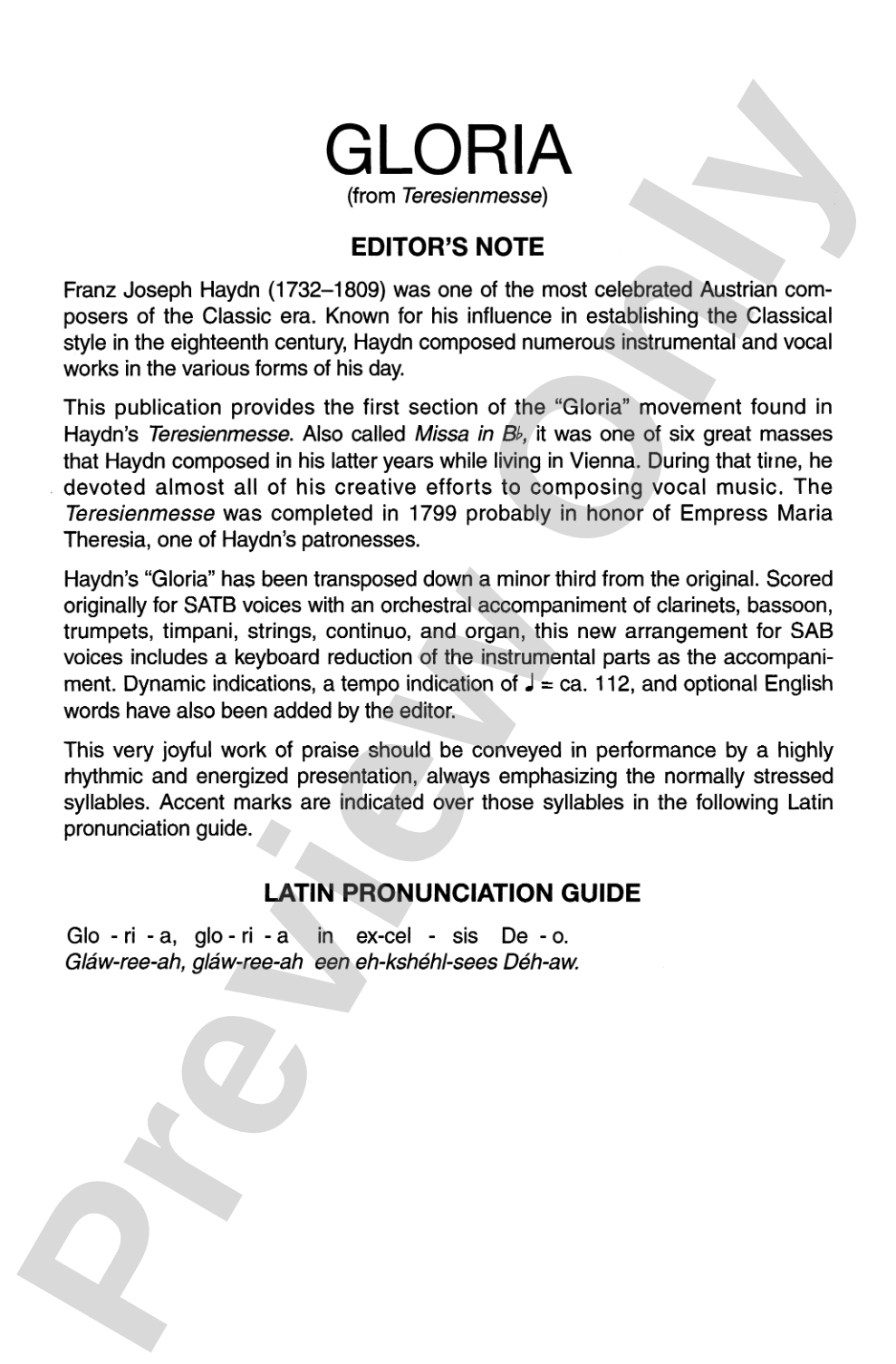
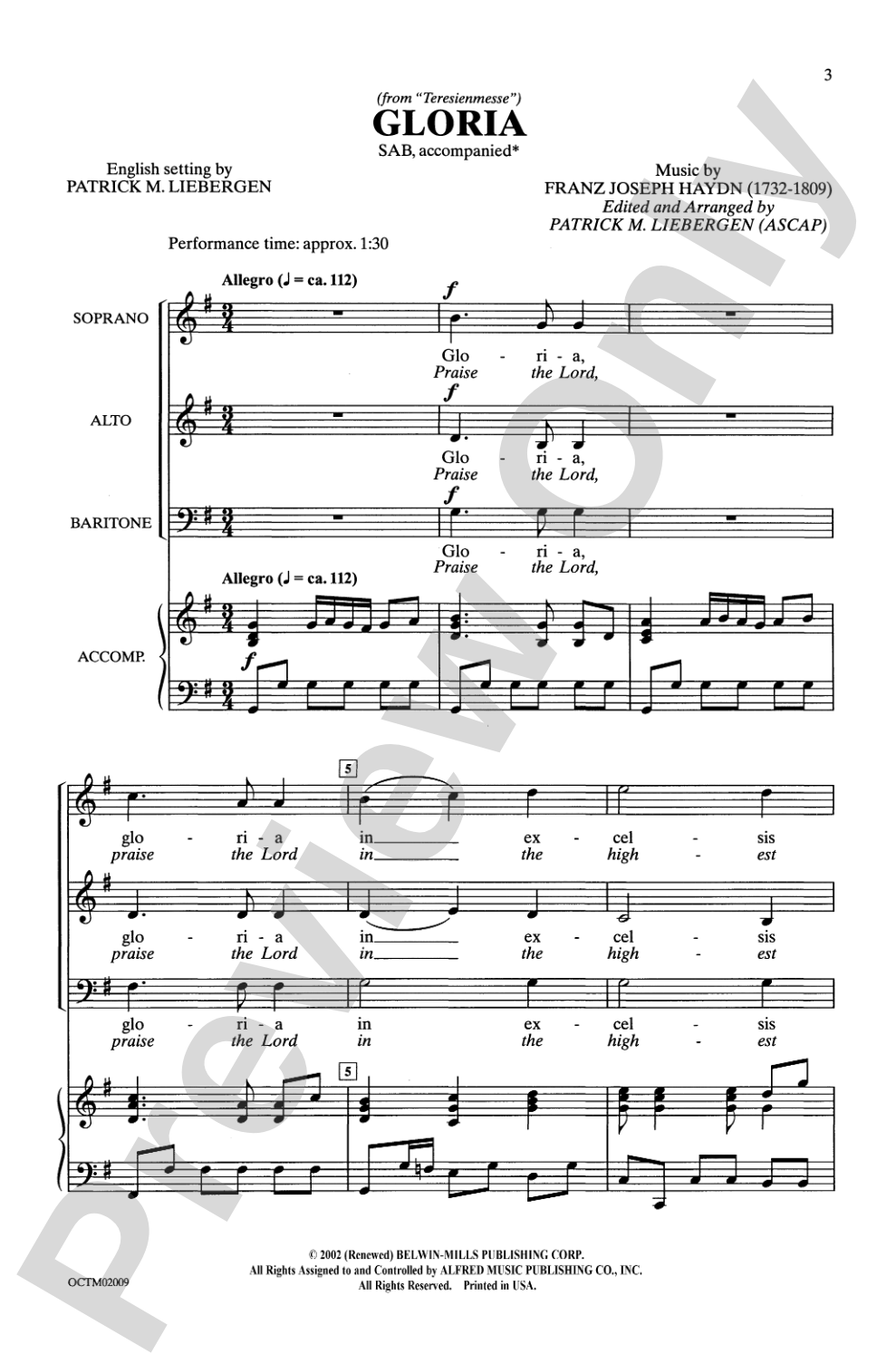
From Haydn's Mass in B[b] (Teresienmesse) Patrick M. Liebergen gives us this highly performable three part version. A great way to expose your choir to classical repertoire!


Gloria (from Teresienmesse): SAB Choral Octavo isn't in MakeMusic Cloud just yet...but it could be. Let us know you'd like to see it, and you'll help shape what comes next. In the meantime, start a free trial and dive into thousands of interactive titles your students can play along with today.
Request This Title
Tell us you want it.
Start Your Free Trial
Explore everything that's ready to play right now.
Sample Audio
1
Audio File
--:--
0:00
0:00
Sample Video
No sample videos found.
Additional Details
Series:
Alfred Archive Edition: Belwin Festival Series
Publisher:
Alfred Music
Page Count:
12
SKU:
00-PO-0002712
More about this title
About the Composer: Franz Joseph Haydn
Franz Joseph Haydn (1732-1809) was a central figure in the Classical era, bridging the Baroque and Romantic periods through his prolific output across nearly every genre. His 14 masses represent some of the finest sacred choral writing of the era, blending formal clarity with emotional warmth and structural innovation. The Teresienmesse, composed in 1799, showcases Haydn's mature style: elegant counterpoint, memorable melodies, and orchestration that enhances rather than overwhelms the text.
Why we love this
Liebergen's arrangement opens Haydn's sophisticated Mass writing to choirs that might otherwise lack the voices for a full four-part version. The SAB voicing preserves the harmonic integrity of the original while sitting comfortably in the middle ranges, making this Gloria accessible for contest season without sacrificing musical substance.
What to expect
Bright, formal, and energetic. Haydn's Gloria unfolds with the ceremonial clarity of classical church music, yet there's warmth in the harmonic movement and a playful elegance in the melodic contours. The piece radiates confidence and joy without becoming bombastic.
Who it's for
Directors working with three-part mixed ensembles who want to program literature beyond contemporary pop arrangements. This arrangement serves choirs preparing for competitive festivals or concert programs that emphasize classical repertoire without requiring advanced vocal ranges or a fourth voice part.
How to get the most out of it
- Balance the soprano and alto lines in exposed passages; the two voices carry most of the melodic weight, so a soprano-dominated blend will cloud Haydn's voice leading.
- Shape the text naturally through phrase breathing rather than strict metric phrasing. Haydn's prosody rewards singers who listen for the rhetorical arc of 'Gloria in excelsis Deo' before locking in to ensemble precision.
- Let the bass line breathe gently under the upper voices. The foundation is there to support harmonic movement, not dominate it; a lighter touch will let the classical texture sing.
- Prepare for quick tempo shifts between the opening Gloria and sections that follow. Mark these clearly in rehearsal and lock in the new tempo before ensemble enters.
How to use it
Pair this with other classical sacred works to build a thematic concert or festival entry. It also works well as a centerpiece in a concert that moves across musical eras, offering a bridge between contemporary pieces and art song or choral works from the Romantic period.
Skills your students will build
- Reading classical vocal phrasing and text-based articulation
- Balancing three-part mixed voicing while maintaining clarity in upper lines
- Understanding harmonic function through Haydn's functional harmony
- Adapting to quick tempo and style changes within a single movement
- Performing with classical diction and formality