
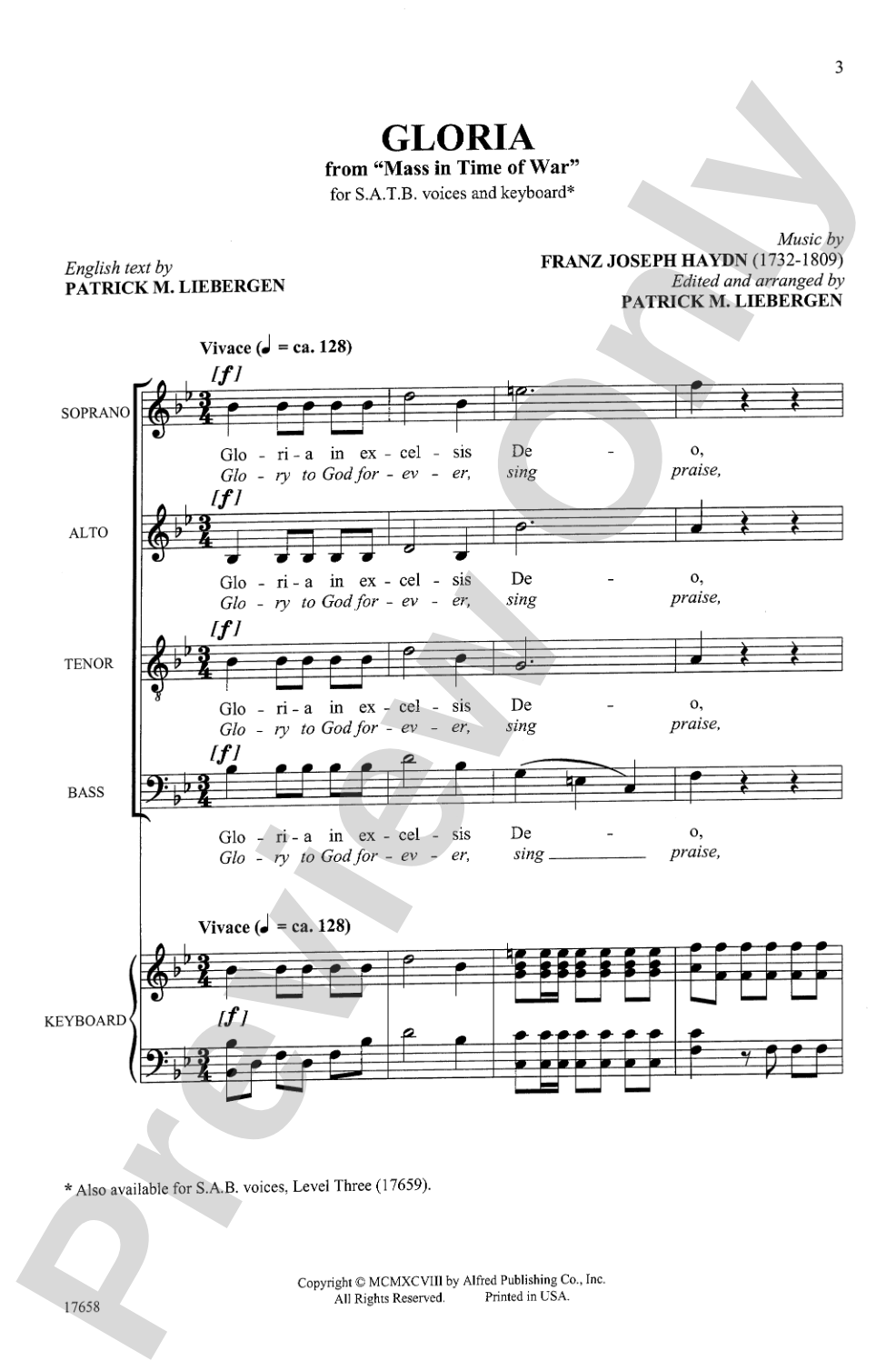

Gloria (from Mass in Time of War): SATB Choral Octavo
From Mass in Time of War
By Franz Joseph Haydn / arr. Patrick M. Liebergen
Item: 00-PO-0002107
$2.95
Minimum order quantity: 20 copies
Pickup currently not available
Related Items
Gloria: PianoTrax Digital Download |
$9.99
|
View | |
Gloria (from Harmoniemesse): SATB Choral Octavo |
$1.75
|
View | |
Gloria (from Heiligmesse): SATB Choral Octavo |
$2.25
|
View | |
Gloria (from Heiligmesse): 3-Part Mixed Choral Octavo |
$2.25
|
View | |
Gloria: SSA Choral Octavo |
$2.25
|
View | |
Gloria: SATB Choral Octavo |
$2.25
|
View | |
Gloria (from Mass in Time of War): SAB Choral Octavo |
$2.95
|
View | |
Gloria (from Teresienmesse): SAB Choral Octavo |
$2.25
|
View | |
Gloria: SATB Choral Octavo |
$1.75
|
View | |
Gloria: SATB Choral Octavo |
$2.50
|
View | |
Gloria: 3-Part Mixed Choral Octavo |
$2.25
|
View | |
Gloria: SSA Choral Octavo |
$2.25
|
View | |
Gloria: SATB Choral Octavo |
$2.25
|
View | |
Gloria: SATB Choral Octavo |
$2.95
|
View | |
Gloria: SAB Choral Octavo |
$2.95
|
View | |
Gloria: SAB Choral Octavo |
$2.25
|
View |
Description
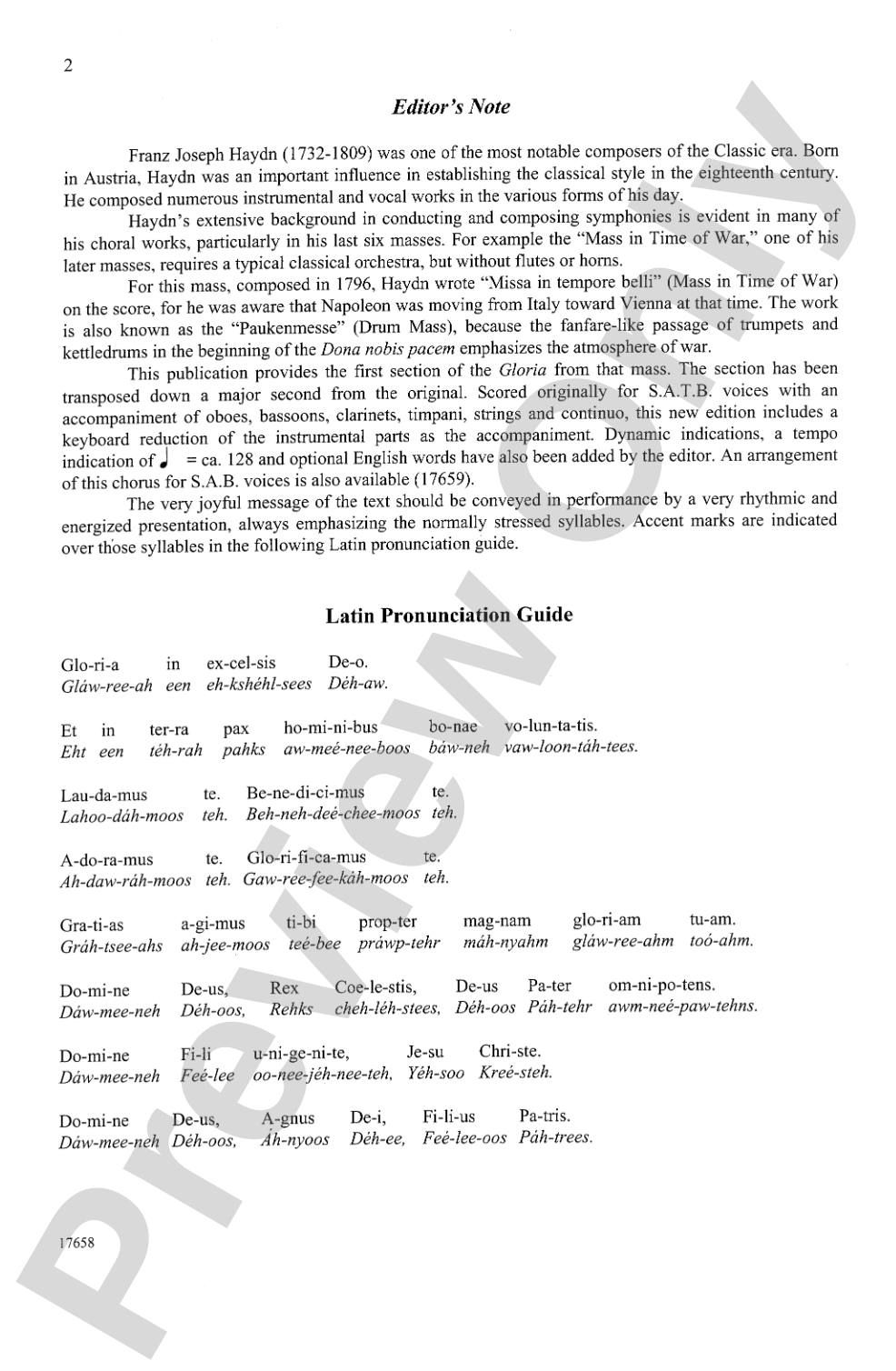
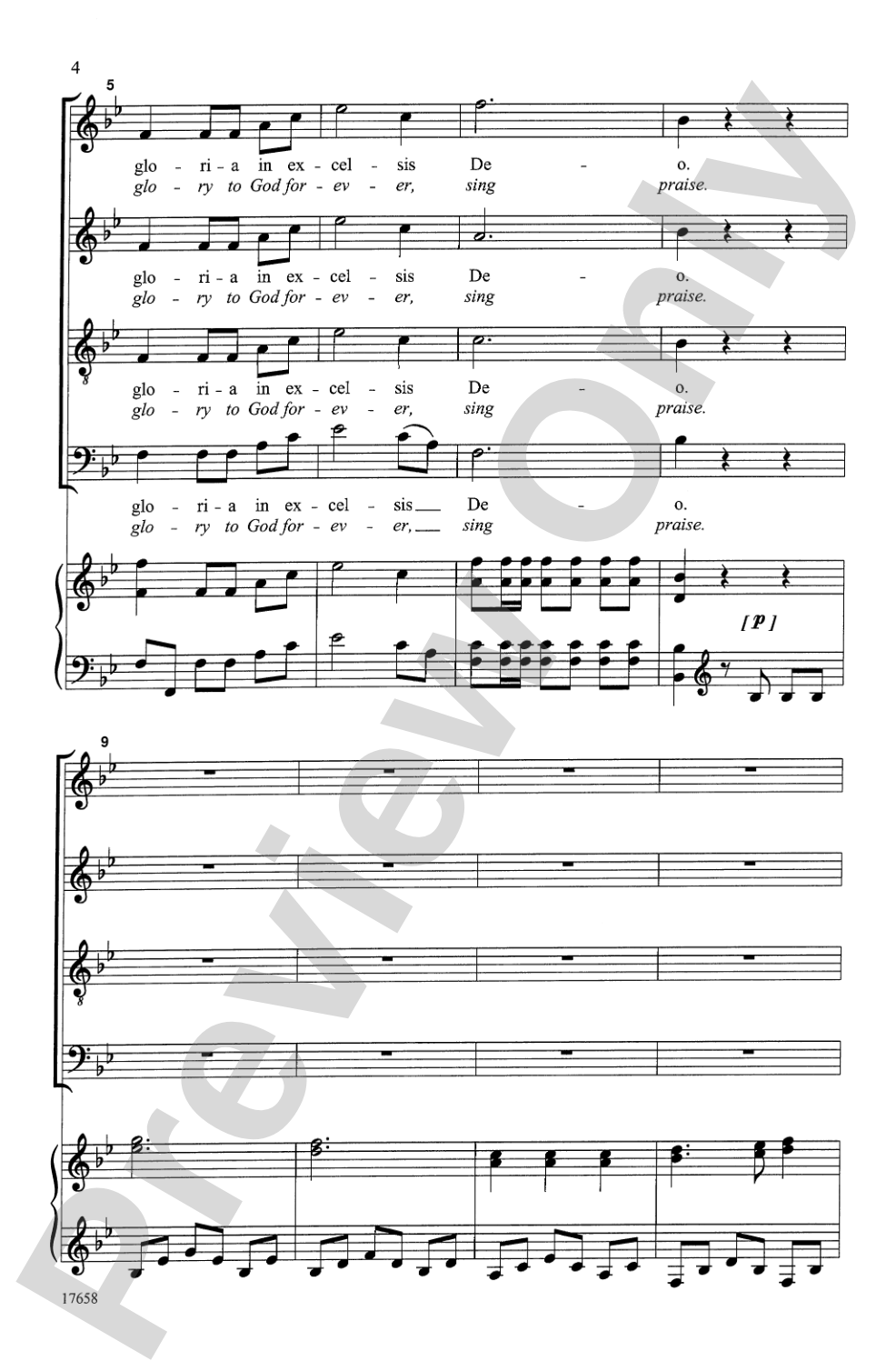
Outstanding edition from Haydn's "Mass in Time of War." Includes Latin pronunciation guide and optional English text. No divisi, no solos, moderate ranges.


Gloria (from Mass in Time of War): SATB Choral Octavo isn't in MakeMusic Cloud just yet...but it could be. Let us know you'd like to see it, and you'll help shape what comes next. In the meantime, start a free trial and dive into thousands of interactive titles your students can play along with today.
Request This Title
Tell us you want it.
Start Your Free Trial
Explore everything that's ready to play right now.
Sample Audio
1
Audio File
--:--
0:00
0:00
Sample Video
No sample videos found.
Additional Details
Series:
Alfred Archive Edition: Alfred Choral Designs
Publisher:
Alfred Music
Page Count:
16
SKU:
00-PO-0002107
More about this title
About the Composer: Franz Joseph Haydn
Franz Joseph Haydn (1732-1809) was a central figure in the Classical era, responsible for establishing the symphony and string quartet as major forms. He spent nearly three decades as Kapellmeister at the Esterházy court in Hungary, where he developed a compositional style marked by clarity, wit, and architectural precision. His sacred works, including fourteen masses, combine liturgical depth with the formal sophistication that made him one of the most performed composers of his time.
The "Mass in Time of War" (Missa in tempore belli) was written in 1796 during the Napoleonic Wars, reflecting both the tension of the era and Haydn's mature mastery. This mass demonstrates how a composer of his stature could write accessible, singable sacred music without sacrificing harmonic richness or emotional authenticity. For music educators, Haydn's masses offer insight into how liturgical music functioned as both devotional art and concert piece.
Why we love this
Arrangers often struggle to adapt Haydn without inflating voice parts or creating unwieldy divisi sections. Patrick M. Liebergen's edition solves that by keeping the writing lean and idiomatic for SATB while preserving the harmonic and rhythmic vitality that makes Haydn's Gloria so compelling. The Latin text paired with an optional English translation means you can program this in multiple liturgical or concert contexts without needing separate editions.
What to expect
The Gloria unfolds with Classical elegance and ceremonial warmth. Haydn's harmonic motion feels inevitable rather than complicated, and the text declamation falls naturally into the vocal ranges. There's a sense of dignity without stiffness, and moments of homophonic power contrast smoothly with sections where individual voices move independently.
Who it's for
This edition works well for intermediate-to-advanced SATB choirs preparing festival or competition repertoire, as well as liturgical choirs seeking a substantial sacred work that doesn't require extensive arranging skill to realize effectively. Directors with limited rehearsal time will appreciate that Liebergen's straightforward voice leading gets results without requiring complex preparation.
How to get the most out of it
- Shape the opening Gloria with bright but not brittle tone quality; Haydn's homophonic textures need clarity without shrillness, especially in the soprano line.
- Anchor the moderate ranges by balancing parts equally rather than favoring the soprano melody. Classical writing distributes interest across the texture, and even inner voice passages carry harmonic weight.
- Treat the Latin pronunciation guide as rehearsal material, not performance decoration. Confidence in the text choices (especially vowel consistency) lifts ensemble sound considerably.
- Address rhythmic precision early and often, particularly in places where Haydn uses strategic rhythmic unison to create dramatic weight. Clean attacks matter more than dynamic volume.
How to use it
Consider pairing this with other shorter sacred works from the Classical or Romantic eras to build a concert of liturgical repertoire. Its 16 pages fit gracefully into a program alongside motets or other Latin texts, and it works equally well as a concert closer or as part of a broader thematic program exploring how composers have set the Gloria text.
Skills your students will build
- Latin text projection and diction (with pronunciation guidance)
- Classical harmonic language and phrase structure
- Balancing polyphonic and homophonic textures in SATB writing
- Performing liturgical music with appropriate style and articulation
- Reading and executing moderate-range parts without forced high or low extremes