
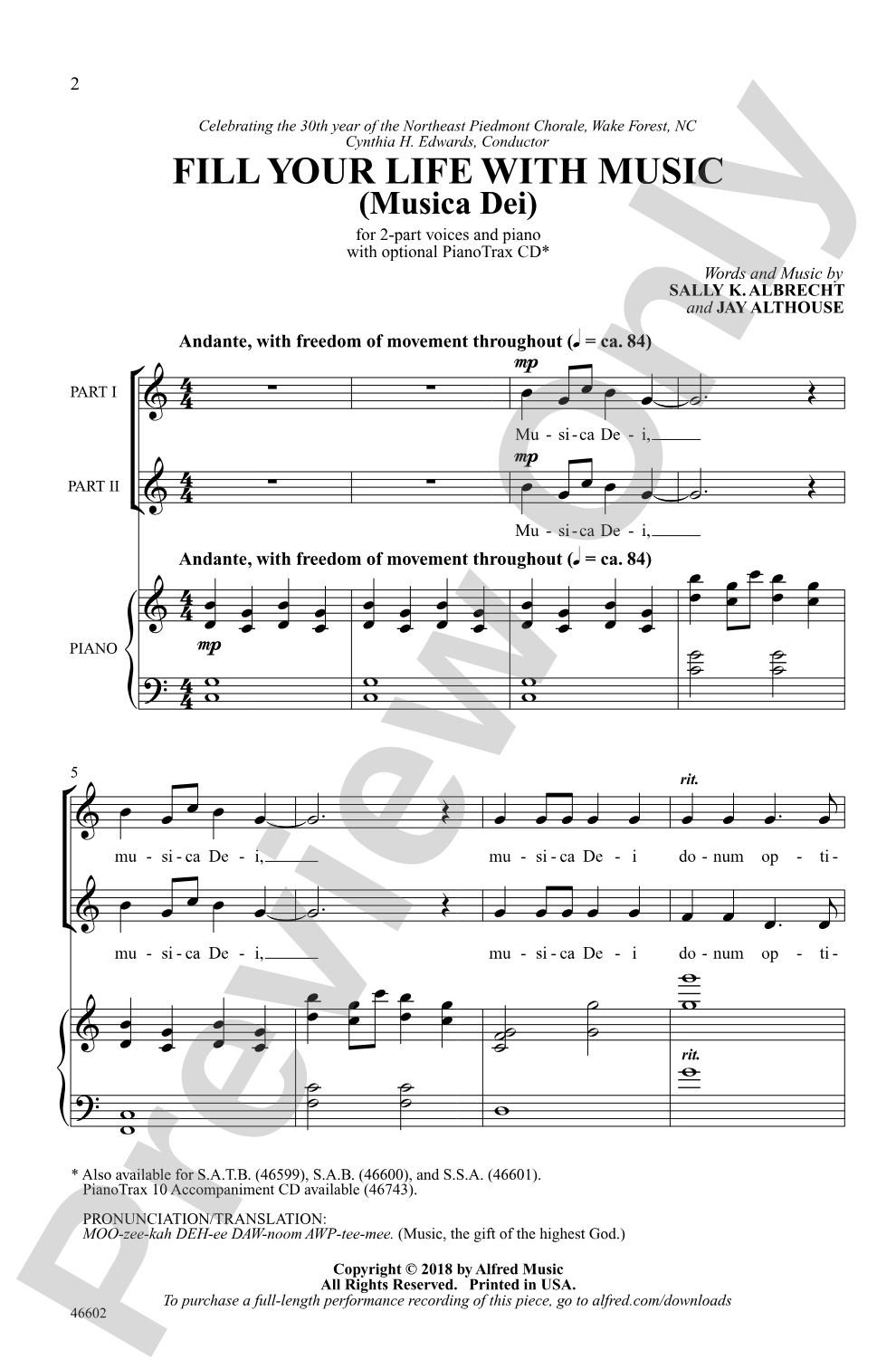

Fill Your Life with Music: 2-Part Choral Octavo
(Musica Dei)
Words and music by Sally K. Albrecht and Jay Althouse
Item: 00-PO-0005766
$2.05
Minimum order quantity: 20 copies
Pickup currently not available
Related Items
Fill Your Life with Music: PianoTrax Digital Download |
$9.99
|
View | |
Fill Your Life with Music: SATB Choral Octavo |
$2.05
|
View | |
Fill Your Life with Music: SAB Choral Octavo |
$2.05
|
View | |
Fill Your Life with Music: SSA Choral Octavo |
$2.05
|
View | |
Fill Your Life with Music: SATB Choral Octavo |
$2.05
|
View | |
Fill Your Life with Music: SAB Choral Octavo |
$2.05
|
View | |
Fill Your Life with Music: SSA Choral Octavo |
$2.05
|
View | |
Fill Your Life with Music: 2-Part Choral Octavo |
$2.05
|
View |
Description
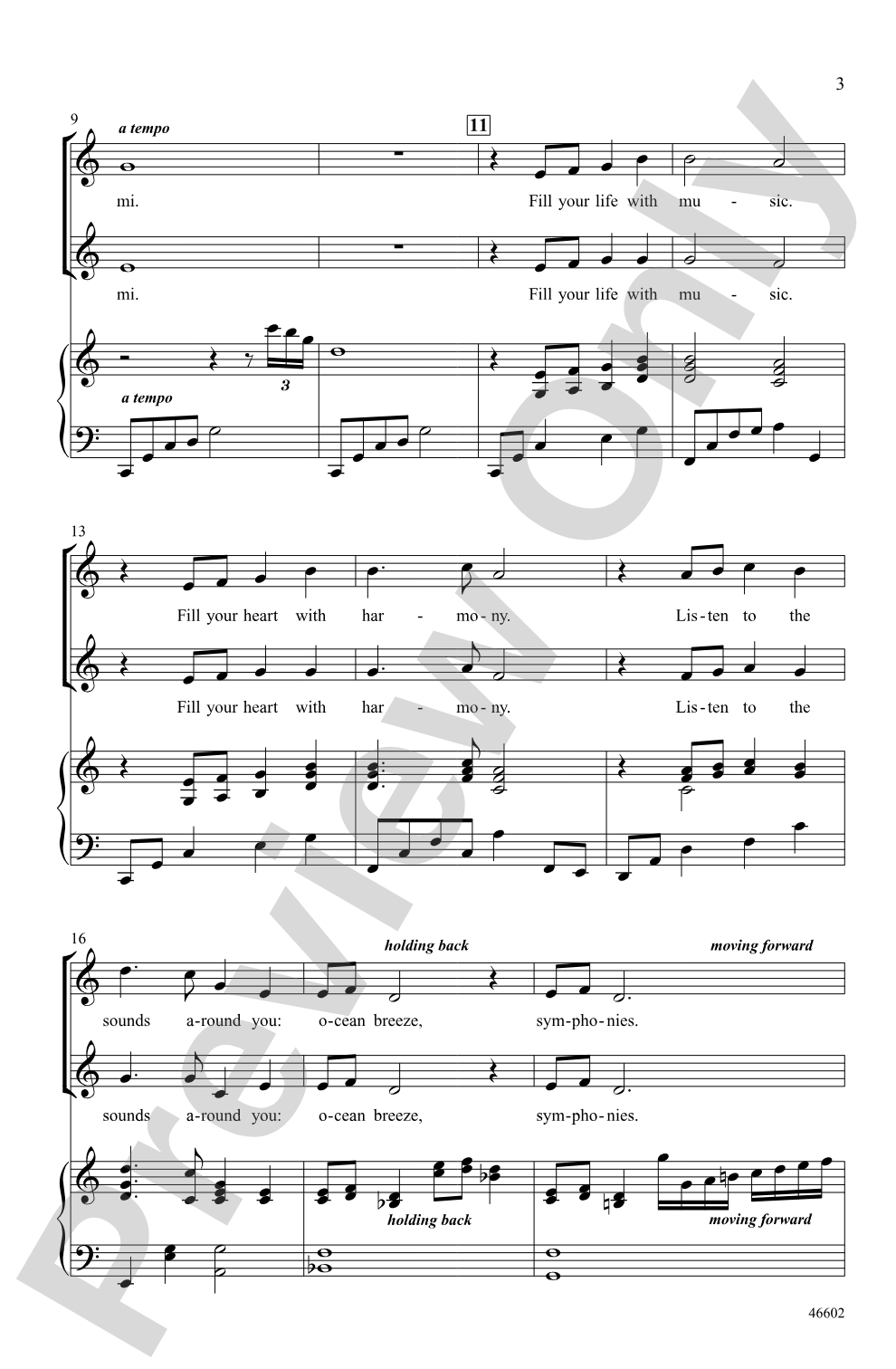
Though most of the piece is in English, a brief Latin phrase provides the framework for this pensive meditation on the world of music and sound that surrounds us. The gentle ebb and flow of tempo allows choirs to explore new depths of choral expression. Sign language is available on Alfred's Movin' DVD.


Fill Your Life with Music: 2-Part Choral Octavo isn't in MakeMusic Cloud just yet...but it could be. Let us know you'd like to see it, and you'll help shape what comes next. In the meantime, start a free trial and dive into thousands of interactive titles your students can play along with today.
Request This Title
Tell us you want it.
Start Your Free Trial
Explore everything that's ready to play right now.
Sample Audio
1
Audio File
--:--
0:00
0:00
Sample Video
No sample videos found.
Additional Details
Series:
Alfred Choral Designs
Publisher:
Alfred Music
Page Count:
8
SKU:
00-PO-0005766
More about this title
About the Composer: Sally K. Albrecht

Sally K. Albrecht has shaped American choral music for over four decades as a composer, conductor, and advocate for movement-integrated singing. Since 1987, she has received the ASCAP Special Music Award annually and maintains more than 600 published choral works in print, along with 75 larger scores and musicals. Her conducting experience spans honor choirs at Lincoln Center, Carnegie Hall, and The Kennedy Center, and she spent over 30 years directing choral and vocal publications at major educational music publishers, including Alfred Music.
Her academic background bridges music and theater: she earned a B.A. in Music and Theater from Rollins College (1976), followed by an M.A. in Drama (1977) and M.M. in Accompanying (1979) from the University of Miami. She has taught at Oakland University, Jersey City State College, and Meredith College. In 2021, she received the Distinguished Alumna Award from both the University of Miami Frost School of Music and Rollins College, where she serves on the Board of Trustees. She resides in Wake Forest, North Carolina, with her husband, composer and arranger Jay Althouse.
Why we love this
Albrecht and Althouse craft pieces that reward careful listening and emotional restraint. The interplay of English text with a Latin phrase, combined with deliberate tempo shifts, gives singers genuine interpretive choices and prevents the work from settling into predictable phrasing. Directors will appreciate how the 2-part voicing remains transparent while allowing for sophisticated harmonic color.
What to expect
Introspective and serene, with moments of gentle contemplation interrupted by the Latin text like a bell struck underwater. The piece breathes rather than drives, inviting singers to inhabit silence as carefully as sound.
Who it's for
Intermediate to advanced 2-part choirs seeking meaningful repertoire that extends beyond rhythmic sing-alongs. This piece works equally well for middle school ensembles ready for interpretive depth and high school or community choirs looking for concert or festival material with substance.
How to get the most out of it
- Shape the tempo changes as genuine musical breaths rather than sudden stops. Let the gentle ebb and flow feel organic, like the natural rhythms of speech and reflection.
- Balance the English and Latin text carefully. The Latin phrase should feel like a moment of arrival or stillness, not a disruption, so highlight its arrival with refined dynamics.
- Explore the sign language option if your ensemble has signers available. Movement transforms this meditation into a multisensory experience and deepens the choir's engagement with the message.
- Work for clarity in the 2-part writing. With only two voicing levels, every harmonic moment carries weight; avoid letting parts blur together.
How to use it
Program this as a centerpiece in a concert exploring sound, language, or musical identity. Its pensive character pairs beautifully alongside more energetic secular or sacred works, creating a moment of stillness and reflection that audiences will remember.
Skills your students will build
- Responding to subtle tempo variations and conducting cues
- Balancing two-part harmony with equal blend and intonation
- Expressing character through dynamics and phrasing rather than text alone
- Integrating movement or sign language with vocal precision