
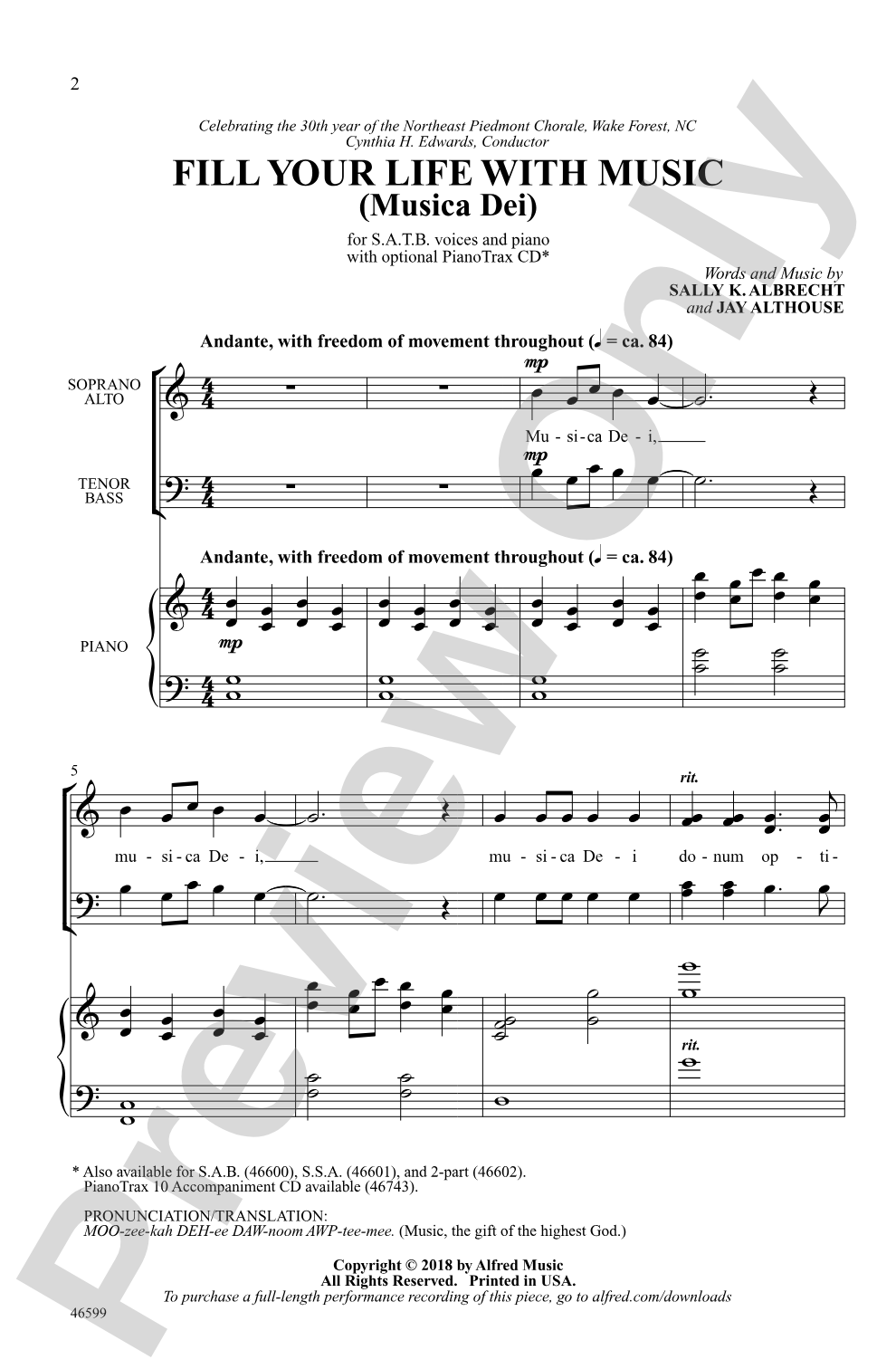
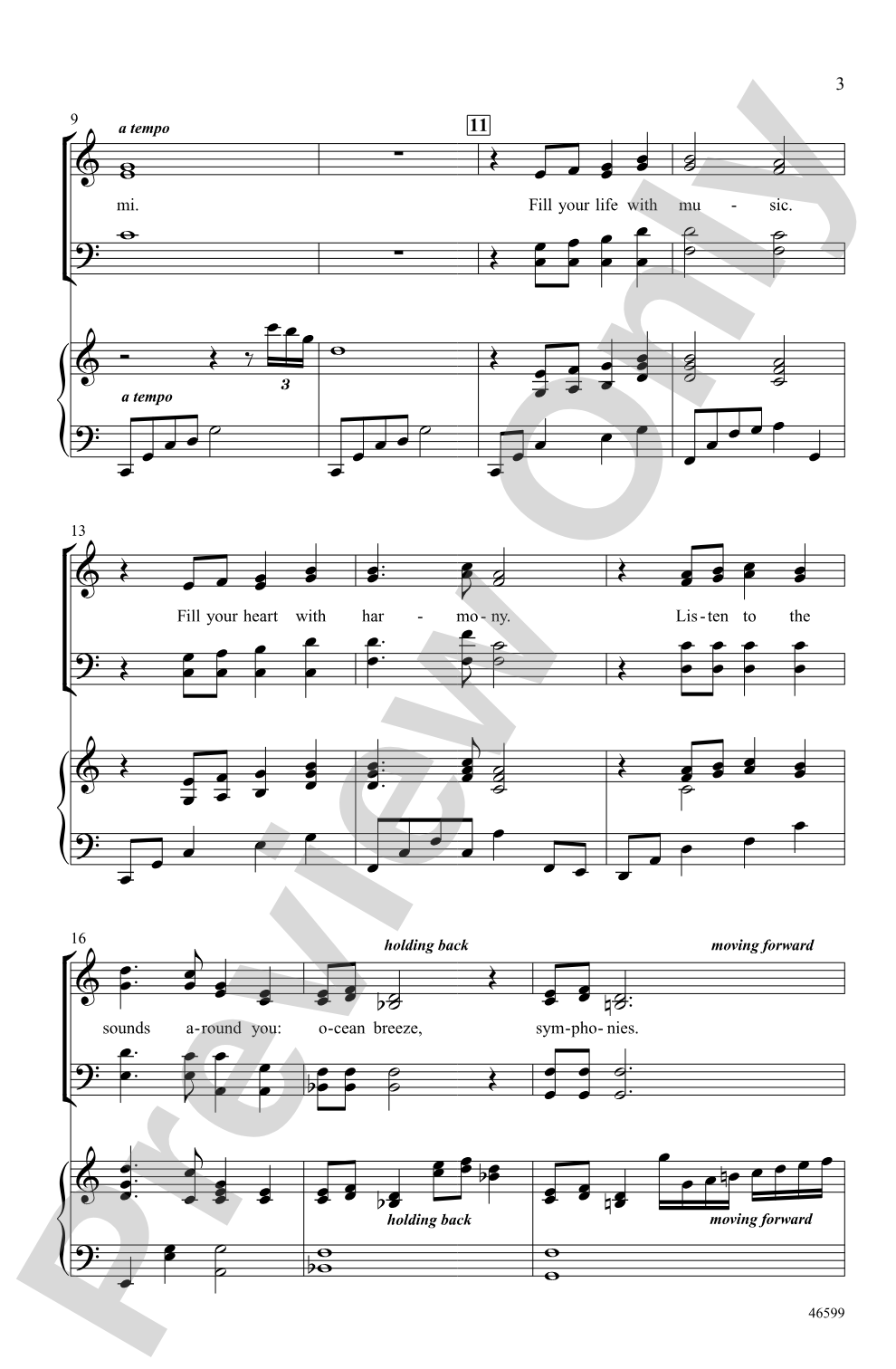

Fill Your Life with Music: SATB Choral Octavo
(Musica Dei)
Words and music by Sally K. Albrecht and Jay Althouse
Item: 00-PO-0005763
$2.05
Minimum order quantity: 20 copies
Pickup currently not available
Related Items
Fill Your Life with Music: PianoTrax Digital Download |
$9.99
|
View | |
Fill Your Life with Music: SAB Choral Octavo |
$2.05
|
View | |
Fill Your Life with Music: SSA Choral Octavo |
$2.05
|
View | |
Fill Your Life with Music: 2-Part Choral Octavo |
$2.05
|
View | |
Fill Your Life with Music: SATB Choral Octavo |
$2.05
|
View | |
Fill Your Life with Music: SAB Choral Octavo |
$2.05
|
View | |
Fill Your Life with Music: SSA Choral Octavo |
$2.05
|
View | |
Fill Your Life with Music: 2-Part Choral Octavo |
$2.05
|
View |
Description
Though most of the piece is in English, a brief Latin phrase provides the framework for this pensive meditation on the world of music and sound that surrounds us. The gentle ebb and flow of tempo allows choirs to explore new depths of choral expression. Sign language is available on Alfred's Movin' DVD.


Fill Your Life with Music: SATB Choral Octavo isn't in MakeMusic Cloud just yet...but it could be. Let us know you'd like to see it, and you'll help shape what comes next. In the meantime, start a free trial and dive into thousands of interactive titles your students can play along with today.
Request This Title
Tell us you want it.
Start Your Free Trial
Explore everything that's ready to play right now.
Sample Audio
1
Audio File
--:--
0:00
0:00
Sample Video
Additional Details
Series:
Alfred Choral Designs
Publisher:
Alfred Music
Page Count:
8
SKU:
00-PO-0005763
More about this title
About the Composer: Sally K. Albrecht
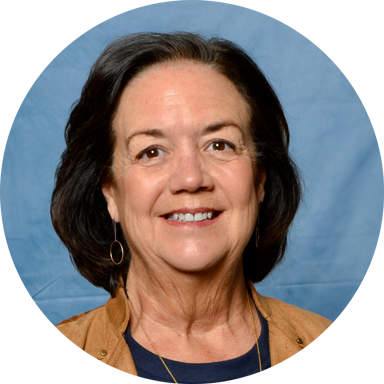
Sally K. Albrecht brings three decades of experience in choral publishing and composition to every piece she writes. As Director of School Choral, Vocal, and Elementary Publications for Alfred Music, she shaped the landscape of accessible choral literature while maintaining her own prolific output of over 600 published works. A recipient of the ASCAP Special Music Award annually since 1987, she has conducted honor choirs at Lincoln Center, Carnegie Hall, and The Kennedy Center, and her expertise in choral movement distinguishes her voice among contemporary composers for young and developing ensembles.
Albrecht earned her B.A. from Rollins College in Music and Theater (1976) before completing both an M.A. in Drama (1977) and an M.M. in Accompanying (1979) at the University of Miami. She has taught at Oakland University, Jersey City State College, and Meredith College. In 2021, she received the Distinguished Alumna Award from both the University of Miami Frost School of Music and Rollins College, where she currently serves on the Board of Trustees.
Why we love this
Albrecht and Althouse craft a piece that respects singers' musicality while remaining genuinely accessible. The interplay of English text with a Latin phrase creates intellectual intrigue without alienating developing choirs, and the flexible tempo framework invites your ensemble to own the emotional arc rather than simply executing it.
What to expect
The piece unfolds like a quiet conversation about the power of music itself. Its pensive tone and gentle tempo fluctuations create intimate moments within the larger ensemble texture, inviting listeners into reflection rather than spectacle.
Who it's for
SATB choirs seeking repertoire that combines accessibility with artistic substance. This octavo works equally well for high school concert choirs, community choruses, and collegiate ensembles preparing for festival performance or recital programming.
How to get the most out of it
- Treat the Latin phrase as the emotional anchor of the piece. Let singers understand its meaning before rehearsing; this knowledge will shape their phrasing and commitment to the text.
- Map the tempo changes visually during sectional rehearsals so singers can anticipate the ebb and flow rather than waiting for your gesture. This builds independence and musical maturity.
- If incorporating sign language (available through Alfred's Movin' DVD), introduce it early and rehearse it separately from the vocal line at first. Integration takes time and deserves dedicated attention.
- Balance the gentleness of the overall character with clear diction in English passages. Soft singing and articulate consonants are not mutually exclusive.
How to use it
Program this as a centerpiece for a concert exploring music's role in human experience, or pair it with contrasting secular works to showcase your choir's range. Its meditative quality makes it an excellent choice for festival competition, where judges value musical maturity and interpretive depth over sheer technical display.
Skills your students will build
- Interpretation of flexible tempo markings and conducting cues
- Singing with textual awareness across two languages
- Ensemble balance and blend in soft, sustained passages
- Integration of movement or sign language with vocal performance
- Musical expression through dynamics and phrasing rather than volume