
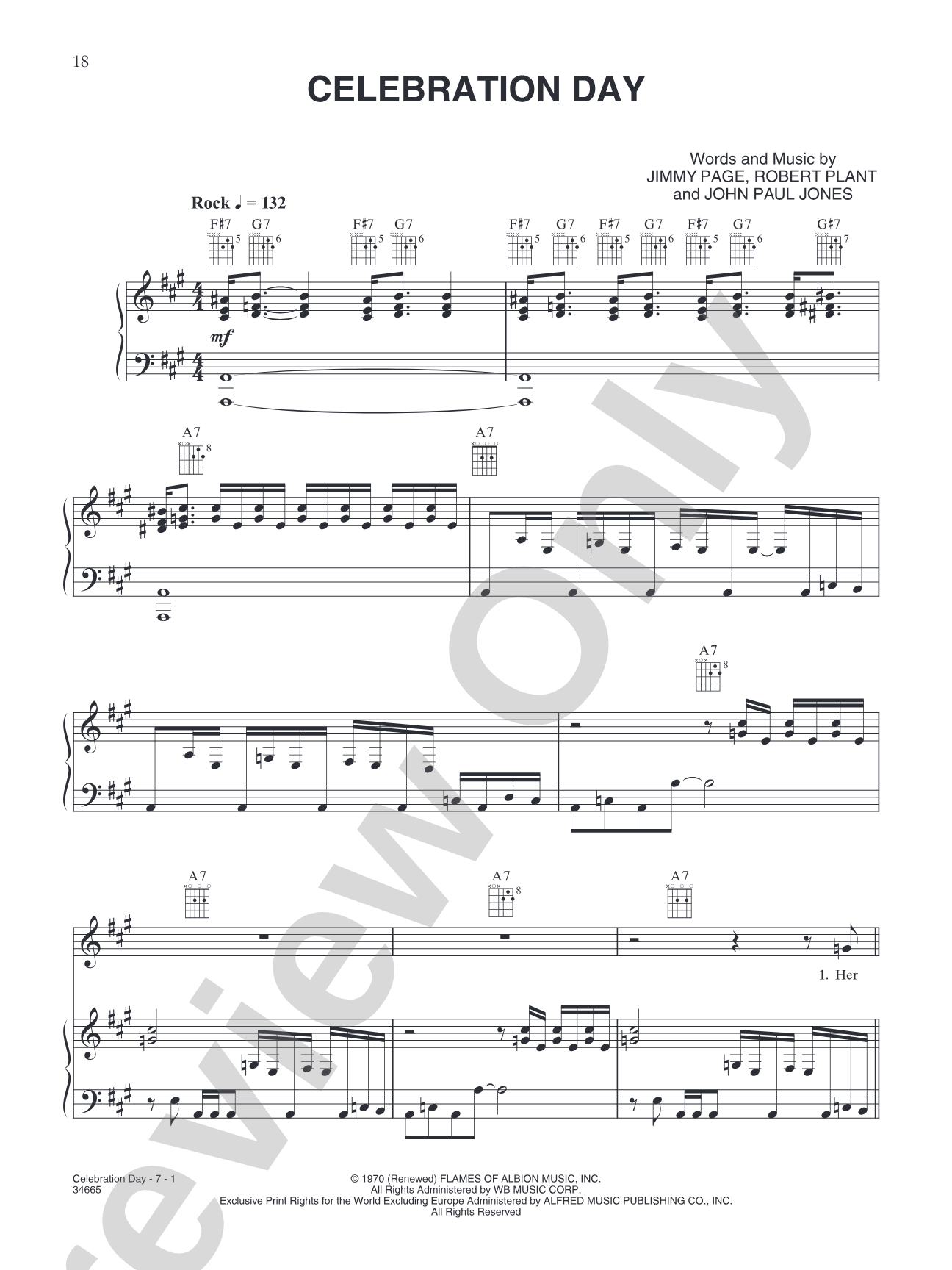
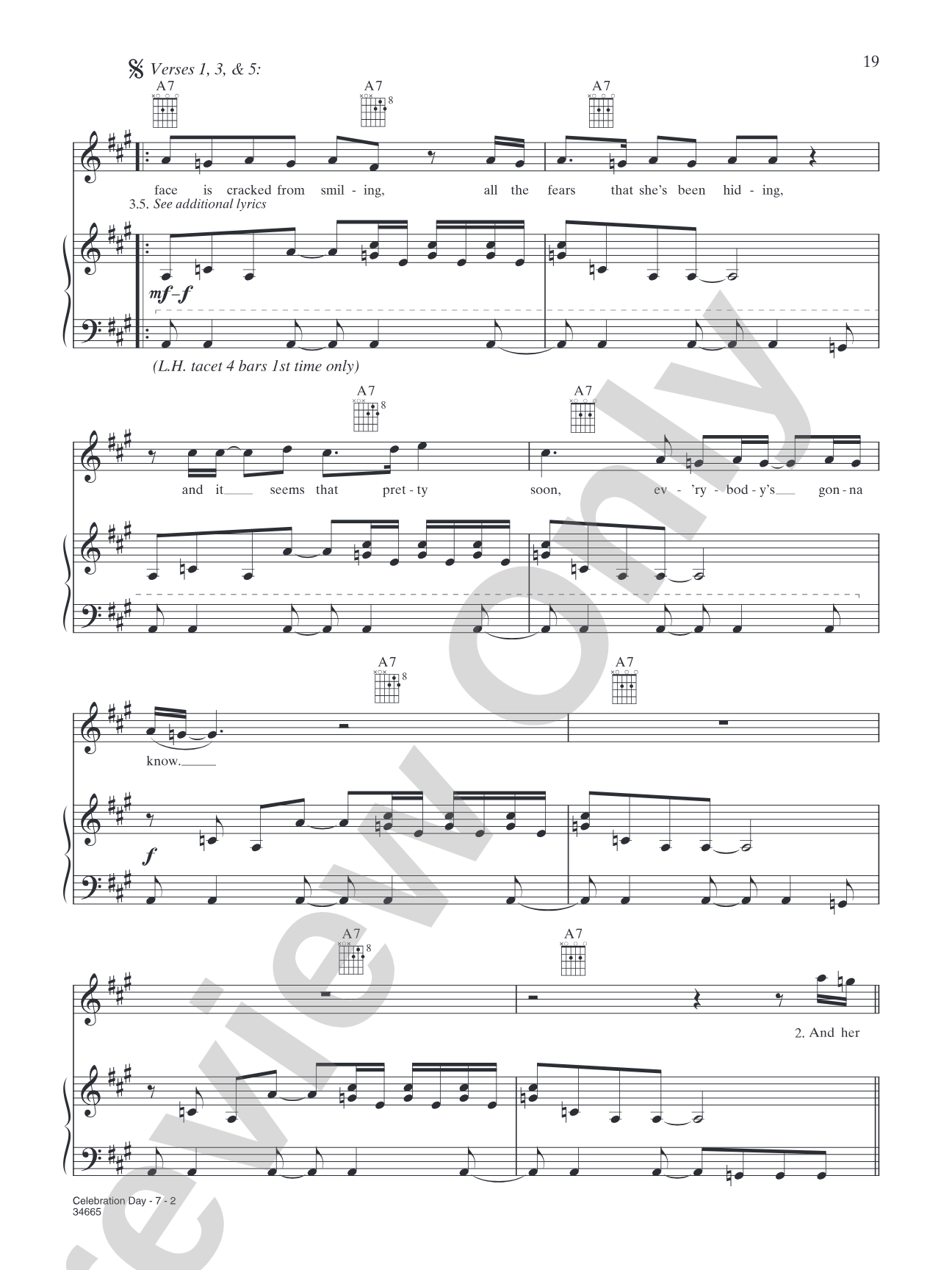

Celebration Day: Piano/Vocal/Chords
Led Zeppelin
Item: 00-XS-0000047
$5.99
Pickup currently not available
Related Items
Immigrant Song: Authentic Guitar TAB |
$5.99
|
View | |
Since I've been loving you: Authentic Guitar TAB |
$9.99
|
View | |
Bron-Y-Aur Stomp: Authentic Guitar TAB |
$9.99
|
View | |
Celebration Day: Authentic Guitar TAB |
$5.99
|
View | |
Friends: Authentic Guitar TAB |
$5.99
|
View | |
Gallows Pole: Authentic Guitar TAB |
$9.99
|
View | |
Hats Off to (Roy) Harper: Authentic Guitar TAB |
$9.99
|
View | |
Out on the Tiles: Authentic Guitar TAB |
$4.99
|
View | |
Tangerine: Authentic Guitar TAB |
$5.99
|
View | |
That's the Way: Authentic Guitar TAB |
$9.99
|
View | |
Bron-Y-Aur Stomp: Piano/Vocal/Chords |
$5.99
|
View | |
Gallows Pole: Piano/Vocal/Chords |
$9.99
|
View | |
Hats Off to Roy Harper: Piano/Vocal/Chords |
$9.99
|
View | |
Immigrant Song: Piano/Vocal/Chords |
$4.99
|
View | |
Out On the Tiles: Piano/Vocal/Chords |
$4.99
|
View | |
Since I've Been Loving You: Piano/Vocal/Chords |
$5.99
|
View | |
Tangerine: Piano/Vocal/Chords |
$5.99
|
View | |
Led Zeppelin: III Platinum Album Edition: Authentic Guitar TAB Book |
$24.99
|
View | |
Led Zeppelin: III Platinum Album Edition: Drum Transcriptions Book |
$19.99
|
View | |
Led Zeppelin: III Platinum Album Edition: Piano/Vocal/Chords Book |
$19.99
|
View | |
Led Zeppelin: III Platinum Album Edition: Authentic Bass TAB Book |
$16.99
|
View |
Description
Matching songbook to Led Zeppelin's third album, featuring detailed piano/vocal/guitar arrangements that capture all the nuances. Included are the intricate bass lines and organ parts played by John Paul Jones, along with keyboard renditions of the essential guitar parts. Guitar World magazine editor Brad Tolinski provides an insightful historical foreword, and Robert Plant has officially certified the accuracy of the lyrics. Titles: Immigrant Song * Friends * Celebration Day * Since I've Been Loving You * Out on the Tiles * Gallows Pole * Tangerine * That's the Way * Bron-Y-Aur Stomp * Hats Off to (Roy) Harper.


Celebration Day: Piano/Vocal/Chords isn't in MakeMusic Cloud just yet...but it could be. Let us know you'd like to see it, and you'll help shape what comes next. In the meantime, start a free trial and dive into thousands of interactive titles your students can play along with today.
Request This Title
Tell us you want it.
Start Your Free Trial
Explore everything that's ready to play right now.
Sample Audio
No sample audio found.
Sample Video
No sample videos found.
Additional Details
Series:
Alfred's Platinum Album Editions
Publisher:
Alfred Music
Page Count:
76
SKU:
00-XS-0000047
More about this title
About the Composer: Jimmy Page
Jimmy Page transformed the electric guitar into an instrument of unlimited sonic possibility. As Led Zeppelin's principal composer and architect, Page created a body of work that spans blues reinterpretation, mystical folk arrangements, and hard rock innovation, establishing sonic templates that continue to influence rock music across genres.
Page's approach to composition emphasizes textural layering and dynamic contrast. His contributions to Led Zeppelin III showcase his ability to shift between acoustic introspection and electric power, often within a single piece, making his work particularly valuable for musicians studying how arrangement choices shape a song's identity.
Why we love this
This edition captures a pivotal album with remarkable fidelity to the original. The inclusion of John Paul Jones's intricate bass and organ parts transforms what could be a simple lead sheet into a complete roadmap of the band's internal musical dialogue, giving pianists and vocalists genuine insight into how the song's architecture was actually constructed.
What to expect
These arrangements reveal the careful construction beneath what often sounds spontaneous. There's a precision and intricacy to the layered keyboards and bass work that reveals why this album stands apart, offering a satisfying blend of acoustic intimacy and electric power throughout.
Who it's for
Piano and keyboard players who want to understand rock arranging at a sophisticated level, vocalists preparing covers or studying how original vocal lines sit within complex harmonic environments, and music students analyzing how multi-instrumental compositions translate to a more accessible score format.
How to get the most out of it
- Treat the organ and bass line transcriptions seriously rather than as secondary elements. These parts often define the harmonic and rhythmic identity of the song; neglecting them flattens the arrangement considerably.
- Pay close attention to the dynamic markings and the shifting relationship between piano and vocal melody. Many arrangements shift focus between keyboard work and voice, and honoring these transitions maintains the song's emotional trajectory.
- Use the guitar part transcriptions as a learning tool for phrasing and articulation on piano. Rock guitar techniques (slides, bends, rhythmic punctuation) have direct piano equivalents that can inform your touch and timing.
- Reference the original recordings while learning these charts. The printed page cannot capture the subtle timing variations and textural choices that give these songs their character; the recording is your interpretive guide.
How to use it
This works well for showcase or recital programming when you want to acknowledge rock's musical sophistication without performing the songs in their original ensemble context. The vocal line settings make these pieces suitable for contemporary music units or electives focused on non-classical repertoire, and the detailed transcriptions serve as excellent material for musicianship and arranging classes.
Skills your students will build
- Reading complex chord symbols in rock contexts
- Interpreting multi-staff keyboard arrangements (piano, organ, synthesizer parts)
- Understanding voice leading and harmonic movement in rock idiom
- Translating guitar techniques and phrasing to keyboard instruments
- Coordinating vocal melody with dense instrumental accompaniment
- Analyzing arrangement choices and their emotional/textural effects