
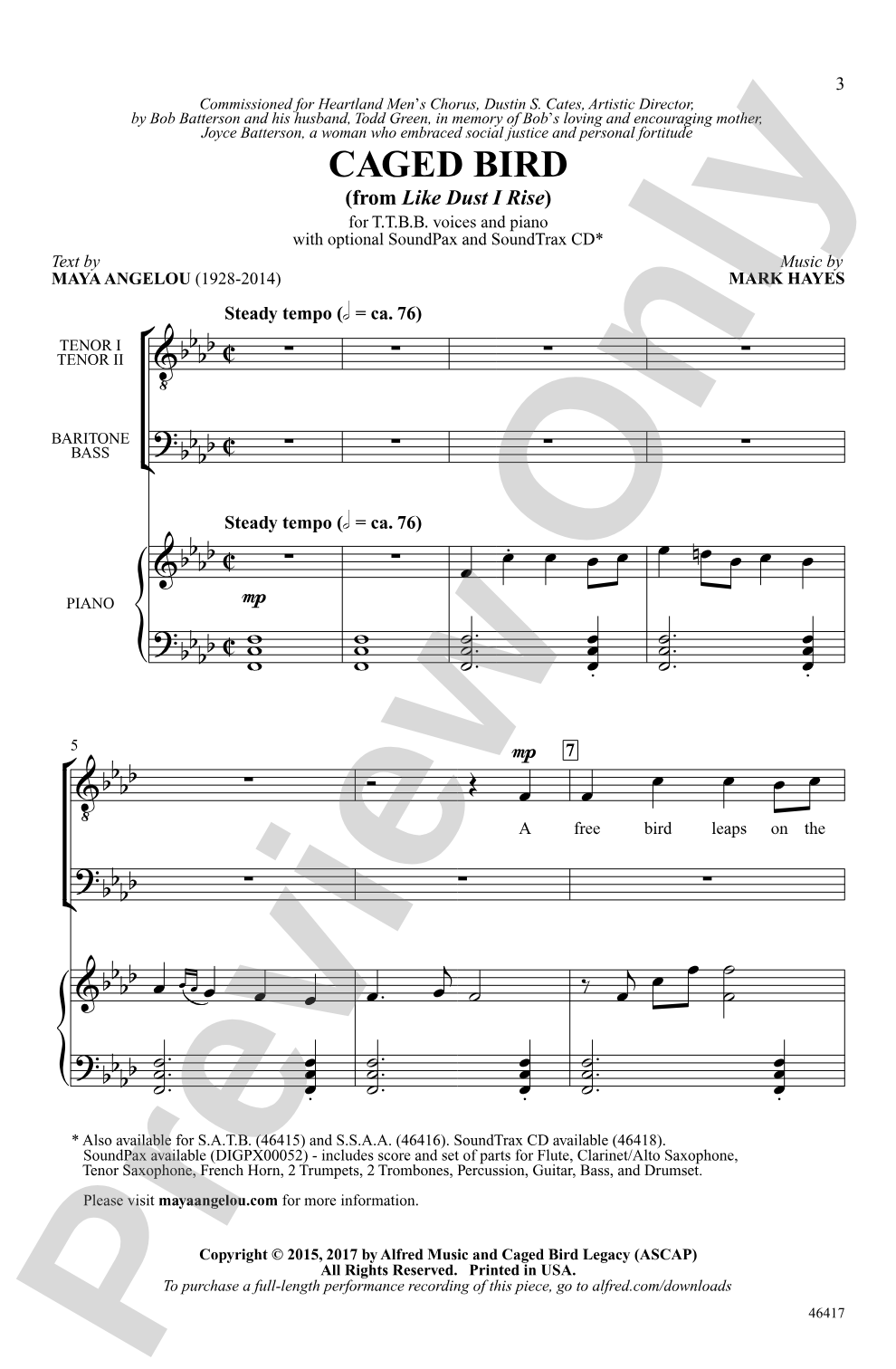
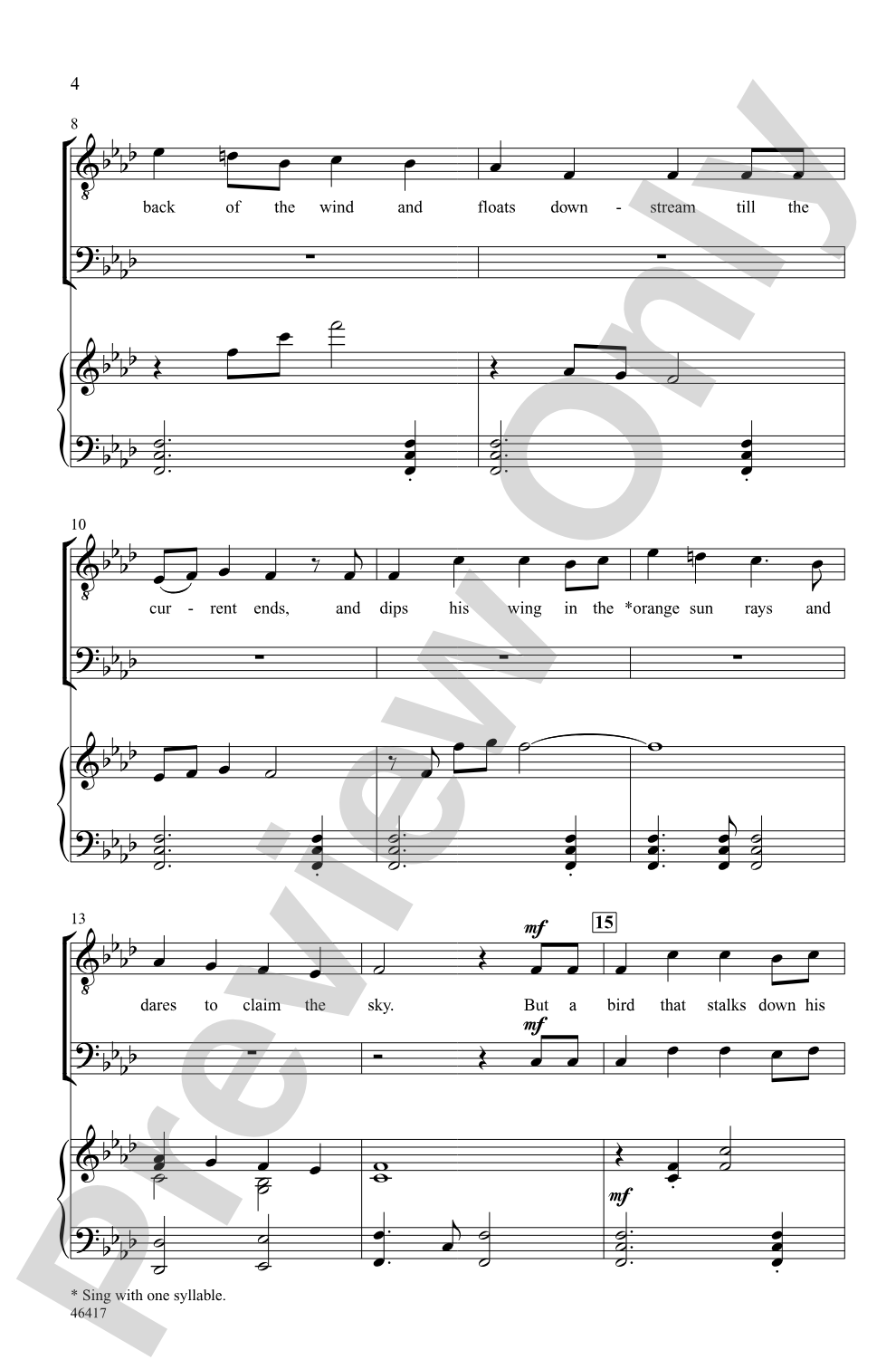

Caged Bird: TTBB Choral Octavo
From Like Dust I Rise (A Choral Song Cycle)
Text by Maya Angelou, music by Mark Hayes
Item: 00-PO-0005655
$1.90
Minimum order quantity: 20 copies
Pickup currently not available
Related Items
Caged Bird: SoundTrax Digital Audio Download |
$29.99
|
View | |
Caged Bird: SATB Choral Octavo |
$1.90
|
View | |
Caged Bird: SSAA Choral Octavo |
$1.90
|
View | |
Caged Bird: Choral SoundPax |
$50.00
|
View | |
Caged Bird: SATB Choral Octavo |
$1.90
|
View | |
Caged Bird: SSAA Choral Octavo |
$1.90
|
View | |
Caged Bird: TTBB Choral Octavo |
$1.90
|
View | |
Caged Bird: Choral Octavo SoundTrax CD |
$29.99
|
View | |
Caged Bird: Choral SoundPax |
$50.00
|
View |
Description
A folk-like setting of Maya Angelou's empowering poem, which compares a bird's longing to be liberated with that of all people. Hayes chooses a minor key with plenty of harmonic tension and a walking tempo that suggests the footsteps of those who have come before. The final Picardy third is the ultimate symbol of freedom. This is the second movement from the song cycle Like Dust I Rise.


Caged Bird: TTBB Choral Octavo isn't in MakeMusic Cloud just yet...but it could be. Let us know you'd like to see it, and you'll help shape what comes next. In the meantime, start a free trial and dive into thousands of interactive titles your students can play along with today.
Request This Title
Tell us you want it.
Start Your Free Trial
Explore everything that's ready to play right now.
Sample Audio
1
Audio File
--:--
2
SATB Recording
--:--
Audio File
0:00
0:00
Sample Video
Additional Details
Series:
Alfred Choral Designs
Publisher:
Alfred Music
Page Count:
12
SKU:
00-PO-0005655
More about this title
About the Composer: Mark Hayes
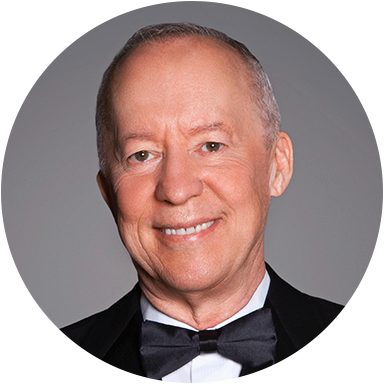
Mark Hayes brings together extensive credentials as a pianist, conductor, and prolific composer with over 1,750 published works across all musical genres. His formal training includes a summa cum laude Bachelor of Music degree in Piano Performance from Baylor University (1975), and his conducting experience spans prestigious venues including Lincoln Center, the National Cathedral, and Carnegie Hall, where he has premiered major works like his Requiem and conducted honor choirs across the Southwest and Midwest.
Beyond classical and sacred music, Hayes has proven himself a versatile creator in musical theatre, orchestration, and record production. His theatrical work includes the score for Civil War Voices (winner of six awards at the 2010 Midtown International Theatre Festival) and orchestrations for productions spanning from Madame Buttermilk to We'll Meet Again. In 2010, Baylor University honored him with the Award for Exemplary Leadership in Christian Music, and his commissions have taken him internationally, including conducting the world premiere of a work he composed for St. Paul's Co-educational College in Hong Kong in 2015.
Why we love this
Hayes transforms Angelou's powerful poem into music that honors its message without melodrama. The harmonic tension in the minor key and the walking tempo create genuine forward momentum, while the surprising Picardy third at the end lands as a earned moment of transcendence rather than cheap uplift. For TTBB singers, this is repertoire that asks them to dig into something musically substantive and emotionally honest.
What to expect
The minor key and walking tempo create an atmosphere of steady, determined movement. There's tension throughout, a sense of striving against something, but never despair. When that final Picardy third arrives, it feels like breaking through into light.
Who it's for
TTBB ensembles seeking repertoire that engages both the voice and the intellect. This piece works well for concert choirs, male chamber ensembles, and any director programming music about resilience, freedom, and human dignity. Singers need secure part-singing skills and comfort with contemporary harmonic language.
How to get the most out of it
- Let the walking tempo feel like deliberate movement, not restlessness. The piece asks for steady forward progress, so lock in your quarter-note pulse and trust the harmonic journey to carry the emotional weight.
- Balance the harmonic complexity across all four voices without letting any line disappear. This is not background music; each part contributes to the tension Hayes builds before that final resolution.
- Shape the text with care. Angelou's words deserve clarity and intention, so communicate the meaning of each phrase even as you manage the music's technical demands.
- Prepare the Picardy third as a genuine surprise. If your singers understand it's coming and what it symbolizes (the major chord shift suggesting liberation), they'll sell that final moment with conviction rather than confusion.
How to use it
Pair this with other works exploring themes of freedom and social justice for a powerful program arc. It also stands alone beautifully as a concert centerpiece or as part of a service focused on peace and brotherhood. The 12-page octavo is substantial enough to anchor a set without overwhelming your rehearsal time.
Skills your students will build
- Reading and singing minor key tonality with clear harmonic function
- Balancing complex four-part harmony while maintaining individual line integrity
- Text expression and emotional communication within contemporary harmonic contexts
- Understanding enharmonic reinterpretation and tonal shifts (the Picardy third as compositional device)
- Steady rhythmic pulse and forward momentum in a walking tempo