
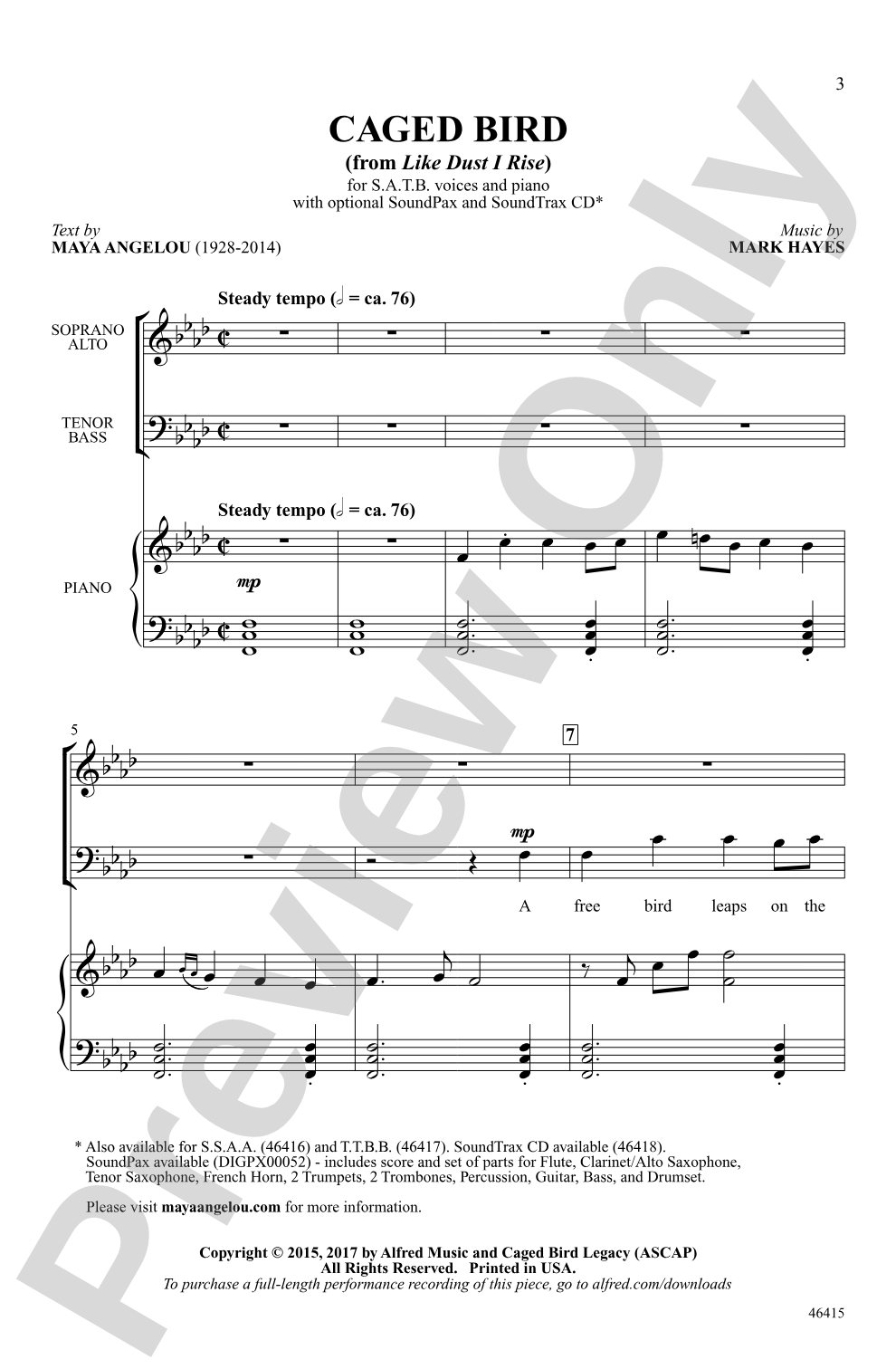
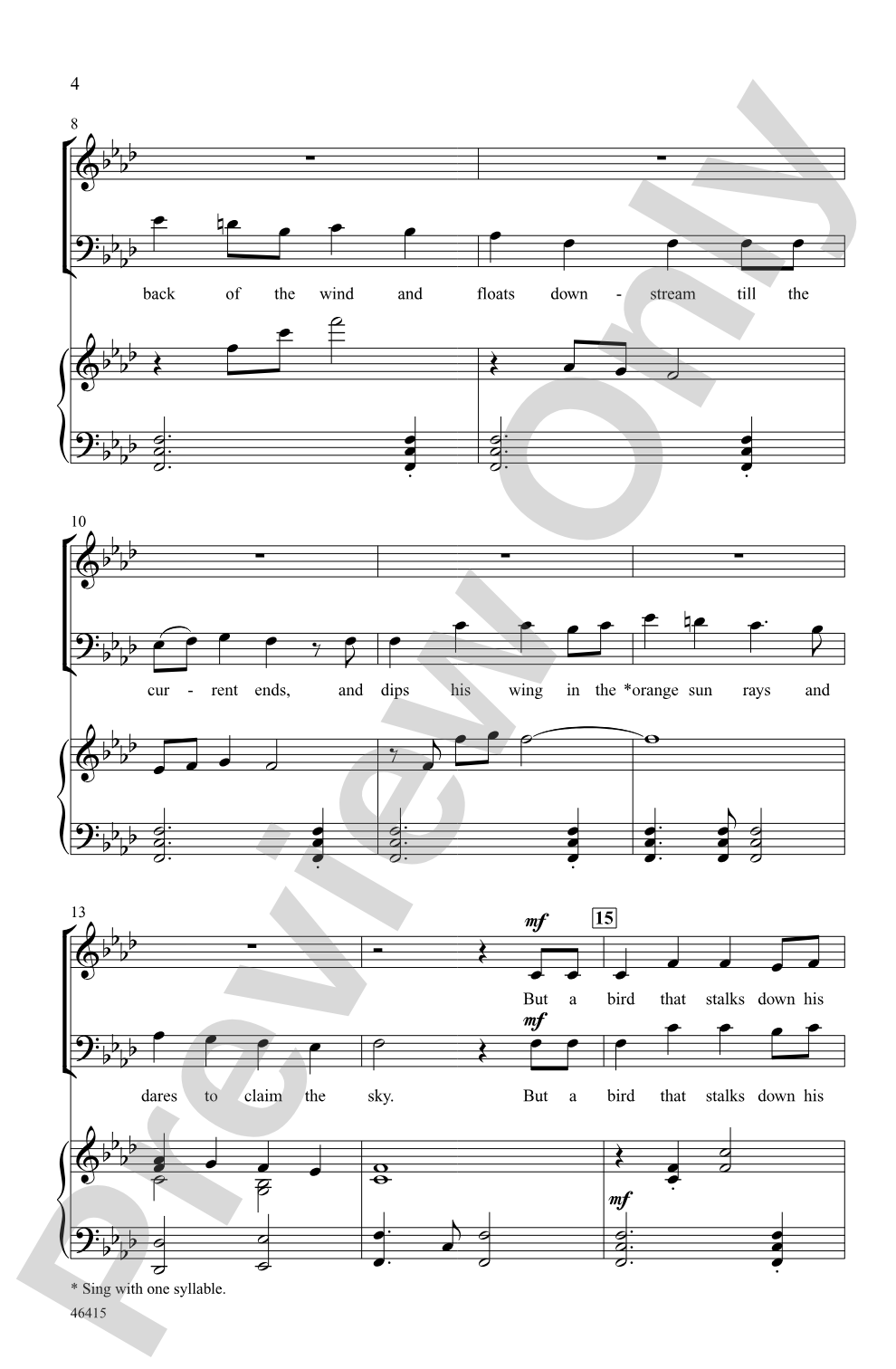

Caged Bird: SATB Choral Octavo
From Like Dust I Rise (A Choral Song Cycle)
Text by Maya Angelou, music by Mark Hayes
Item: 00-PO-0005653
$1.90
Minimum order quantity: 20 copies
Pickup currently not available
Related Items
Caged Bird: SoundTrax Digital Audio Download |
$29.99
|
View | |
Caged Bird: SSAA Choral Octavo |
$1.90
|
View | |
Caged Bird: TTBB Choral Octavo |
$1.90
|
View | |
Caged Bird: Choral SoundPax |
$50.00
|
View | |
Caged Bird: SATB Choral Octavo |
$1.90
|
View | |
Caged Bird: SSAA Choral Octavo |
$1.90
|
View | |
Caged Bird: TTBB Choral Octavo |
$1.90
|
View | |
Caged Bird: Choral Octavo SoundTrax CD |
$29.99
|
View | |
Caged Bird: Choral SoundPax |
$50.00
|
View |
Description
A folk-like setting of Maya Angelou's empowering poem, which compares a bird's longing to be liberated with that of all people. Hayes chooses a minor key with plenty of harmonic tension and a walking tempo that suggests the footsteps of those who have come before. The final Picardy third is the ultimate symbol of freedom. This is the second movement from the song cycle Like Dust I Rise.


Caged Bird: SATB Choral Octavo isn't in MakeMusic Cloud just yet...but it could be. Let us know you'd like to see it, and you'll help shape what comes next. In the meantime, start a free trial and dive into thousands of interactive titles your students can play along with today.
Request This Title
Tell us you want it.
Start Your Free Trial
Explore everything that's ready to play right now.
Sample Audio
1
Audio File
--:--
2
SATB Recording
--:--
Audio File
0:00
0:00
Sample Video
Additional Details
Series:
Alfred Choral Designs
Publisher:
Alfred Music
Page Count:
12
SKU:
00-PO-0005653
More about this title
About the Composer: Mark Hayes
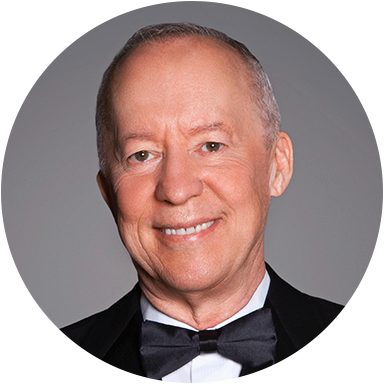
Mark Hayes has established himself as a prolific composer and arranger with more than 1,750 published works spanning classical, sacred, and secular genres. A summa cum laude graduate in Piano Performance from Baylor University (1975), Hayes has conducted major venues including Lincoln Center, the National Cathedral, and Carnegie Hall, while also serving as guest conductor for regional honor choirs. His compositional output ranges widely, from large-scale sacred works like his Requiem (premiered at Lincoln Center in 2013) to intimate choral settings, piano collections, and musical theater scores.
Beyond concert hall commissions, Hayes has composed for educational contexts and international celebrations, including a work for treble and mixed voices with orchestra that premiered in Hong Kong in 2015. His orchestrations and arrangements have contributed to theatrical productions, and his catalog includes over 100 piano books in styles from gospel to jazz. In 2010, Baylor University recognized his contributions to Christian music education with its Award for Exemplary Leadership. Based in Kansas City, Missouri, Hayes continues to compose, conduct, and record.
Why we love this
Hayes transforms Angelou's poem into a vocal experience that honors both the text and its emotional weight through harmonic sophistication rather than surface brightness. The minor-key setting and strategic use of tension demand something real from singers; this isn't decorative choral writing. The Picardy third at the close delivers a moment of transcendence that will land differently every time your singers experience it, making this piece something that grows with repetition and reflection.
What to expect
Restrained and purposeful, like a voice speaking truth without performative emotion. The minor tonality and walking tempo create forward motion that feels deliberate rather than urgent, while the harmonic language adds color and complexity that invites listeners inward. The final Picardy third breaks the spell and opens a window to light.
Who it's for
This octavo works for treble-heavy adult choirs, community choruses with intermediate-advanced singers, and high school honor choirs ready for music that engages both technically and emotionally. Directors seeking repertoire that connects poetry to social themes will find this particularly valuable for concerts centered on peace, human dignity, or civil rights.
How to get the most out of it
- Establish the walking tempo early in rehearsal and maintain it with precision throughout. Hayes uses the steady pulse as metaphor, so rhythmic consistency from all four voices strengthens the text's message.
- Shape the harmonic tension carefully rather than smoothing it away. The minor tonality and chromatic movement shouldn't feel uncomfortable; they should feel intentional and purposeful.
- Prepare singers for the Picardy third by explaining its historical context as a symbol of resolution and hope. This final shift deserves a moment of lift and brightness that contrasts with everything preceding it.
- Balance the SATB texture so that no single voice line dominates. Hayes writes all four parts as active participants in the musical argument, not as support for a solo line.
How to use it
Pair this as a centerpiece for a thematic program on freedom, resilience, or justice, where it can anchor a set of complementary secular works. Alternatively, program it alongside Hayes's other song cycle movements or other contemporary settings of African American poetry and prose. Its 12-page length makes it substantial enough to command attention without requiring an entire concert devoted to a single piece.
Skills your students will build
- Sustaining ensemble intonation through extended minor-key passages with chromatic movement
- Balancing independent voice lines in four-part harmony without prioritizing melody over texture
- Interpreting text through musical gesture, connecting poetic language to harmonic and rhythmic choices
- Managing harmonic tension and resolution, including the tonal shift in the final Picardy third