
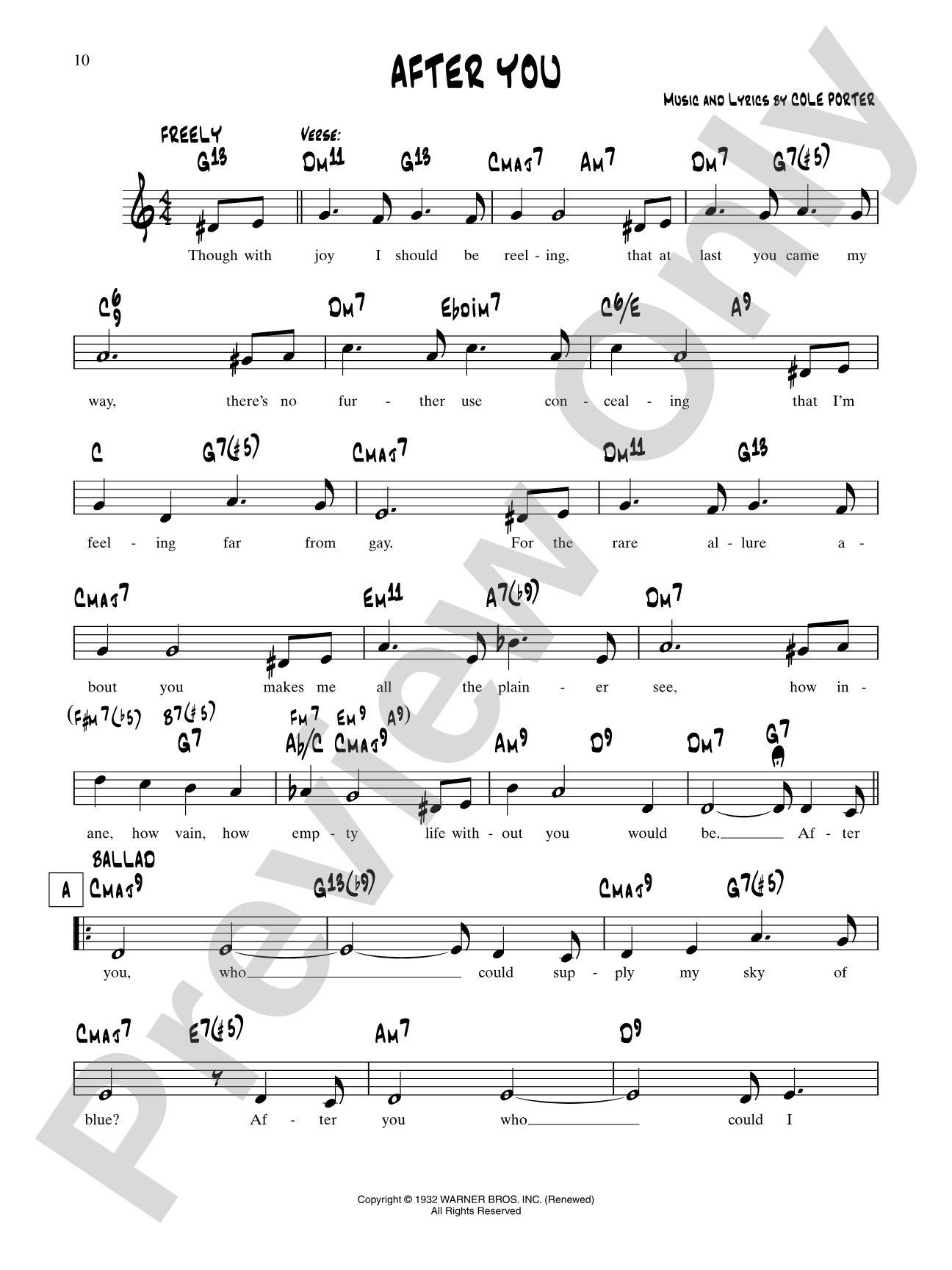

After You, Who?: Lead Sheet
Cole Porter
Item: 00-PSL-000263
$4.99
One moment…
Description
Titles include: After You, Who? * All of You * All Through the Night * Another Op'nin', Another Show * Anything Goes * At Long Last Love * Be a Clown * Begin the Beguine * Don't Fence Me In * Easy to Love * I Concentrate on You * I Get a Kick Out of You * I Love Paris * I've Got You Under My Skin * In the Still of the Night * Just One of Those Things * Let's Do It (Let's Fall in Love) * Love for Sale * Night and Day * What Is This Thing Called Love? * You Do Something to Me * You're the Top.


After You, Who?: Lead Sheet isn't in MakeMusic Cloud just yet...but it could be. Let us know you'd like to see it, and you'll help shape what comes next. In the meantime, start a free trial and dive into thousands of interactive titles your students can play along with today.
Request This Title
Tell us you want it.
Start Your Free Trial
Explore everything that's ready to play right now.
Sample Audio
No sample audio found.
Sample Video
No sample videos found.
Additional Details
Series:
American Songwriters Series
Publisher:
Alfred Music
Page Count:
96
SKU:
00-PSL-000263
More about this title
About the Artist: Cole Porter
Cole Porter (1891-1964) stands as one of Broadway's most sophisticated songwriters, known for witty lyrics, unexpected harmonic turns, and melodies that lodge instantly in memory. His contributions shaped American musical theatre across four decades, from the 1920s through the 1950s, and his songs remain central to jazz and standards repertoire worldwide.
Porter's gift for clever wordplay and urbane sophistication set him apart from his contemporaries. He composed and wrote lyrics for his own songs, a rarity among Broadway composers, allowing his distinctive voice to shape both music and text. His work rewards close attention from singers and pianists alike, offering harmonic sophistication wrapped in apparent simplicity.
Why we love this
These 22 essential Porter standards provide singers and pianists with repertoire that develops interpretive maturity and harmonic awareness. The collection balances accessibility with sophistication; even familiar melodies reveal new layers when you engage with Porter's chord progressions and lyrical nuance. Programming any of these pieces signals serious musical intent to your audience.
What to expect
Elegant and knowing, these songs invite you into a world of clever sophistication. The melodies feel inevitable once you learn them, yet the harmonies keep surprising you with unexpected turns and sophisticated substitutions that reward repeated listening.
Who it's for
Vocalists preparing for auditions, recitals, or jazz standards repertoire will find essential material here. Pianists looking to deepen their understanding of jazz harmony and American songwriting craftsmanship can build foundation and improvisation skills from these lead sheets.
How to get the most out of it
- Pay attention to Porter's chromatic harmonic movement and unexpected chord substitutions. These details distinguish his arrangements from simpler lead sheet reductions, and singing or playing through them cleanly requires precision.
- Use the lyrical rhythm as your guide when learning the melody. Porter's phrasing often anticipates or delays the downbeat deliberately, and respecting his text rhythm creates authentic interpretation.
- Treat the chord symbols as suggestions for exploration rather than fixed voicings. These standards have been reharmonized countless ways; find voicings that suit your voice type or pianistic range.
- Balance the sophistication of the harmony with directness in your delivery. Porter's wit lands best when performed with confidence rather than overindulgence.
How to use it
Select individual standards to pair with art song or classical material, creating a programming statement about American musical heritage. These pieces work equally well in recital settings, casual performance contexts, or as a complete Cole Porter evening.
Skills your students will build
- Reading lead sheet notation and interpreting chord symbols
- Navigating chromatic harmony and jazz-inflected chord substitutions
- Coordinating lyrical phrasing with harmonic rhythm
- Developing interpretive choices within familiar standards
- Building sight-reading fluency in jazz and popular music idioms