
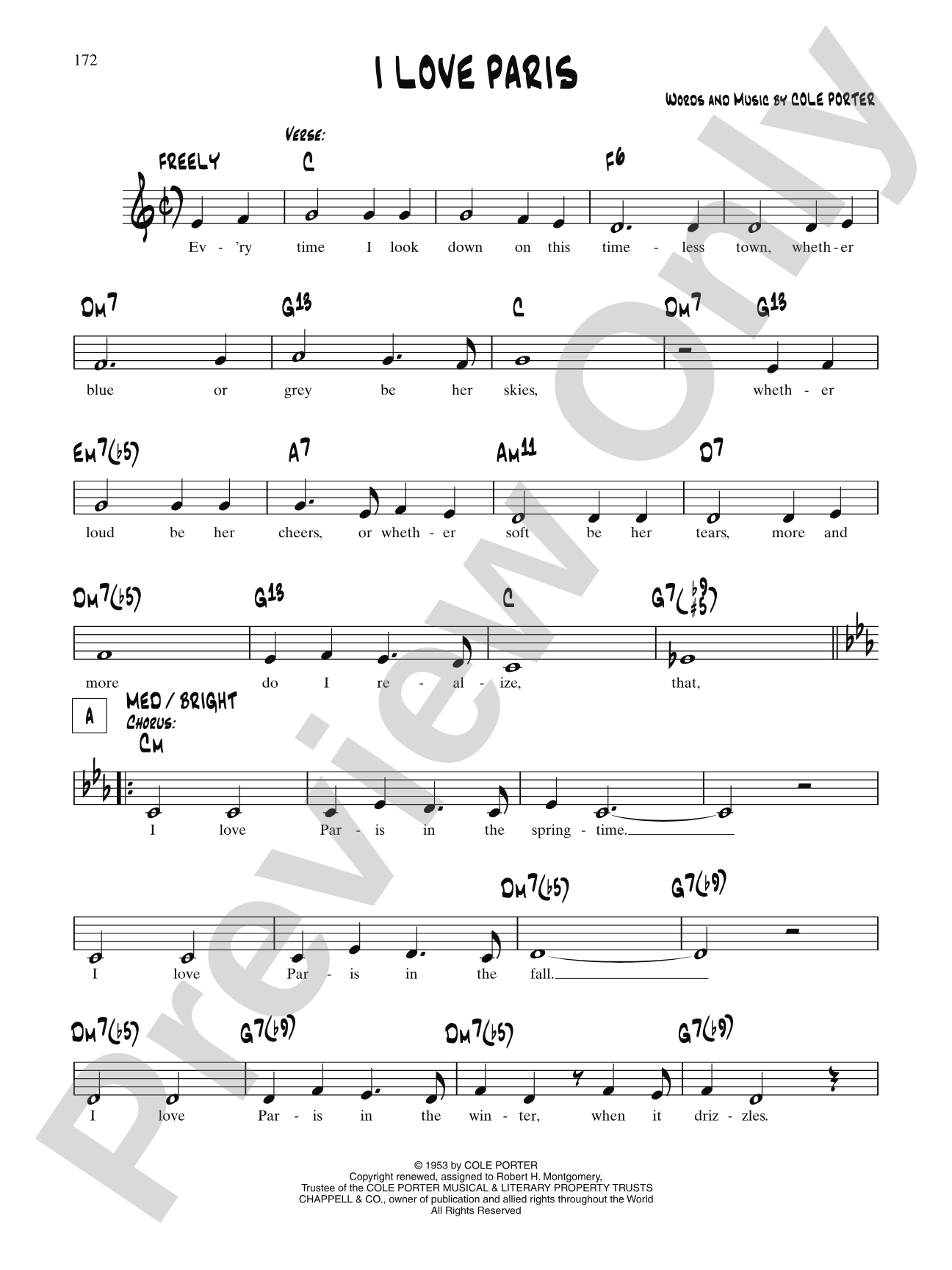

I Love Paris (From "Can-can"): Lead Sheet
Cole Porter
Item: 00-PSL-000346
$4.99
One moment…
Description
Titles include: After You, Who? * All of You * All Through the Night * Another Op'nin', Another Show * Anything Goes * At Long Last Love * Be a Clown * Begin the Beguine * Don't Fence Me In * Easy to Love * I Concentrate on You * I Get a Kick Out of You * I Love Paris * I've Got You Under My Skin * In the Still of the Night * Just One of Those Things * Let's Do It (Let's Fall in Love) * Love for Sale * Night and Day * What Is This Thing Called Love? * You Do Something to Me * You're the Top.


I Love Paris (From "Can-can"): Lead Sheet isn't in MakeMusic Cloud just yet...but it could be. Let us know you'd like to see it, and you'll help shape what comes next. In the meantime, start a free trial and dive into thousands of interactive titles your students can play along with today.
Request This Title
Tell us you want it.
Start Your Free Trial
Explore everything that's ready to play right now.
Sample Audio
No sample audio found.
Sample Video
No sample videos found.
Additional Details
Series:
American Songwriters Series
Publisher:
Alfred Music
Page Count:
96
SKU:
00-PSL-000346
More about this title
About the Artist: Cole Porter
Cole Porter (1891–1964) was an American composer and lyricist whose sophisticated melodies and witty, urbane lyrics defined the golden age of American musical theater. Born into a wealthy family in Indiana, Porter studied at Yale and later in Paris, where he absorbed the musical influences that would shape his distinctive style. His songs are marked by chromatic harmonies, unexpected key changes, and clever rhyme schemes that challenged performers and audiences alike.
Porter's catalog includes some of the most recorded standards in American music. His works for stage and film showcase his ability to write for both intimate jazz settings and grand theatrical productions. His songs remain central to the jazz repertoire and continue to challenge and delight singers, pianists, and musicians across all genres.
Why we love this
This collection captures Porter's mastery of the standard form in its most concentrated form. Every song here rewards close attention to harmony and lyrical detail, making it an ideal resource for jazz singers, piano students, and musicians building a foundation in American songbook repertoire. The breadth of styles within Porter's output—from up-tempo novelty numbers to introspective ballads—gives performers room to explore different interpretive approaches and vocal or instrumental textures.
What to expect
Cole Porter's world is one of elegance and wit, where sophisticated harmony dances with clever wordplay and genuine emotion. These songs evoke a glamorous, urbane sensibility—cocktail lounges and Broadway theaters, romance and humor intertwined. Whether playful and syncopated or deeply introspective, each song carries an unmistakable quality of refinement and intelligence that invites performers to match its sophistication with their own musicianship.
Who it's for
This lead sheet collection serves singers preparing auditions or expanding their standards repertoire, pianists and guitarists accompanying jazz or theater students, and music theory students studying mid-20th-century harmonic practice. It's equally valuable for jazz ensembles seeking authentic chart material and for music programs building a systematic introduction to American musical theater composition.
How to get the most out of it
- Pay special attention to Porter's chromatic voice leading and unexpected harmonic resolutions; these create the sophistication that makes the songs feel contemporary even decades later.
- Use the chord symbols to explore reharmonization possibilities, particularly on repeated sections where Porter's original chords can support modern jazz voicings.
- Notice how Porter's lyrics often contain internal rhymes and rhythmic complexities that demand careful diction and phrasing from singers.
- Trust the melismatic passages and wider intervallic leaps; they're written to showcase vocal control and musicality, not to complicate delivery.
How to use it
Integrate individual Porter songs into jazz repertoire classes, music history units focused on Broadway and American standards, or concert programming that explores the development of song form in the 20th century. This collection works well as a reference resource for private voice and piano teachers introducing students to the standards, and as a foundation for jazz combos or piano trio repertoire. Consider pairing multiple Porter selections in a recital to highlight his range across comedic, romantic, and introspective material.
Skills your students will build
- Reading and interpreting lead sheets with complex chord progressions
- Navigating chromatic harmony and unexpected harmonic resolutions
- Understanding song form and phrase architecture in the American standard
- Aligning vocal phrasing and diction with rhythmically complex lyrical content
- Recognizing and performing swing rhythms and jazz inflections in a theatrical context