
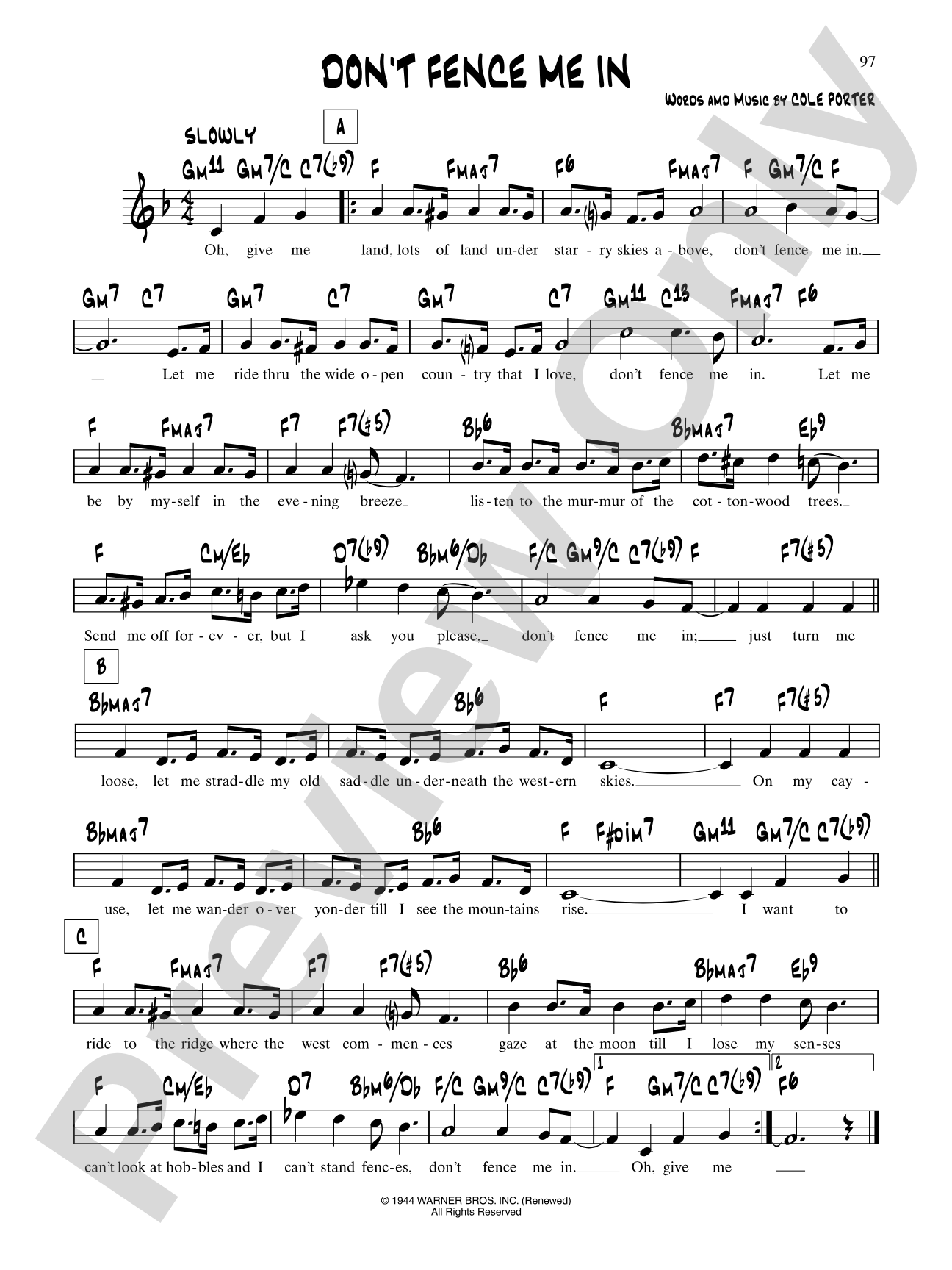

Don't Fence Me In (From "Hollywood Canteen"): Lead Sheet
Cole Porter
Item: 00-PSL-000274
$4.99
One moment…
Description
Titles include: After You, Who? * All of You * All Through the Night * Another Op'nin', Another Show * Anything Goes * At Long Last Love * Be a Clown * Begin the Beguine * Don't Fence Me In * Easy to Love * I Concentrate on You * I Get a Kick Out of You * I Love Paris * I've Got You Under My Skin * In the Still of the Night * Just One of Those Things * Let's Do It (Let's Fall in Love) * Love for Sale * Night and Day * What Is This Thing Called Love? * You Do Something to Me * You're the Top.


Don't Fence Me In (From "Hollywood Canteen"): Lead Sheet isn't in MakeMusic Cloud just yet...but it could be. Let us know you'd like to see it, and you'll help shape what comes next. In the meantime, start a free trial and dive into thousands of interactive titles your students can play along with today.
Request This Title
Tell us you want it.
Start Your Free Trial
Explore everything that's ready to play right now.
Sample Audio
No sample audio found.
Sample Video
No sample videos found.
Additional Details
Series:
American Songwriters Series
Publisher:
Alfred Music
Page Count:
96
SKU:
00-PSL-000274
More about this title
About the Artist: Cole Porter
Cole Porter (1891-1964) was an American composer and lyricist who dominated musical theatre for four decades, creating some of the most sophisticated and witty songs ever written for Broadway and film. His melodies balanced accessibility with harmonic complexity, while his lyrics combined clever wordplay, urbane humor, and genuine emotional depth, making his standards enduringly popular with jazz singers, cabaret performers, and classical musicians alike.
Why we love this
This collection captures the breadth of Porter's compositional genius across multiple decades of Broadway and Hollywood output. Each song presents distinct harmonic language and lyrical sophistication, giving pianists and singers genuine interpretive choices rather than formulaic material. Programming selections from this book alongside classical repertoire or other American songbook titles demonstrates the legitimacy of popular song as serious musical literature.
What to expect
These songs embody the glamour and wit of 1930s-1940s Broadway and Hollywood, blending sophisticated harmonies with conversational, often playful lyrics. Whether you're performing a romantic ballad or a rhythmic novelty number, Porter's writing conveys elegance without pretension, making these pieces feel both polished and genuinely human.
Who it's for
Pianists and singers preparing audition material, recital programs, or jazz-influenced repertoire will find a comprehensive resource here. Music educators teaching American musical theatre history or introducing students to standards will value the range and quality of these 22 pieces.
How to get the most out of it
- Recognize the harmonic language in each piece: Porter's chord progressions often favor unexpected resolutions and chromatic voice leading that reward careful attention to the written accompaniment.
- Approach the lyrics with dramatic intention rather than casual delivery. Porter's wit and wordplay demand clarity and rhythmic precision to land effectively.
- Use the chord symbols to understand harmonic structure and improvise or reharmonize sections for solo performance, especially valuable if performing multiple pieces in sequence.
- Balance the sophistication of the accompaniment with accessibility in your interpretation; these songs work best when they sound conversational and natural despite their compositional craft.
How to use it
Create a themed recital or concert segment exploring American songbook standards, or pair individual Porter pieces with classical art song to demonstrate the legitimacy of Great American Songbook material in formal performance contexts. This collection also serves well as a teaching source for students exploring jazz harmony, lyrical interpretation, and the bridge between classical and popular music traditions.
Skills your students will build
- Reading and interpreting chord symbol notation
- Understanding sophisticated harmonic progressions and chromatic voice leading
- Singing or playing with rhythmic precision and lyrical clarity
- Interpreting and performing with appropriate stylistic nuance for each song
- Improvising accompaniments and reharmonizing melodies