
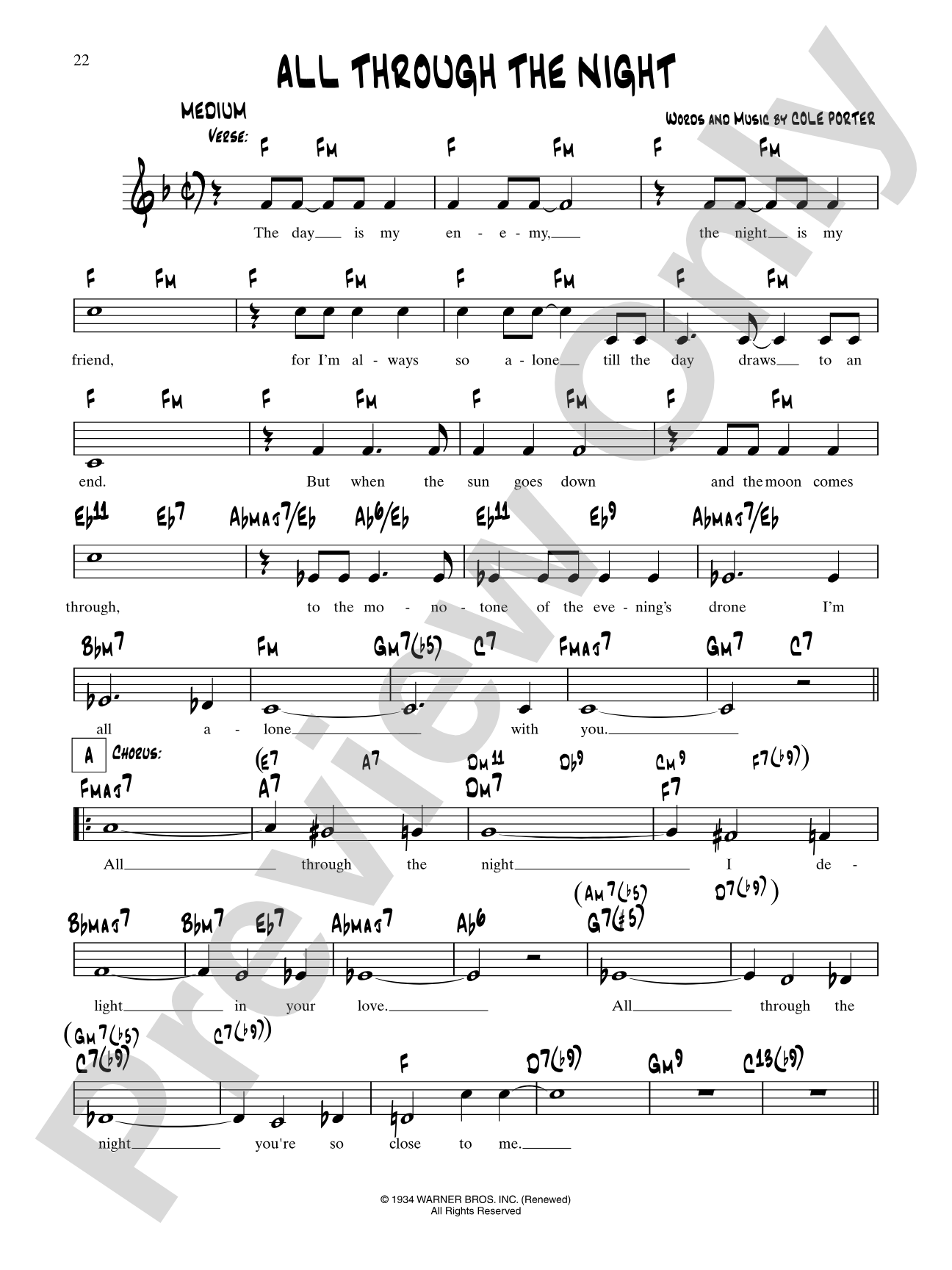

All Through The Night: Lead Sheet
Cole Porter
Item: 00-PSL-000268
$4.99
One moment…
Description
Titles include: After You, Who? * All of You * All Through the Night * Another Op'nin', Another Show * Anything Goes * At Long Last Love * Be a Clown * Begin the Beguine * Don't Fence Me In * Easy to Love * I Concentrate on You * I Get a Kick Out of You * I Love Paris * I've Got You Under My Skin * In the Still of the Night * Just One of Those Things * Let's Do It (Let's Fall in Love) * Love for Sale * Night and Day * What Is This Thing Called Love? * You Do Something to Me * You're the Top.


All Through The Night: Lead Sheet isn't in MakeMusic Cloud just yet...but it could be. Let us know you'd like to see it, and you'll help shape what comes next. In the meantime, start a free trial and dive into thousands of interactive titles your students can play along with today.
Request This Title
Tell us you want it.
Start Your Free Trial
Explore everything that's ready to play right now.
Sample Audio
No sample audio found.
Sample Video
No sample videos found.
Additional Details
Series:
American Songwriters Series
Publisher:
Alfred Music
Page Count:
96
SKU:
00-PSL-000268
More about this title
About the Artist: Cole Porter
Cole Porter (1891-1964) composed some of the twentieth century's most elegant and witty songs, establishing himself as a master of sophisticated melody and urbane lyrical wordplay. His Broadway musicals and film scores became the foundation of the American standard repertoire, influencing generations of jazz musicians, pop singers, and music theater performers. Porter's harmonic language was advanced for its time, featuring unexpected chord progressions and chromatic movement that rewarded close listening and musical literacy.
Why we love this
This collection gathers Porter's most teachable standards in lead sheet format, giving pianists and singers direct access to the melodies, harmonies, and lyrical wit that define his songwriting. The piano-vocal-chords layout supports both solo study and collaborative rehearsal, making it equally valuable for music theater preparation, jazz standards study, or simply exploring one of America's most distinctive compositional voices. These songs reward repeated listening and performance; each reveals new harmonic sophistication and melodic craft with familiarity.
What to expect
These songs inhabit a world of elegant sophistication and clever wordplay, where sophisticated harmony meets singable melody. Whether performing "Night and Day" or "Anything Goes," you're engaging with music that feels both timeless and immediately recognizable, shaped by a composer who understood how to balance musical complexity with genuine expressivity. There's a sense of refinement and wit throughout; Porter never sacrificed substance for style.
Who it's for
Pianists preparing for auditions, recitals, or music theater repertoire study will find these standards essential. Singers building their standards repertoire benefit from the lead sheet format, which pairs melody with full harmonic information for intelligent interpretation. Jazz musicians and contemporary music theater students deepen their understanding of American songwriting fundamentals through Porter's inventive harmonic language.
How to get the most out of it
- Lean into the harmonic language. Porter's chord choices are deliberate and often unexpected; resist the urge to simplify or rush through changes. Let them breathe.
- Shape phrases by the lyrical content, not just the bar lines. Porter matched melody and text with precision, so understanding the text clarifies the musical intention.
- Listen to multiple recorded interpretations before settling on your own approach. These songs have been recorded by everyone from Frank Sinatra to Ella Fitzgerald to modern interpreters, each revealing different facets of the same composition.
- Balance the sophistication of the harmony with clarity in performance. The chords should serve the melody and lyric, never overshadow them.
How to use it
Program these songs in a standards recital or music theater concert to anchor your program with repertoire that audiences know and love. Solo pianists can explore Porter's compositional craft across different moods and styles within a single concert. For music theater curricula, use individual selections as audition material, study pieces, or preparation for Broadway-influenced performance work.
Skills your students will build
- Reading lead sheets with jazz-influenced chord symbols and extensions
- Interpreting chromatic voice leading and unexpected harmonic progressions
- Balancing lyrical clarity with harmonic sophistication in performance
- Collaborating between piano and voice using the vocal line and accompaniment layout
- Developing interpretive choices based on textual and musical nuance