
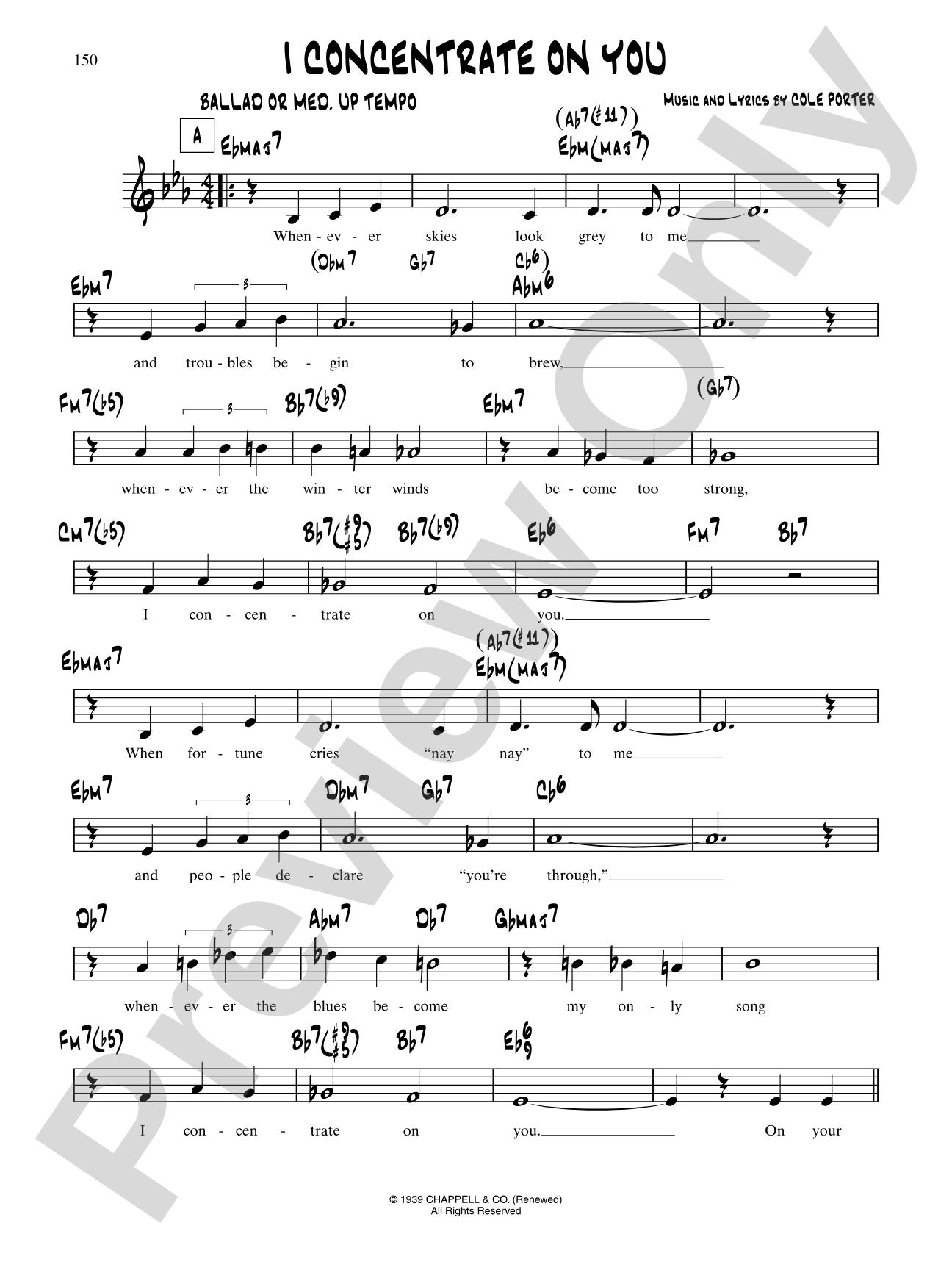

I Concentrate On You: Lead Sheet
Cole Porter
Item: 00-PSL-000345
$4.99
One moment…
Description
Titles include: After You, Who? * All of You * All Through the Night * Another Op'nin', Another Show * Anything Goes * At Long Last Love * Be a Clown * Begin the Beguine * Don't Fence Me In * Easy to Love * I Concentrate on You * I Get a Kick Out of You * I Love Paris * I've Got You Under My Skin * In the Still of the Night * Just One of Those Things * Let's Do It (Let's Fall in Love) * Love for Sale * Night and Day * What Is This Thing Called Love? * You Do Something to Me * You're the Top.


I Concentrate On You: Lead Sheet isn't in MakeMusic Cloud just yet...but it could be. Let us know you'd like to see it, and you'll help shape what comes next. In the meantime, start a free trial and dive into thousands of interactive titles your students can play along with today.
Request This Title
Tell us you want it.
Start Your Free Trial
Explore everything that's ready to play right now.
Sample Audio
No sample audio found.
Sample Video
No sample videos found.
Additional Details
Series:
American Songwriters Series
Publisher:
Alfred Music
Page Count:
96
SKU:
00-PSL-000345
More about this title
About the Artist: Cole Porter
Cole Porter (1891-1964) stands as one of the most sophisticated and witty songwriters in American musical theater history. His ability to craft elegant melodies paired with clever, urbane lyrics made him a dominant force on Broadway from the 1920s through the 1950s, producing standards that remain central to the jazz and theater repertoire today.
Why we love this
Porter's catalog reads like a masterclass in songwriting craft. These 22 standards showcase his signature harmonic sophistication and memorable hooks, making them ideal for singers developing jazz phrasing and pianists building their foundation in comping and voicing. Whether students are preparing auditions, learning to navigate lead sheets, or discovering why these tunes have endured for a century, this collection offers repertoire that rewards careful listening and repeated performance.
What to expect
Sophisticated, urbane, and endlessly clever. Porter's melodies are luxurious and singable, yet his harmonies surprise you with chromatic movement and witty resolutions. These songs feel like walking through a glamorous, mid-century nightclub where every phrase carries both warmth and an undercurrent of clever irony.
Who it's for
Pianists and singers preparing jazz or musical theater repertoire will find this collection essential. It serves students building their knowledge of American standards, vocalists developing their ability to interpret a lead sheet independently, and instrumentalists learning to comp and improvise over changes that defined the jazz tradition.
How to get the most out of it
- Approach the harmony with attention to Porter's chromatic voice leading and unexpected chord substitutions; mark your lead sheet with the implied voice movements to strengthen your accompaniment choices.
- Listen to multiple recorded interpretations (Ella Fitzgerald, Frank Sinatra, Billie Holiday) to hear how great singers navigate Porter's lyrics and phrasing; notice how they shape the rhythm within the song's structure rather than rushing.
- Use the chord symbols to explore comping textures on piano; Porter's standards reward both sparse, spacious playing and fuller voicings depending on the song's mood and tempo.
- Pay special attention to the lyrics and their relationship to the melodic contour; Porter often places syllabic emphasis in unexpected places that can shift how you interpret the rhythm.
How to use it
Build a concert around American songbook standards by pairing these titles with instrumental jazz trio arrangements or featuring multiple singers in turn. Alternatively, use selections from this collection as accompaniment-optional recital or audition repertoire for voice and piano students throughout the year. These pieces work equally well in a formal concert setting or an informal salon-style performance.
Skills your students will build
- Reading and interpreting lead sheet notation (melody, chord symbols, form)
- Harmonic analysis of chromatic voice leading and jazz-influenced substitutions
- Piano comping and voicing choices over standard jazz changes
- Vocal phrasing and rhythmic flexibility within a structured song form
- Understanding lyrical content and how it informs musical interpretation