
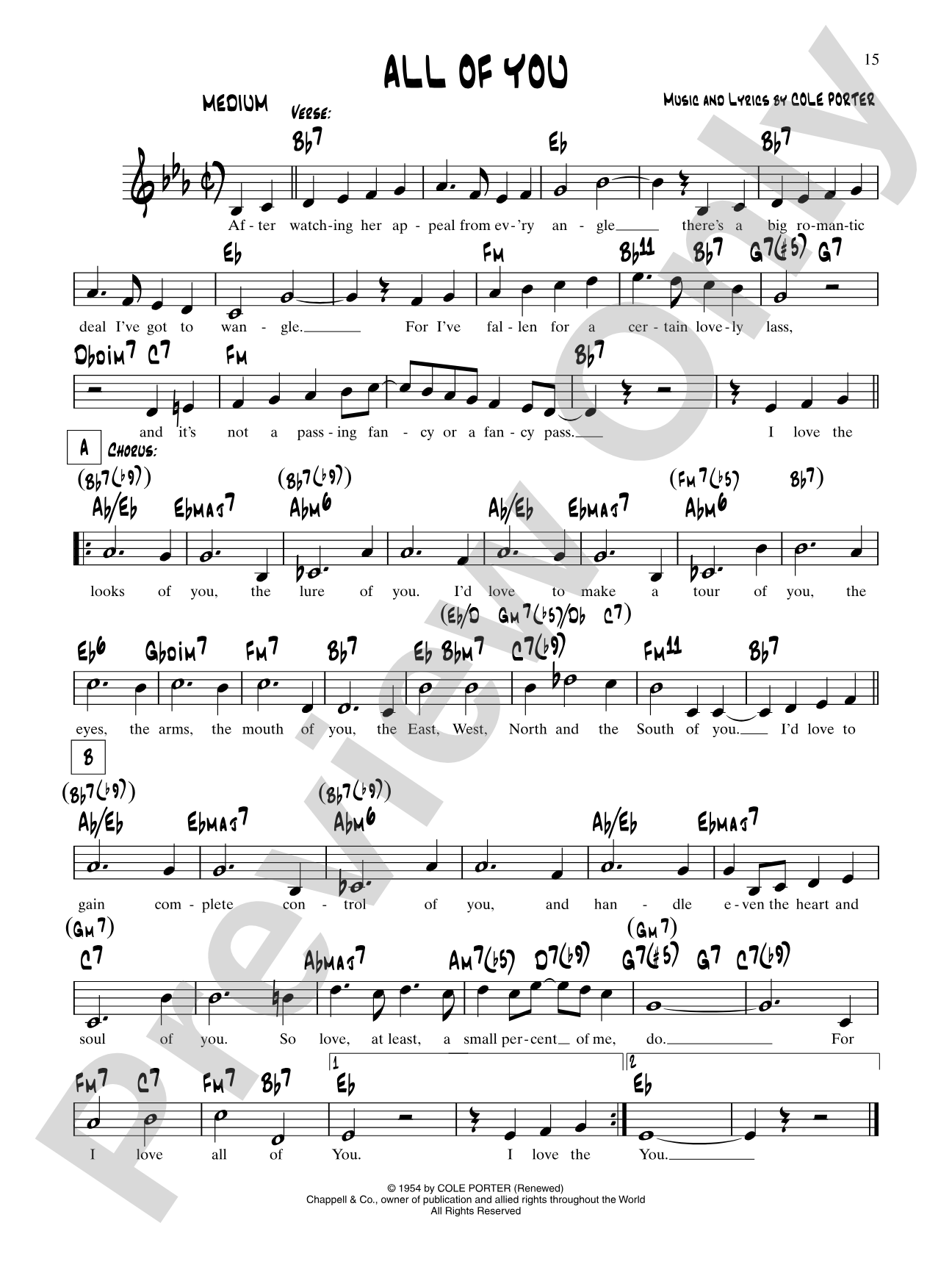

All Of You: Lead Sheet
Cole Porter
Item: 00-PSL-000342
$4.99
One moment…
Description
Titles include: After You, Who? * All of You * All Through the Night * Another Op'nin', Another Show * Anything Goes * At Long Last Love * Be a Clown * Begin the Beguine * Don't Fence Me In * Easy to Love * I Concentrate on You * I Get a Kick Out of You * I Love Paris * I've Got You Under My Skin * In the Still of the Night * Just One of Those Things * Let's Do It (Let's Fall in Love) * Love for Sale * Night and Day * What Is This Thing Called Love? * You Do Something to Me * You're the Top.


All Of You: Lead Sheet isn't in MakeMusic Cloud just yet...but it could be. Let us know you'd like to see it, and you'll help shape what comes next. In the meantime, start a free trial and dive into thousands of interactive titles your students can play along with today.
Request This Title
Tell us you want it.
Start Your Free Trial
Explore everything that's ready to play right now.
Sample Audio
No sample audio found.
Sample Video
No sample videos found.
Additional Details
Series:
American Songwriters Series
Publisher:
Alfred Music
Page Count:
96
SKU:
00-PSL-000342
More about this title
About the Artist: Cole Porter
Cole Porter (1891-1964) stands as one of America's most sophisticated songwriting voices, crafting scores for Broadway musicals that balanced wit, elegance, and genuine emotional depth. His harmonic language pushed boundaries for popular music; songs like "Night and Day" and "I've Got You Under My Skin" contain chromatic movement and unexpected chord substitutions that reward close harmonic study. Porter's lyrics matched his music's intelligence, layering clever wordplay with genuine sentiment in pieces that work equally well in concert halls, jazz clubs, and voice studios.
For music educators and performers, Porter's catalog offers an essential window into the American songwriting tradition. These standards sit at the intersection of classical training and popular idiom, making them ideal for developing musicians who need fluency in both worlds. His melodies are memorable yet nuanced; his harmonies challenge players to understand voice leading and chord extensions; his lyrics demand interpretive maturity from singers.
Why we love this
Porter's songbook rewards repeated study in ways that many standard collections don't. These aren't just tunes to play through; they're compositional lessons disguised as songs. The harmonic sophistication here serves pedagogy as much as artistry, giving pianists and singers a genuine reason to slow down and understand what's happening beneath the surface.
What to expect
These songs carry the urbane sophistication of 1930s and 1940s Broadway, where intelligence and entertainment coexisted naturally. You'll feel the elegance in Porter's melodic contours, the shimmer of his harmonic colors, and the real human emotion beneath the clever surfaces. This is music that assumes your listener is sophisticated enough to catch a sophisticated joke, yet emotionally open enough to feel a genuine moment of longing or joy.
Who it's for
Pianists and singers working toward fluency in standards and jazz repertoire, as well as music students who need to understand how classical harmonic principles apply to popular song. This collection serves voice students preparing audition material, jazz pianists building a core repertoire, and any musician serious about the American songwriting tradition.
How to get the most out of it
- Pay attention to the harmonic rhythm underneath the melody. Porter often syncopates his changes in ways that feel deceptively simple until you map out the voice leading; locking into the actual chord movement rather than the surface rhythm opens up the phrase structure.
- Approach the melody as a singable line even when you're reading it as a pianist. Porter's tunes are inherently vocal, and treating them that way (with shape, breath points, and legit phrasing) prevents the accompaniment from sounding overly busy or fragmented.
- Use the lead sheet format as an opportunity to learn the tune's DNA. Rather than defaulting to comping patterns, voice the chords in ways that highlight the voice leading and keep the harmony transparent; this is especially rewarding in uptempo numbers like "Anything Goes" where clarity matters.
- Singers should find the narrative in the lyric before worrying about the melody. Porter's words carry specific dramatic weight and humor that shape how the music should breathe; rushing the text or treating it as secondary undermines the song's actual architecture.
How to use it
Program these as a complete concert or series of performances throughout the year, pairing them with classical art songs or contemporary vocalist repertoire to show the continuum of American song. A single Porter evening works beautifully as well, letting audiences experience the range within one songwriter's voice; consider building a thematic concert around a lyrical thread (love, the city, nightlife) that runs through multiple pieces. In a teaching studio, use them as core material for developing interpretive skills, harmonic literacy, and standards repertoire simultaneously.
Skills your students will build
- Reading and voicing extended and chromatic harmony
- Interpreting sophisticated lyrics with dramatic intention
- Understanding melodic phrasing shaped by harmonic rhythm
- Sight-reading from lead sheet notation
- Building fluency in the American songwriting tradition
- Analyzing and performing music that balances popular appeal with compositional sophistication