
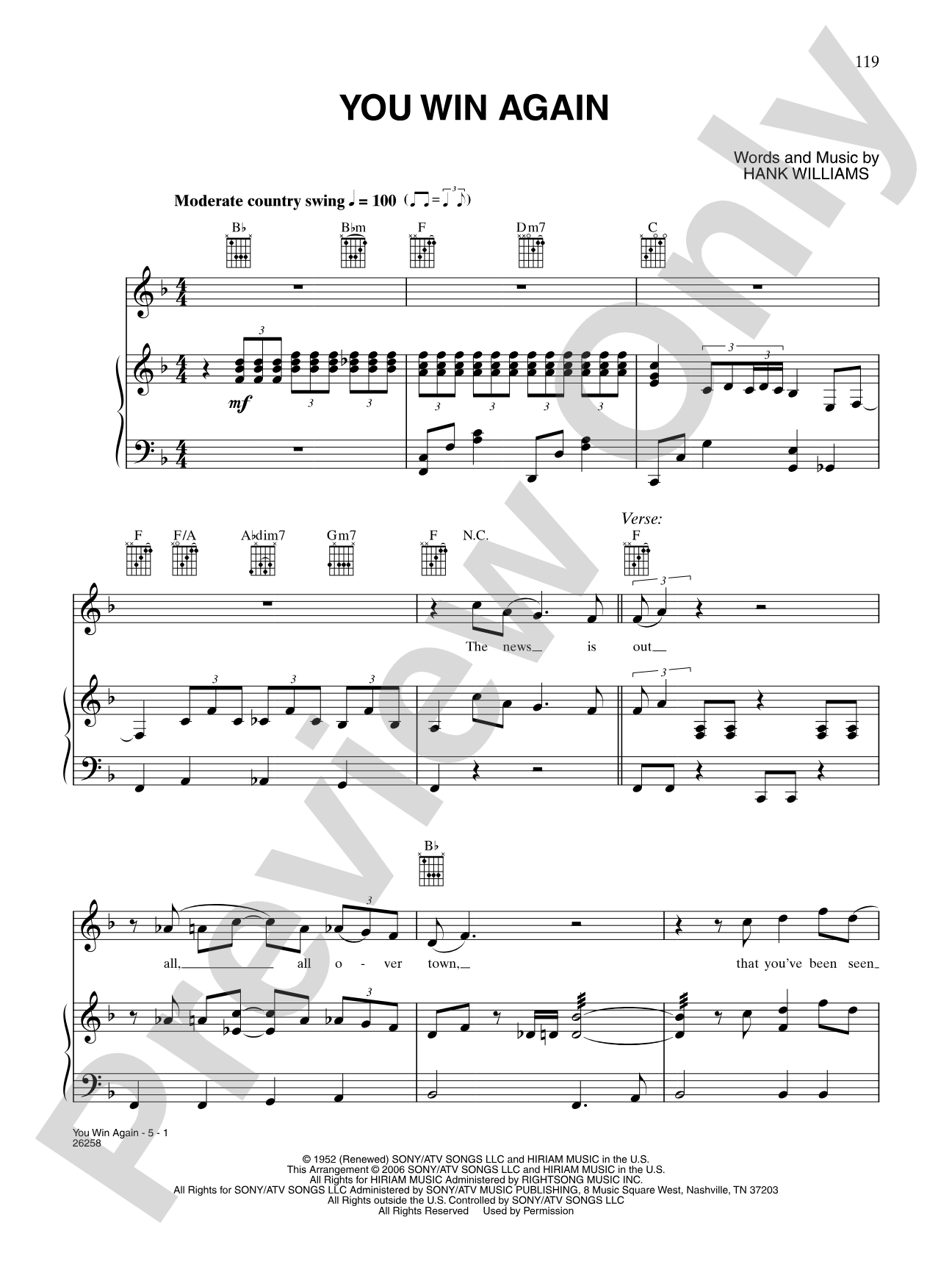

You Win Again: Piano/Vocal/Chords
Jerry Lee Lewis
Item: 00-PSP-000164
$4.99
One moment…
Related Items
What'd I Say: Lead Sheet |
$4.99
|
View | |
Breathless: Piano/Vocal/Chords |
$4.99
|
View | |
Great Balls Of Fire: Piano/Vocal/Chords |
$4.99
|
View | |
Over The Rainbow (from "The Wizard of Oz"): Piano/Vocal/Chords |
$4.99
|
View | |
What'd I Say: Piano/Vocal/Chords |
$5.99
|
View | |
Jerry Lee Lewis: Greatest Hits: Piano/Vocal/Chords Book |
$22.99
|
View |
Description
Legendary singer/songwriter and pianist Jerry Lee Lewis was one of the first great rock & roll artists. Nicknamed "The Killer," Jerry Lee Lewis was as famous for his music and energetic live performances as his controversial personal life. This book provides the lyrics along with piano and chord arrangements for 30 of Jerry Lee Lewis' most famous hit songs. A must-have for Jerry Lee Lewis fans!
Titles: Another Place Another Time * Big Legged Woman * Breathless * Carry Me Back to Ole Virginia * Chantilly Lace * Crawdad Song * End of the Road * Great Balls of Fire * High School Confidential * I Am What I Am * Lewis Boogie * Lucille * Me and Bobby McGee * Middle Age Crazy * New Orleans Boogie * Once More with Feeling * One Has My Name (The Other Has My Heart) * Over the Rainbow * Rockin' My Life Away * She Even Woke Me Up to Say Goodbye * She Still Comes Around (To Love What's Left of Me) * Think About It Darlin' * Thirty Nine and Holding * To Make Love Sweeter for You * Wall Around Heaven * What'd I Say * What's Made Milwaukee Famous (Has Made a Loser Out of Me) * Whole Lot of Shakin' Going On * Would You Take Another Chance on Me * You Win Again.


Titles: Another Place Another Time * Big Legged Woman * Breathless * Carry Me Back to Ole Virginia * Chantilly Lace * Crawdad Song * End of the Road * Great Balls of Fire * High School Confidential * I Am What I Am * Lewis Boogie * Lucille * Me and Bobby McGee * Middle Age Crazy * New Orleans Boogie * Once More with Feeling * One Has My Name (The Other Has My Heart) * Over the Rainbow * Rockin' My Life Away * She Even Woke Me Up to Say Goodbye * She Still Comes Around (To Love What's Left of Me) * Think About It Darlin' * Thirty Nine and Holding * To Make Love Sweeter for You * Wall Around Heaven * What'd I Say * What's Made Milwaukee Famous (Has Made a Loser Out of Me) * Whole Lot of Shakin' Going On * Would You Take Another Chance on Me * You Win Again.
You Win Again: Piano/Vocal/Chords isn't in MakeMusic Cloud just yet...but it could be. Let us know you'd like to see it, and you'll help shape what comes next. In the meantime, start a free trial and dive into thousands of interactive titles your students can play along with today.
Request This Title
Tell us you want it.
Start Your Free Trial
Explore everything that's ready to play right now.
Sample Audio
No sample audio found.
Sample Video
No sample videos found.
Additional Details
Publisher:
Alfred Music
Page Count:
156
SKU:
00-PSP-000164
More about this title
About the Artist: Jerry Lee Lewis
Jerry Lee Lewis emerged from Ferriday, Louisiana, as one of rock and roll's most electrifying pioneers. His virtuosic piano playing, combined with his raw vocal energy and showmanship, made him a cornerstone of early rock and roll alongside Elvis Presley and Chuck Berry. Lewis recorded prolifically across rock, country, and blues throughout a career spanning seven decades, earning the nickname "The Killer" for his commanding stage presence and technical mastery.
Beyond his controversial personal history, Lewis's musical legacy rests on his ability to blend gospel-inflected piano technique with rhythm and blues sensibility, creating songs that remain deeply influential in rock and country music education. His recordings and compositions continue to serve as foundational texts for understanding rock and roll's origins and the role of keyboard playing in the genre's development.
Why we love this
This collection captures 30 of Lewis's most enduring recordings in a single, accessible resource for pianists and singers. The breadth of material spans his rock classics, country recordings, and rhythm-and-blues inflected pieces, giving performers a genuine cross-section of his catalog rather than a curated "greatest hits" package. For musicians studying rock and roll history or exploring the keyboard's central role in the genre, these arrangements provide immediate, playable entry points into authentic early rock repertoire.
What to expect
These songs pulse with the swagger and irreverence of 1950s rock and roll, balanced against moments of genuine vulnerability and technical display. From the explosive energy of "Great Balls of Fire" to the tender country introspection of "She Even Woke Me Up to Say Goodbye," the collection swings between raw exuberance and emotional depth, reflecting Lewis's range as both a rocker and a balladeer. The piano arrangements sit right at the intersection of gospel technique, blues sensibility, and straight-ahead rock and roll energy.
Who it's for
This book serves pianists and singers who want to perform authentic early rock and roll repertoire, whether for a recital, a rock history showcase, or personal study. It's equally valuable for music educators introducing students to the foundations of rock and roll and the keyboard's essential role in shaping the genre. Musicians exploring country-rock crossover material or studying the blues tradition will find rich material here.
How to get the most out of it
- Approach the rhythmic drive of these pieces with the same energy Lewis brought to his recordings; the piano part carries much of the groove, so commit fully to the syncopation rather than playing it safely
- Study Lewis's recorded versions to absorb his distinctive vocal phrasing and piano flourishes, then adapt what you discover to fit your own voice and touch
- Use the chord chart as a launching point for improvisation, especially on blues-based pieces like "What'd I Say," rather than treating it as a rigid harmonic blueprint
- Pay attention to the dynamic range implied by Lewis's original arrangements; these songs depend on contrast between quieter verses and explosive choruses for their impact
How to use it
Program this collection on a recital exploring American popular music traditions, pairing selections with other early rock pioneers or building an entire set around Jerry Lee Lewis's career arc. In a classroom context, use individual songs to illustrate how piano technique, blues harmony, and rhythm and blues phrasing shaped rock and roll's development. Single tracks work well as opening pieces in a rock-focused recital or as showcases for students developing keyboard improvisation skills.
Skills your students will build
- Syncopated rhythmic reading and performance in a rock context
- Blues and gospel-influenced chord voicings and comping patterns
- Authentic phrasing and articulation in early rock and roll style
- Sight-reading lyrics, chord charts, and piano arrangements in real time
- Stylistic interpretation of vocal material written for a distinctive artist
- Left-hand independence and boogie-woogie influenced bass patterns