
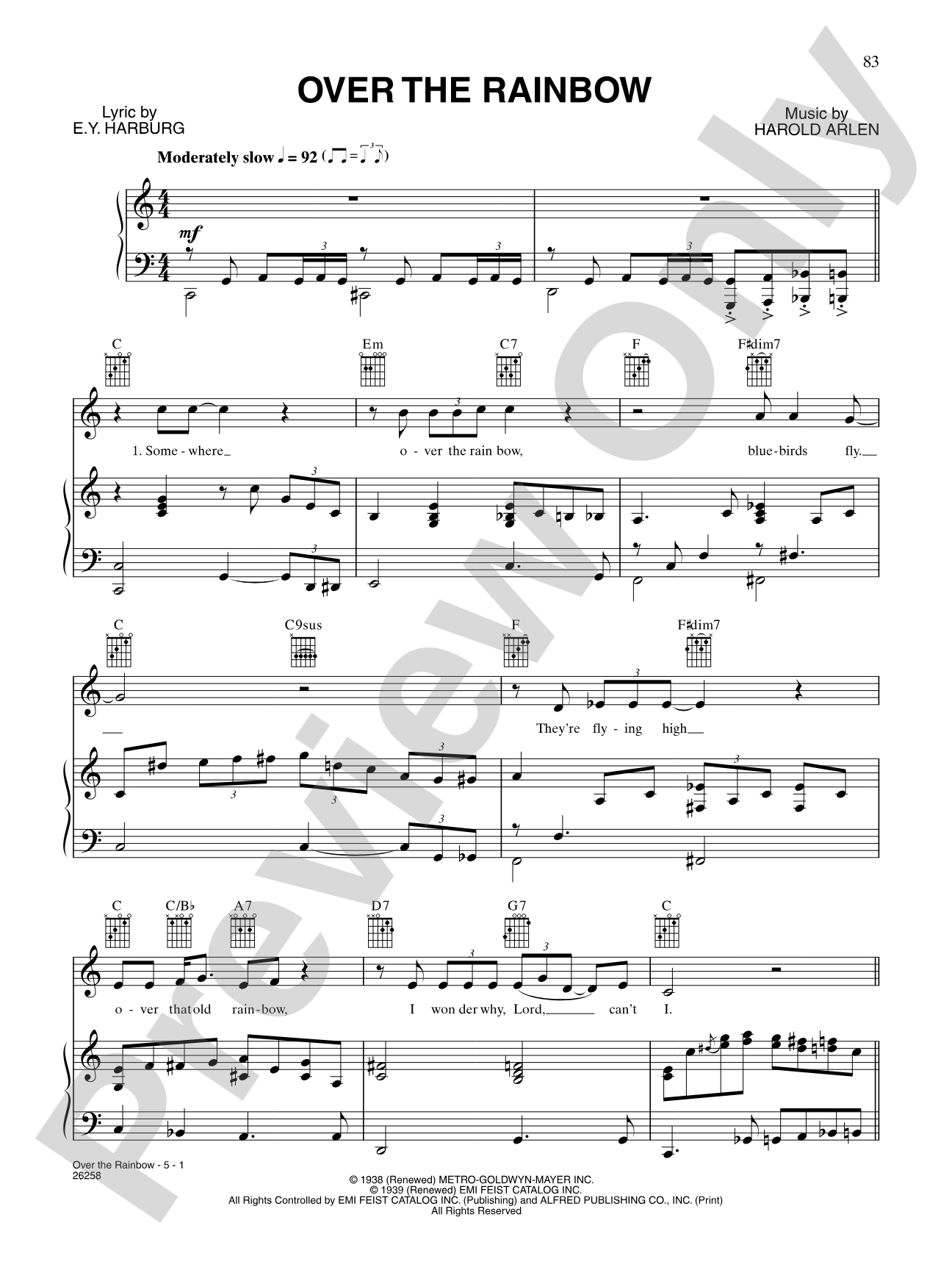

Over The Rainbow (from "The Wizard of Oz"): Piano/Vocal/Chords
Jerry Lee Lewis
Item: 00-PSP-000162
$4.99
One moment…
Description
Legendary singer/songwriter and pianist Jerry Lee Lewis was one of the first great rock & roll artists. Nicknamed "The Killer," Jerry Lee Lewis was as famous for his music and energetic live performances as his controversial personal life. This book provides the lyrics along with piano and chord arrangements for 30 of Jerry Lee Lewis' most famous hit songs. A must-have for Jerry Lee Lewis fans!
Titles: Another Place Another Time * Big Legged Woman * Breathless * Carry Me Back to Ole Virginia * Chantilly Lace * Crawdad Song * End of the Road * Great Balls of Fire * High School Confidential * I Am What I Am * Lewis Boogie * Lucille * Me and Bobby McGee * Middle Age Crazy * New Orleans Boogie * Once More with Feeling * One Has My Name (The Other Has My Heart) * Over the Rainbow * Rockin' My Life Away * She Even Woke Me Up to Say Goodbye * She Still Comes Around (To Love What's Left of Me) * Think About It Darlin' * Thirty Nine and Holding * To Make Love Sweeter for You * Wall Around Heaven * What'd I Say * What's Made Milwaukee Famous (Has Made a Loser Out of Me) * Whole Lot of Shakin' Going On * Would You Take Another Chance on Me * You Win Again.


Titles: Another Place Another Time * Big Legged Woman * Breathless * Carry Me Back to Ole Virginia * Chantilly Lace * Crawdad Song * End of the Road * Great Balls of Fire * High School Confidential * I Am What I Am * Lewis Boogie * Lucille * Me and Bobby McGee * Middle Age Crazy * New Orleans Boogie * Once More with Feeling * One Has My Name (The Other Has My Heart) * Over the Rainbow * Rockin' My Life Away * She Even Woke Me Up to Say Goodbye * She Still Comes Around (To Love What's Left of Me) * Think About It Darlin' * Thirty Nine and Holding * To Make Love Sweeter for You * Wall Around Heaven * What'd I Say * What's Made Milwaukee Famous (Has Made a Loser Out of Me) * Whole Lot of Shakin' Going On * Would You Take Another Chance on Me * You Win Again.
Over The Rainbow (from "The Wizard of Oz"): Piano/Vocal/Chords isn't in MakeMusic Cloud just yet...but it could be. Let us know you'd like to see it, and you'll help shape what comes next. In the meantime, start a free trial and dive into thousands of interactive titles your students can play along with today.
Request This Title
Tell us you want it.
Start Your Free Trial
Explore everything that's ready to play right now.
Sample Audio
No sample audio found.
Sample Video
No sample videos found.
Additional Details
Publisher:
Alfred Music
Page Count:
156
SKU:
00-PSP-000162
More about this title
About the Composer: Harold Arlen
Harold Arlen (1905-1986) composed some of the most enduring melodies in American musical theater. His gift for crafting singable, memorable tunes made him a natural fit for Broadway and Hollywood, where he collaborated with lyricists including Yip Harburg and Johnny Mercer to create standards that have outlasted the shows they came from.
Arlen's music sits at the intersection of jazz harmony and popular song form. His melodies have a natural lift and his harmonic choices often surprised listeners with unexpected chromatic movement, giving even his most accessible songs a sophisticated musical foundation. For singers and pianists, his work offers both emotional accessibility and genuine musical substance.
Why we love this
This collection pairs one of Arlen's most iconic melodies with the recording legacy of Jerry Lee Lewis, giving pianists and singers a chance to explore how a classic standard lives inside rock and roll. The 156-page format provides enough repertoire for ongoing study, and the piano/vocal/chords arrangement makes it workable for solo pianists, collaborative duets, or singers preparing audition material.
What to expect
Ascending and hopeful, with a melody that feels both simple and sophisticated at once. Arlen's harmonic foundation gives the song a subtle complexity that rewards careful listening, while the overall shape invites performers to find their own emotional truth within it.
Who it's for
Pianists and singers who want to explore American standards through a rock and roll lens, as well as music students interested in how the same melody can support wildly different interpretive approaches. This collection works for solo piano recital preparation, vocal study, or ensemble accompaniment.
How to get the most out of it
- Listen closely to the harmonic underpinning, even if you're drawn to the melody line. Arlen's chord choices often move in unexpected directions; letting those changes guide your phrasing will deepen the song's emotional arc.
- The bridge section deserves careful attention. Arlen typically introduces new harmonic territory there, and playing through it deliberately will help you understand the song's overall architecture before building interpretive choices on top.
- Balance simplicity with intention. The melody's directness is one of its strengths; resist the urge to over-embellish. Instead, let your touch and timing carry the meaning.
How to use it
Feature this arrangement in a recital section exploring how standards bridge genres, or use it as a stepping stone in a singer's audition preparation to show range across rock, pop, and traditional song styles. The full collection also serves as ongoing reference material for pianists expanding their standards repertoire.
Skills your students will build
- Reading and interpreting piano/vocal/chords notation
- Analyzing functional harmony in standard song form
- Balancing accompaniment voice leading with melody support
- Interpreting a single melody across different performance traditions