
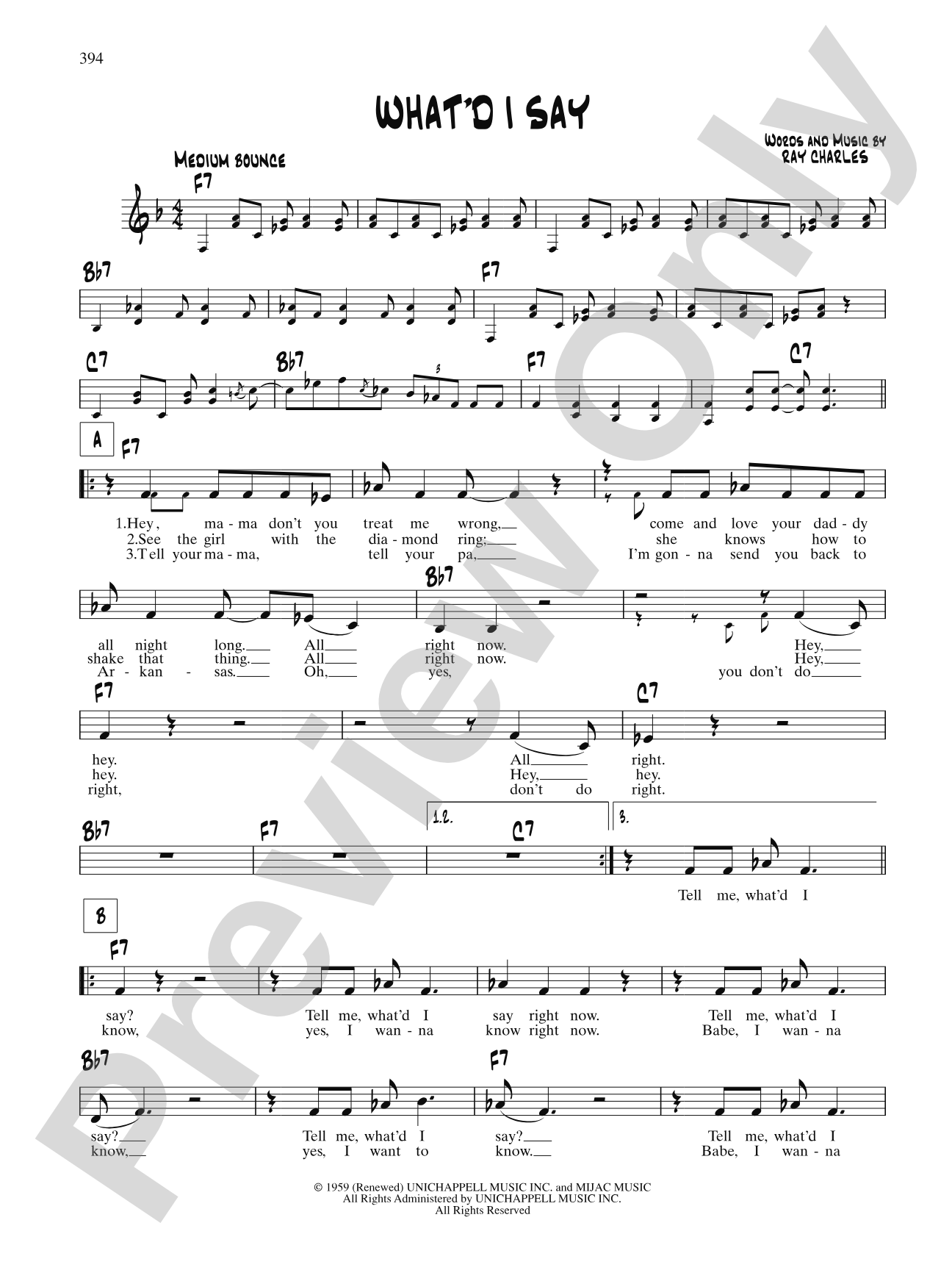

What'd I Say: Lead Sheet
Jerry Lee Lewis
Item: 00-PSL-000435
$4.99
One moment…
Related Items
Breathless: Piano/Vocal/Chords |
$4.99
|
View | |
Great Balls Of Fire: Piano/Vocal/Chords |
$4.99
|
View | |
Over The Rainbow (from "The Wizard of Oz"): Piano/Vocal/Chords |
$4.99
|
View | |
What'd I Say: Piano/Vocal/Chords |
$5.99
|
View | |
You Win Again: Piano/Vocal/Chords |
$4.99
|
View | |
Jerry Lee Lewis: Greatest Hits: Piano/Vocal/Chords Book |
$22.99
|
View |
Description
Legendary singer/songwriter and pianist Jerry Lee Lewis was one of the first great rock & roll artists. Nicknamed "The Killer," Jerry Lee Lewis was as famous for his music and energetic live performances as his controversial personal life. This book provides the lyrics along with piano and chord arrangements for 30 of Jerry Lee Lewis' most famous hit songs. A must-have for Jerry Lee Lewis fans!
Titles: Another Place Another Time * Big Legged Woman * Breathless * Carry Me Back to Ole Virginia * Chantilly Lace * Crawdad Song * End of the Road * Great Balls of Fire * High School Confidential * I Am What I Am * Lewis Boogie * Lucille * Me and Bobby McGee * Middle Age Crazy * New Orleans Boogie * Once More with Feeling * One Has My Name (The Other Has My Heart) * Over the Rainbow * Rockin' My Life Away * She Even Woke Me Up to Say Goodbye * She Still Comes Around (To Love What's Left of Me) * Think About It Darlin' * Thirty Nine and Holding * To Make Love Sweeter for You * Wall Around Heaven * What'd I Say * What's Made Milwaukee Famous (Has Made a Loser Out of Me) * Whole Lot of Shakin' Going On * Would You Take Another Chance on Me * You Win Again.


Titles: Another Place Another Time * Big Legged Woman * Breathless * Carry Me Back to Ole Virginia * Chantilly Lace * Crawdad Song * End of the Road * Great Balls of Fire * High School Confidential * I Am What I Am * Lewis Boogie * Lucille * Me and Bobby McGee * Middle Age Crazy * New Orleans Boogie * Once More with Feeling * One Has My Name (The Other Has My Heart) * Over the Rainbow * Rockin' My Life Away * She Even Woke Me Up to Say Goodbye * She Still Comes Around (To Love What's Left of Me) * Think About It Darlin' * Thirty Nine and Holding * To Make Love Sweeter for You * Wall Around Heaven * What'd I Say * What's Made Milwaukee Famous (Has Made a Loser Out of Me) * Whole Lot of Shakin' Going On * Would You Take Another Chance on Me * You Win Again.
What'd I Say: Lead Sheet isn't in MakeMusic Cloud just yet...but it could be. Let us know you'd like to see it, and you'll help shape what comes next. In the meantime, start a free trial and dive into thousands of interactive titles your students can play along with today.
Request This Title
Tell us you want it.
Start Your Free Trial
Explore everything that's ready to play right now.
Sample Audio
No sample audio found.
Sample Video
No sample videos found.
Additional Details
Publisher:
Alfred Music
Page Count:
156
SKU:
00-PSL-000435
More about this title
About the Artist: Jerry Lee Lewis
Jerry Lee Lewis emerged from Ferriday, Louisiana, in the 1950s as one of rock and roll's most electrifying pioneers. His combination of boogie-woogie piano, wild vocal delivery, and magnetic stage presence made him a force that rivaled Elvis Presley and Chuck Berry, earning him the nickname "The Killer" for his incendiary performances.
Lewis recorded prolifically across rock, country, and soul idioms, scoring major hits with "Great Balls of Fire," "Whole Lot of Shakin' Going On," and "What'd I Say." His influence on rock piano and his ability to blend genres established him as a foundational figure in American popular music, with a catalog that continues to inspire musicians across generations.
Why we love this
This collection captures the raw energy that made Lewis essential listening for a generation, offering vocalists and pianists direct access to his most recognizable material in a practical lead sheet format. The mix of uptempo rockers, ballads, and country-inflected numbers gives ensembles genuine variety for programming, whether building a rock and roll revue or exploring the crossover appeal that defined Lewis's career. The chord charts and lyrics make these songs immediately singable for performers at multiple skill levels.
What to expect
These songs pulse with the joy and swagger of mid-20th-century American popular music. You'll find infectious rhythms, memorable hooks, romantic yearning in the slower numbers, and the kind of piano-fueled propulsion that made Lewis a live performance legend. There's theatrical energy here without apology.
Who it's for
Vocalists, pianist-singers, and small jazz or rock ensembles who want to perform authentic rock and roll standards with melodic and harmonic substance. This is especially valuable for performers exploring the intersection of rock, country, and R&B, or anyone studying the piano-driven rock tradition that Lewis helped establish.
How to get the most out of it
- Balance the vocal line against the piano; these songs thrive when both elements drive forward together rather than one accompanying the other
- Pay attention to the rhythmic feel notated in each chart. Lewis's style spans straight eighths ("Great Balls of Fire") and swung feels ("Whole Lot of Shakin' Going On"), and capturing the right groove transforms the performance
- Use the chord voicings as a starting point, not a ceiling. Lewis's piano playing was inventive and percussive; don't be afraid to reharmonize or add bluesy extensions if they serve the song
- The vocal delivery matters as much as the melody. Study recordings to understand Lewis's phrasing, his rhythmic placement, and where he bends or slurs notes for character
How to use it
Build a rock and roll concert or cabaret evening around selections from this collection, pairing uptempo numbers with ballads to create dynamic pacing. This material also works beautifully in a jazz or American music history course, where students can study how Lewis bridged rock, country, and soul traditions. Individual songs are strong enough to anchor a recital or serve as show-stoppers between classical or contemporary repertoire.
Skills your students will build
- Reading lead sheets and interpreting chord symbols while maintaining melodic integrity
- Understanding boogie-woogie and swing rhythmic feels, including the difference between straight and swung eighths
- Balancing improvisation and interpretation within a fixed melodic and harmonic structure
- Performing rock and roll repertoire with authentic phrasing and rhythmic confidence
- Coordinating vocal and piano parts in a cohesive ensemble sound