
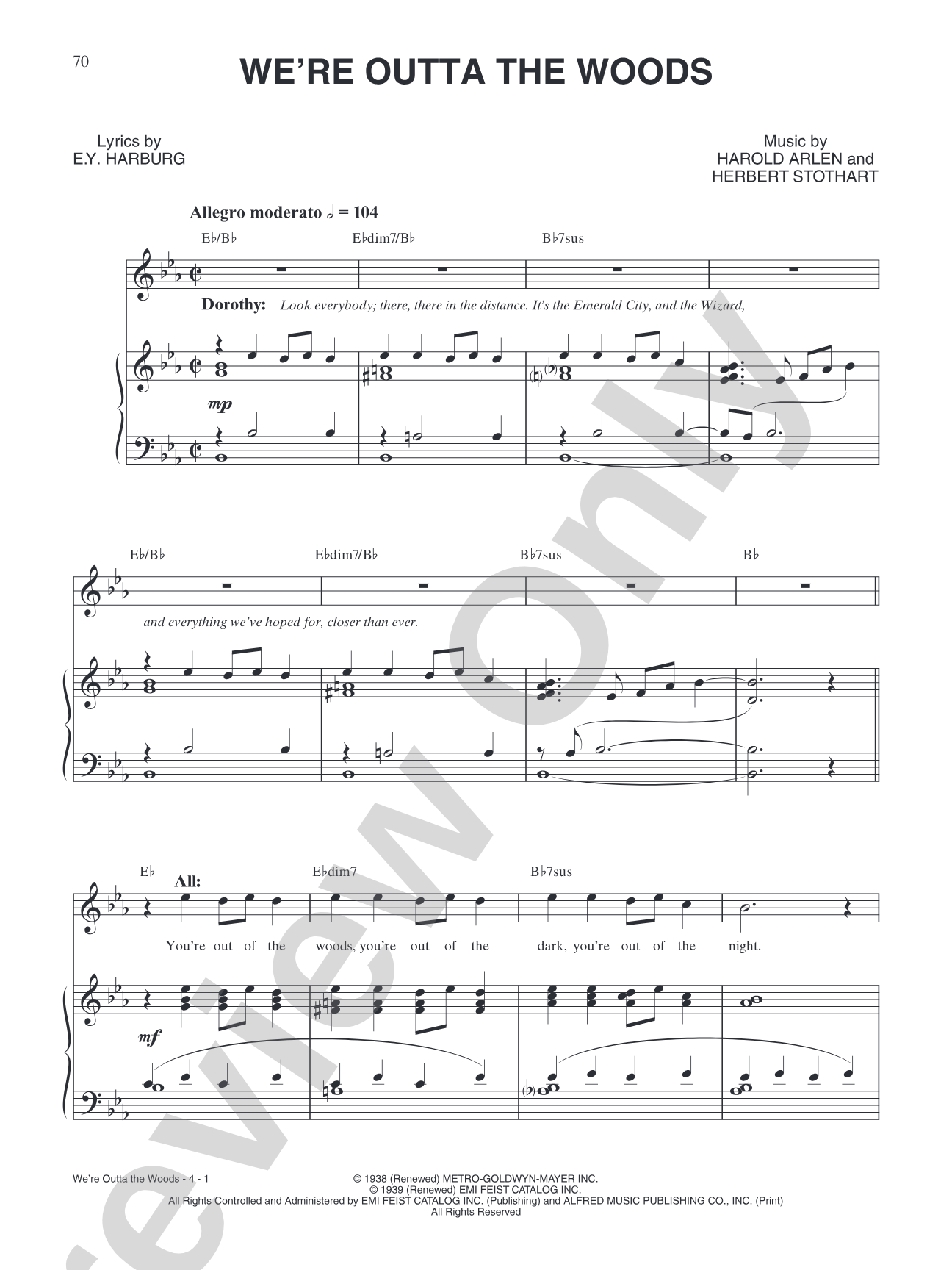

We're Outta the Woods (from Andrew Lloyd Webber's "The Wizard of Oz"): Piano/Vocal/Chords
Music by Harold Arlen, lyrics by E. Y. Harburg, with new songs by Andrew Lloyd Webber and Tim Rice
Item: 00-XS-0000412
$4.99
One moment…
Related Items
If I Only Had a Brain (from Andrew Lloyd Webber's "The Wizard of Oz"): Piano/Vocal/Chords |
$4.99
|
View | |
The Merry Old Land of Oz (from Andrew Lloyd Webber's "The Wizard of Oz"): Piano/Vocal/Chords |
$5.99
|
View | |
Munchkin Land/Ding Dong! The Witch Is Dead (from Andrew Lloyd Webber's "The Wizard of Oz"): Piano/Vocal/Chords |
$9.99
|
View | |
Over the Rainbow (from Andrew Lloyd Webber's "The Wizard of Oz"): Piano/Vocal/Chords |
$4.99
|
View | |
Follow the Yellow Brick Road (from Andrew Lloyd Webber's "The Wizard of Oz"): Piano/Vocal/Chords |
$4.99
|
View | |
If I Only Had a Heart (from Andrew Lloyd Webber's "The Wizard of Oz"): Piano/Vocal/Chords |
$5.99
|
View | |
If I Only Had the Nerve/We're Off to See the Wizard (from Andrew Lloyd Webber's "The Wizard of Oz"): Piano/Vocal/Chords |
$5.99
|
View | |
Hail-Hail! The Witch is Dead (from Andrew Lloyd Webber's "The Wizard of Oz"): Piano/Vocal/Chords |
$5.99
|
View | |
The Wizard of Oz: Selections from Andrew Lloyd Webber's New Stage Production: Piano/Vocal/Guitar Book |
$21.99
|
View |
Description
Upon its 2011 debut, Andrew Lloyd Webber's spectacular new stage production of The Wizard of Oz dazzled London audiences and embarked on a course for productions around the world. Building upon the original story and the classic movie score with music by Harold Arlen and lyrics by E.Y. Harburg, Lloyd Webber masterfully transforms the work by contributing more than a half-dozen new, original songs that at last successfully adapt the world's most beloved movie musical for live theatre. This collectible songbook contains piano/vocal sheet music for every song on the original cast recording, along with several pages of brilliant color photos from the original London production. Titles: Nobody Understands Me * Over the Rainbow * Wonders of the World * Munchkinland / Ding-Dong! The Witch Is Dead * Follow the Yellow Brick Road * If I Only Had a Brain * If I Only Had a Heart * If I Only Had the Nerve / We're Off to See the Wizard * We're Outta the Woods * The Merry Old Land of Oz * Bring Me the Broomstick * Red Shoes Blues * The Rescue * Hail-Hail! The Witch Is Dead * The Wizard's Departure * Already Home.


Discover MakeMusic Cloud: thousands of interactive titles your students can play along with today.
Sample Audio
No sample audio found.
Sample Video
No sample videos found.
Additional Details
Publisher:
Alfred Music
Page Count:
116
SKU:
00-XS-0000412
More about this title
About the Composer: Harold Arlen
Harold Arlen (1905-1986) stands among America's most prolific and inventive songwriters, with a gift for melody that could shift from whimsy to heartbreak in a single phrase. His collaboration with lyricist E.Y. Harburg on The Wizard of Oz produced some of the most enduring songs in musical theatre history, including "Over the Rainbow," a standard that has outlasted generations of performers.
Arlen's harmonic language—marked by unexpected key changes, jazz inflections, and blues sensibilities—made him a favorite among musicians and singers alike. Teachers and students benefit from studying his work because it bridges popular song and art song, demonstrating how accessible melodies can rest on sophisticated harmonic foundations. His songs reward careful interpretation and reveal new layers with each performance.
Why we love this
This edition captures the full theatrical scope of Andrew Lloyd Webber's reimagining while keeping the emotional core of Arlen's original melodies intact. Pianists get to inhabit both the familiar classics and Webber's new additions, creating a complete story arc in one collection. For singers and music theatre programs, having all seventeen songs from the original cast recording in one volume eliminates the need to hunt down scattered sheet music and allows for cohesive rehearsal and performance.
What to expect
Opening these pages feels like stepping into a beloved story that has been lovingly restored rather than rebuilt. The familiar melodies arrive with fresh harmonic textures and unexpected moments of vulnerability, while Webber's original contributions deepen the emotional landscape Dorothy travels. There is both comfort and discovery here: the security of singing "Over the Rainbow" alongside the thrill of encountering something genuinely new.
Who it's for
Music theatre programs preparing full or partial stagings of Lloyd Webber's Wizard of Oz will find every song they need in one complete resource. Solo vocalists, pianists, and singers in advanced choir or musical theatre electives benefit from exploring how modern compositional sensibilities can coexist with enduring melodies. Accompanists and music directors gain insight into how theatrical songwriting balances accessibility with harmonic sophistication.
How to get the most out of it
- Study the original film recordings of Arlen's songs first to internalize the melodic DNA before approaching Webber's orchestrations; this context makes the familiar songs richer and the new ones feel like natural extensions.
- Pay close attention to the harmonic movements underneath the melody, particularly in Arlen's passages where a single chord change shifts the emotional weight of a phrase.
- Balance the weight of accompaniment against the vocal line; these arrangements sit the voice front and center, so resist the urge to overplay the piano part.
- Mark the structural transitions between the classic songs and Webber's new material so singers understand how the score navigates between homage and innovation.
How to use it
Programme this as a complete show package for a full theatrical production, or select individual songs for a musical theatre concert or song recital that celebrates the evolution of this classic story. Music theatre ensembles can use individual numbers as audition material or as teaching pieces that explore how different composers approach similar dramatic moments. Pianists preparing for collaborative recitals will find rewarding accompaniment work across a range of vocal styles and emotional territories.
Skills your students will build
- Interpreting theatrical legit (legitimate/classical) singing while maintaining conversational diction
- Navigating harmonic transitions between tonal centres and recognizing jazz-influenced voice leading
- Accompanying singers with sensitivity to dynamic balance and textural clarity in a theatrical context
- Understanding dramatic storytelling through song selection and sequencing within a full score
- Sight-reading and adapting to varied accompaniment textures and rhythmic patterns across multiple songs