
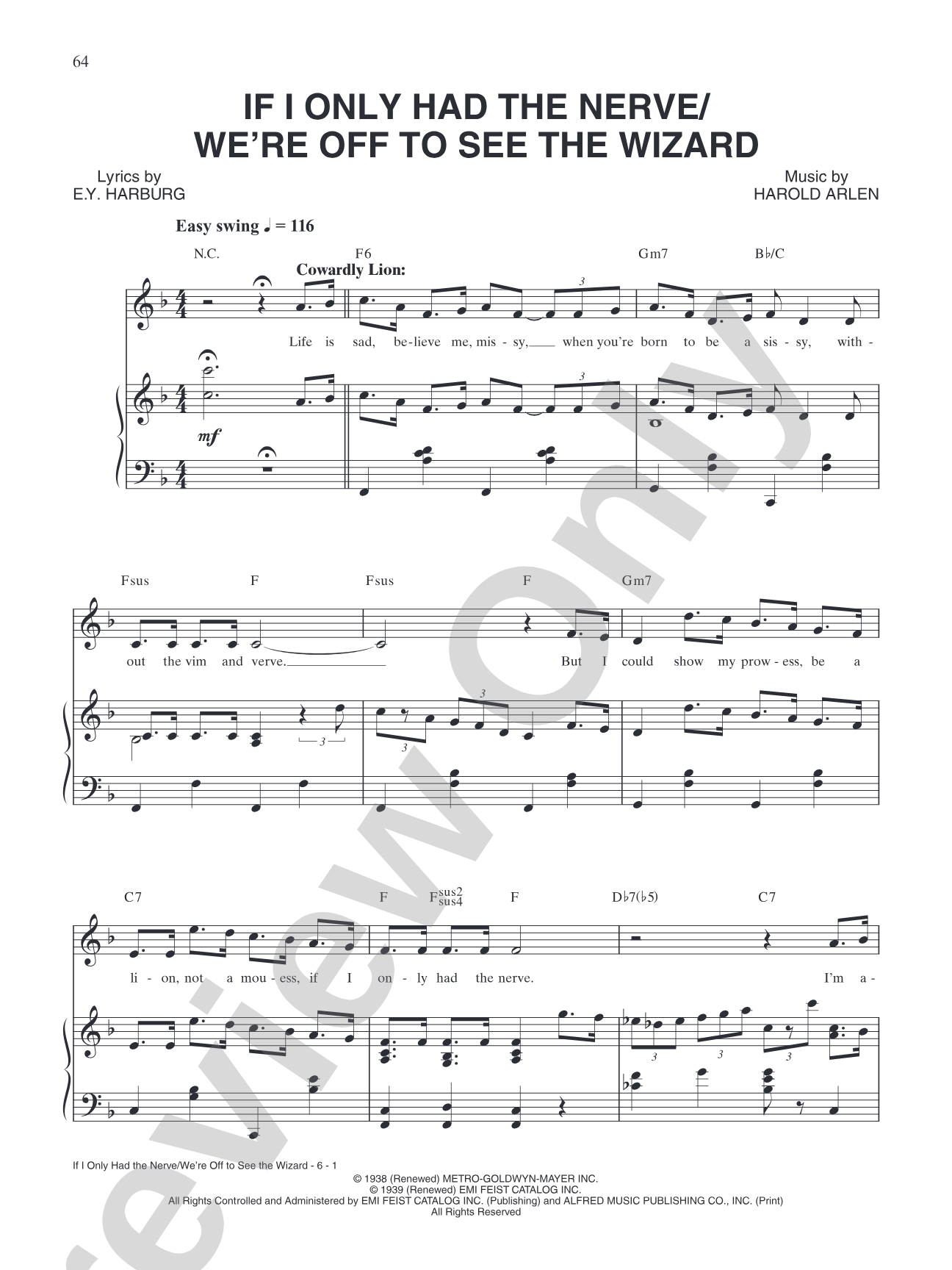
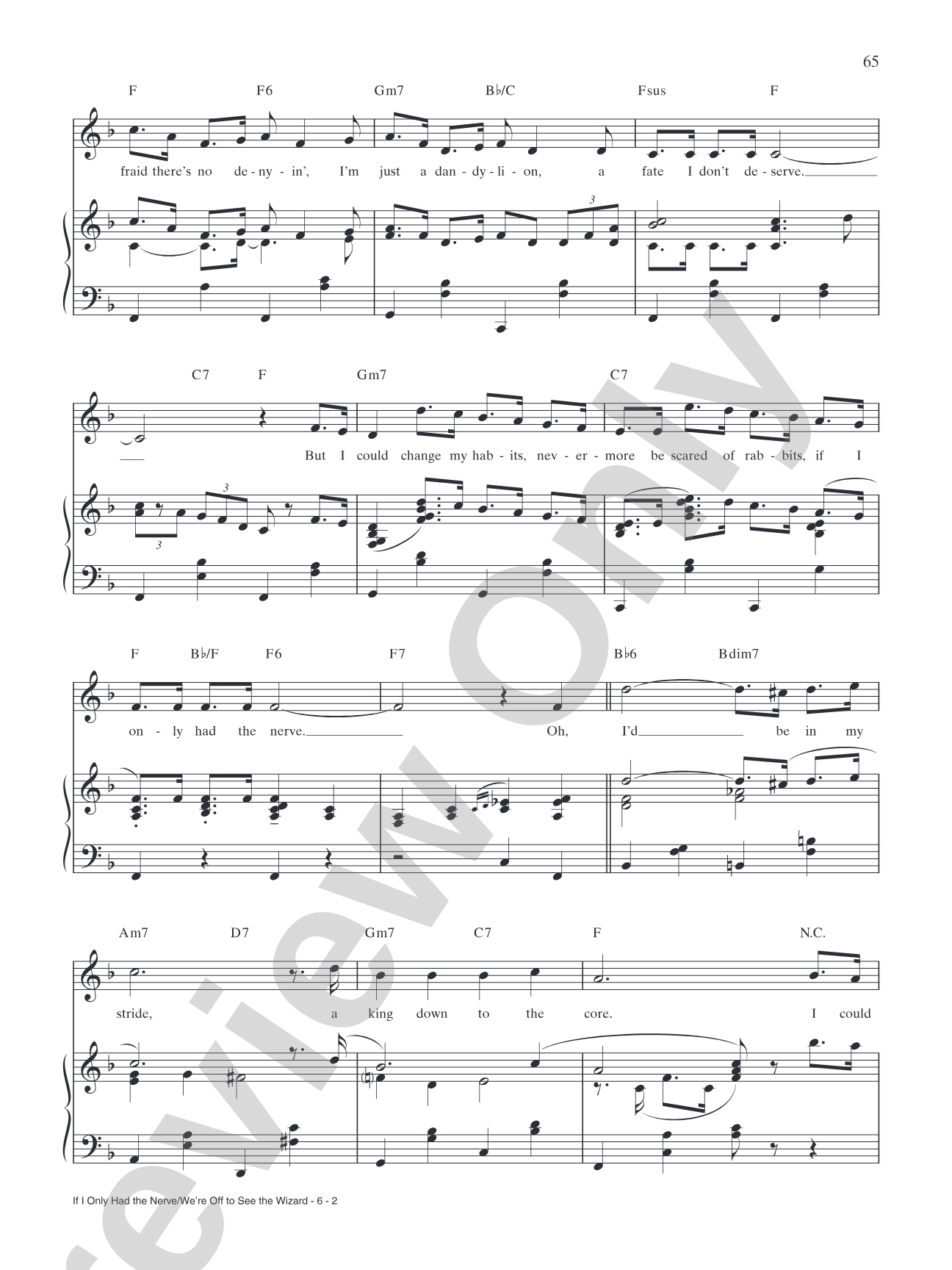

If I Only Had the Nerve/We're Off to See the Wizard (from Andrew Lloyd Webber's "The Wizard of Oz"): Piano/Vocal/Chords
Music by Harold Arlen, lyrics by E. Y. Harburg, with new songs by Andrew Lloyd Webber and Tim Rice
Item: 00-XS-0000428
$5.99
One moment…
Related Items
If I Only Had a Brain (from Andrew Lloyd Webber's "The Wizard of Oz"): Piano/Vocal/Chords |
$4.99
|
View | |
The Merry Old Land of Oz (from Andrew Lloyd Webber's "The Wizard of Oz"): Piano/Vocal/Chords |
$5.99
|
View | |
Munchkin Land/Ding Dong! The Witch Is Dead (from Andrew Lloyd Webber's "The Wizard of Oz"): Piano/Vocal/Chords |
$9.99
|
View | |
We're Outta the Woods (from Andrew Lloyd Webber's "The Wizard of Oz"): Piano/Vocal/Chords |
$4.99
|
View | |
Over the Rainbow (from Andrew Lloyd Webber's "The Wizard of Oz"): Piano/Vocal/Chords |
$4.99
|
View | |
If I Only Had a Heart (from Andrew Lloyd Webber's "The Wizard of Oz"): Piano/Vocal/Chords |
$5.99
|
View | |
Hail-Hail! The Witch is Dead (from Andrew Lloyd Webber's "The Wizard of Oz"): Piano/Vocal/Chords |
$5.99
|
View | |
The Wizard of Oz: Selections from Andrew Lloyd Webber's New Stage Production: Piano/Vocal/Guitar Book |
$21.99
|
View |
Description
Upon its 2011 debut, Andrew Lloyd Webber's spectacular new stage production of The Wizard of Oz dazzled London audiences and embarked on a course for productions around the world. Building upon the original story and the classic movie score with music by Harold Arlen and lyrics by E.Y. Harburg, Lloyd Webber masterfully transforms the work by contributing more than a half-dozen new, original songs that at last successfully adapt the world's most beloved movie musical for live theatre. This collectible songbook contains piano/vocal sheet music for every song on the original cast recording, along with several pages of brilliant color photos from the original London production. Titles: Nobody Understands Me * Over the Rainbow * Wonders of the World * Munchkinland / Ding-Dong! The Witch Is Dead * Follow the Yellow Brick Road * If I Only Had a Brain * If I Only Had a Heart * If I Only Had the Nerve / We're Off to See the Wizard * We're Outta the Woods * The Merry Old Land of Oz * Bring Me the Broomstick * Red Shoes Blues * The Rescue * Hail-Hail! The Witch Is Dead * The Wizard's Departure * Already Home.


If I Only Had the Nerve/We're Off to See the Wizard (from Andrew Lloyd Webber's "The Wizard of Oz"): Piano/Vocal/Chords isn't in MakeMusic Cloud just yet...but it could be. Let us know you'd like to see it, and you'll help shape what comes next. In the meantime, start a free trial and dive into thousands of interactive titles your students can play along with today.
Request This Title
Tell us you want it.
Start Your Free Trial
Explore everything that's ready to play right now.
Sample Audio
No sample audio found.
Sample Video
No sample videos found.
Additional Details
Publisher:
Alfred Music
Page Count:
116
SKU:
00-XS-0000428
More about this title
About the Composer: Harold Arlen
Harold Arlen (1905-1986) shaped American musical theatre through a prolific career that spanned from the 1930s through the 1980s. His gift for melody and his ability to write in virtually any musical idiom made him one of the most recorded composers in history. Arlen's collaboration with lyricist E.Y. Harburg on The Wizard of Oz produced some of the most enduring songs in American popular music, and his influence extends across Broadway, film, and jazz standards that remain central to the repertoire singers learn and perform.
Beyond Oz, Arlen composed for Over the Rainbow, Stormy Weather, and countless other works that continue to define how singers approach ballads, rhythmic songs, and theatrical storytelling. His harmonic language influenced generations of musical theatre composers, and his songs reward close study of how melody, harmony, and lyrical content work together to create emotional impact.
Why we love this
This book captures two essential moments from Lloyd Webber's reimagining alongside the beloved Arlen originals, offering singers and pianists access to some of theatre's most performed duets and character songs in a single, beautifully produced volume. The inclusion of color photos from the original London production provides visual context and inspiration that can deepen how performers understand their characters and the dramatic arc of the story. For any voice teacher, vocal director, or pianist working on musical theatre repertoire, these arrangements offer immediately singable material at professional quality without requiring separate downloads or recordings.
What to expect
These songs balance whimsy with genuine character depth. The Cowardly Lion's "If I Only Had the Nerve" combines comedic vulnerability with surprising emotional truth, while "We're Off to See the Wizard" lifts the ensemble forward with infectious optimism and theatrical drive. Arlen's melodic gift ensures that every song sits naturally for the voice, whether you're singing a comic turn or a soaring ballad.
Who it's for
This book serves singers preparing musical theatre repertoire, voice teachers building lesson libraries with Broadway standards, and pianists accompanying singers in studio or recital settings. It is equally valuable for directors casting school or community productions of The Wizard of Oz who want authentic published material that their cast can learn from and perform with confidence.
How to get the most out of it
- Invest in the character voice for the Cowardly Lion's featured moment; "If I Only Had the Nerve" requires a specific vocal personality that shifts between introspection and comic bravado, and the piano part will follow your interpretive choices.
- Shape the harmonic movement in "We're Off to See the Wizard" as a transition number; the ensemble energy should feel propulsive, and the accompaniment needs momentum to support the shift in dramatic tone.
- Explore the lyrical content alongside the melodic line; Arlen's gift for matching music to text means that careful diction and phrasing will reveal musical architecture you might otherwise miss.
- Use the color photos as rehearsal reference; matching the visual energy and period styling choices in the images will inform performance choices about tempo, energy level, and character interaction.
How to use it
Extract these duets for musical theatre revue concerts, where they anchor a program with instantly recognized material that audiences connect with immediately. Use individual songs as lesson material for singers developing comfort with character work and theatrical storytelling. Program them in a full production of The Wizard of Oz, either the original film score or Lloyd Webber's version, with this book serving as your authoritative rehearsal and performance source.
Skills your students will build
- Singing character songs with distinct vocal personalities and emotional arcs
- Accompanying singers in musical theatre styles with appropriate harmonic support and tempo flexibility
- Reading and interpreting chord symbols for improvised accompaniment
- Performing ensemble numbers that balance individual vocal lines with group energy
- Shaping lyrical content to match dramatic context and melodic phrasing