
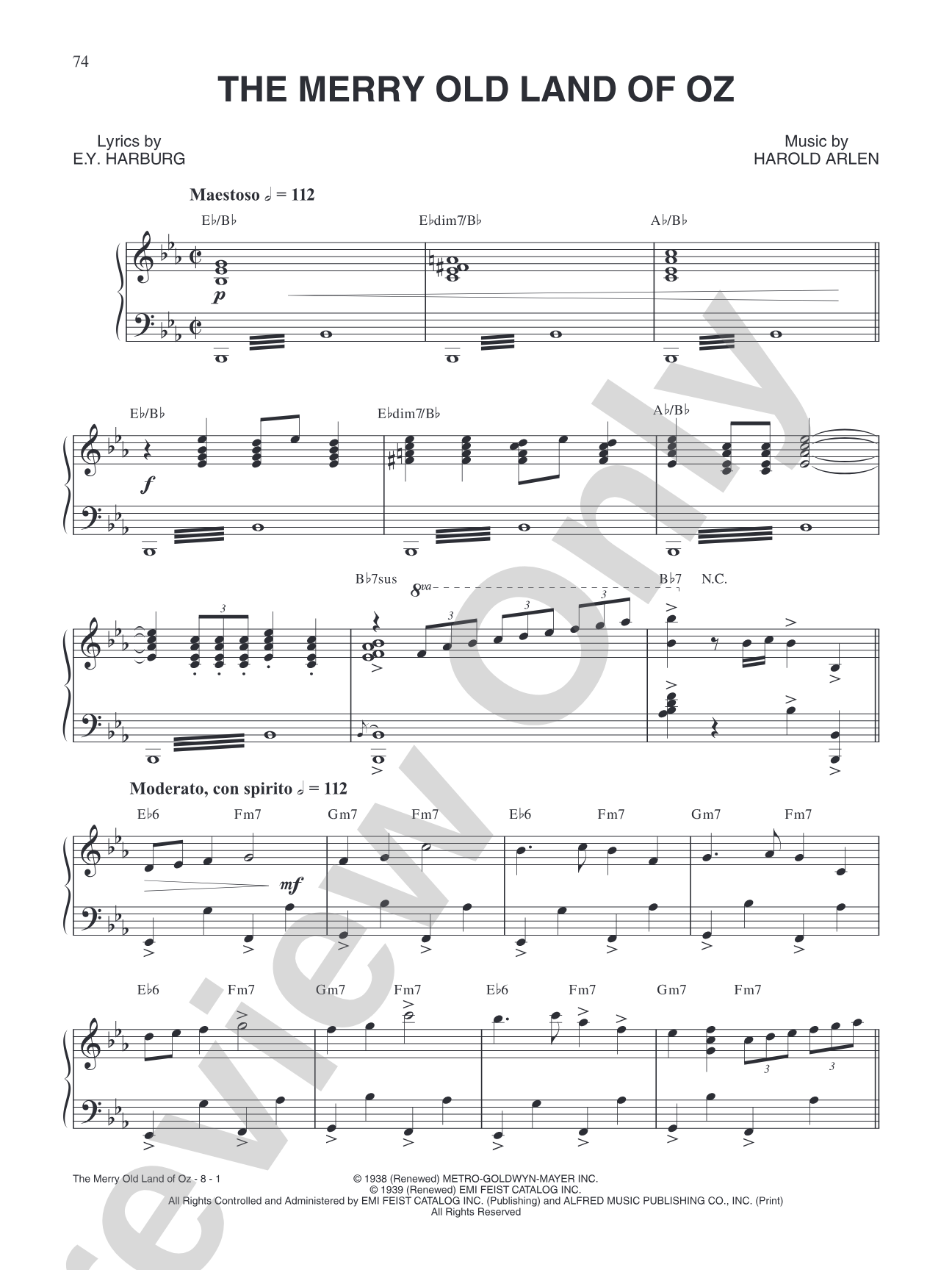
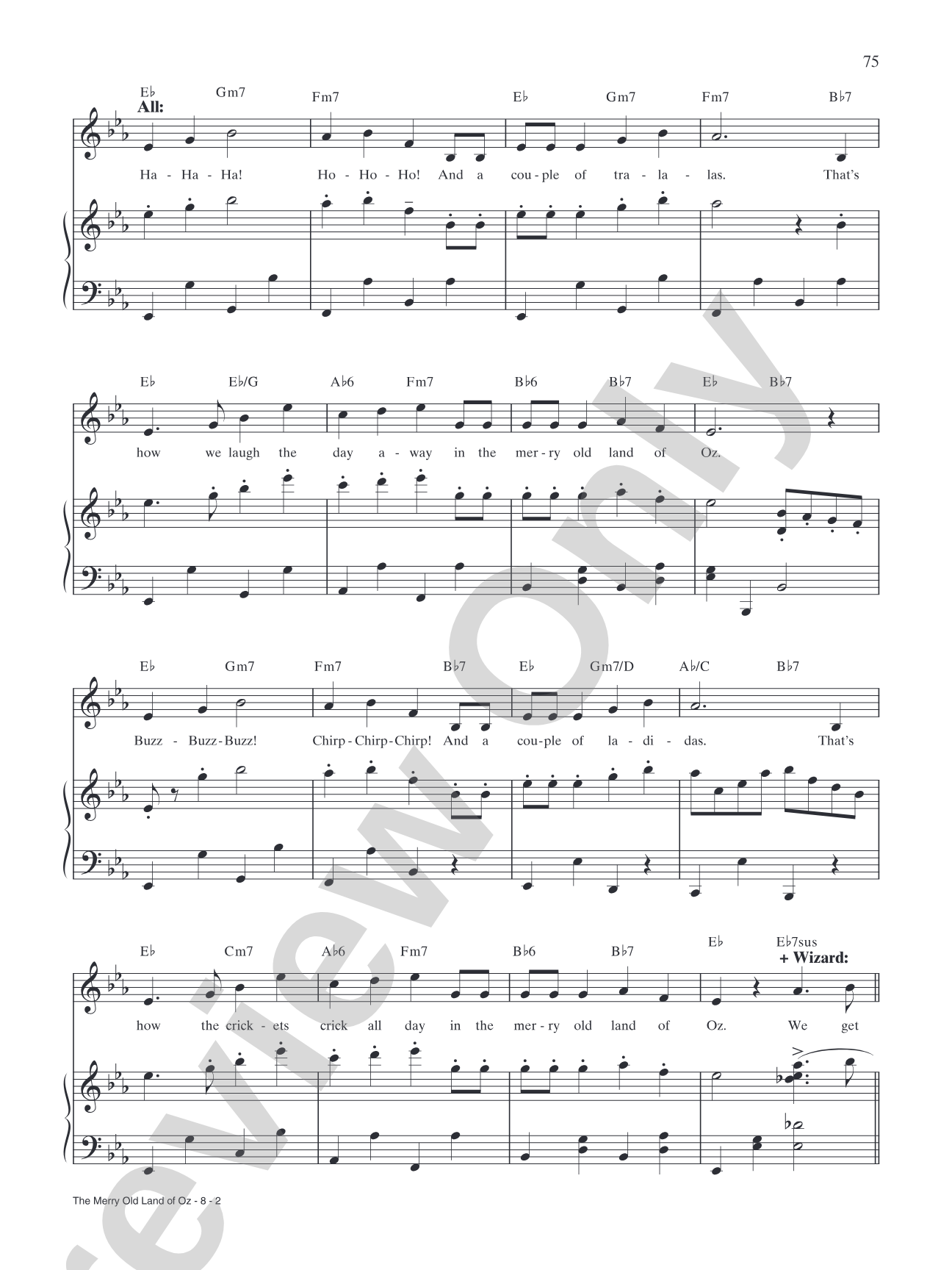

The Merry Old Land of Oz (from Andrew Lloyd Webber's "The Wizard of Oz"): Piano/Vocal/Chords
Music by Harold Arlen, lyrics by E. Y. Harburg, with new songs by Andrew Lloyd Webber and Tim Rice
Item: 00-XS-0000410
$5.99
One moment…
Related Items
If I Only Had a Brain (from Andrew Lloyd Webber's "The Wizard of Oz"): Piano/Vocal/Chords |
$4.99
|
View | |
Munchkin Land/Ding Dong! The Witch Is Dead (from Andrew Lloyd Webber's "The Wizard of Oz"): Piano/Vocal/Chords |
$9.99
|
View | |
We're Outta the Woods (from Andrew Lloyd Webber's "The Wizard of Oz"): Piano/Vocal/Chords |
$4.99
|
View | |
Over the Rainbow (from Andrew Lloyd Webber's "The Wizard of Oz"): Piano/Vocal/Chords |
$4.99
|
View | |
If I Only Had a Heart (from Andrew Lloyd Webber's "The Wizard of Oz"): Piano/Vocal/Chords |
$5.99
|
View | |
If I Only Had the Nerve/We're Off to See the Wizard (from Andrew Lloyd Webber's "The Wizard of Oz"): Piano/Vocal/Chords |
$5.99
|
View | |
Hail-Hail! The Witch is Dead (from Andrew Lloyd Webber's "The Wizard of Oz"): Piano/Vocal/Chords |
$5.99
|
View | |
The Wizard of Oz: Selections from Andrew Lloyd Webber's New Stage Production: Piano/Vocal/Guitar Book |
$21.99
|
View |
Description
Upon its 2011 debut, Andrew Lloyd Webber's spectacular new stage production of The Wizard of Oz dazzled London audiences and embarked on a course for productions around the world. Building upon the original story and the classic movie score with music by Harold Arlen and lyrics by E.Y. Harburg, Lloyd Webber masterfully transforms the work by contributing more than a half-dozen new, original songs that at last successfully adapt the world's most beloved movie musical for live theatre. This collectible songbook contains piano/vocal sheet music for every song on the original cast recording, along with several pages of brilliant color photos from the original London production. Titles: Nobody Understands Me * Over the Rainbow * Wonders of the World * Munchkinland / Ding-Dong! The Witch Is Dead * Follow the Yellow Brick Road * If I Only Had a Brain * If I Only Had a Heart * If I Only Had the Nerve / We're Off to See the Wizard * We're Outta the Woods * The Merry Old Land of Oz * Bring Me the Broomstick * Red Shoes Blues * The Rescue * Hail-Hail! The Witch Is Dead * The Wizard's Departure * Already Home.


The Merry Old Land of Oz (from Andrew Lloyd Webber's "The Wizard of Oz"): Piano/Vocal/Chords isn't in MakeMusic Cloud just yet...but it could be. Let us know you'd like to see it, and you'll help shape what comes next. In the meantime, start a free trial and dive into thousands of interactive titles your students can play along with today.
Request This Title
Tell us you want it.
Start Your Free Trial
Explore everything that's ready to play right now.
Sample Audio
No sample audio found.
Sample Video
No sample videos found.
Additional Details
Publisher:
Alfred Music
Page Count:
116
SKU:
00-XS-0000410
More about this title
About the Composer: Harold Arlen
Harold Arlen (1905-1986) composed some of the most enduring melodies in American musical theater and film. His gift for writing memorable, singable lines made him a favorite among performers and audiences alike, and his work spans from Broadway productions to Hollywood's Golden Age. Arlen's collaboration with lyricist E.Y. Harburg on The Wizard of Oz created a score that has influenced generations of composers and remains central to music education and performance.
Why we love this
This songbook gives singers and pianists access to the complete vocal score from Andrew Lloyd Webber's theatrical reimagining, blending Arlen's timeless melodies with Webber's new material and dramatic arrangements. The collection spans solo moments, ensemble numbers, and dramatic transitions, offering a rich variety of musical contexts for recitals, concert performances, and classroom study. Color production photos provide visual context and inspiration for staging.
What to expect
These songs carry the whimsy and heart of the beloved film while embracing the theatrical grandeur of a stage production. You'll encounter moments of intimate reflection alongside full ensemble celebrations, all grounded in Arlen's gift for melody that audiences recognize and singers love to perform.
Who it's for
Singers preparing solo material for recitals, auditions, or concert performances will find a wealth of options across vocal ranges and character types. Pianists accompanying singers benefit from clear chord symbols and well-voiced keyboard parts that support without overwhelming. Musicians studying the intersection of classic musical theater composition and contemporary theatrical adaptation will find this score an excellent teaching resource.
How to get the most out of it
- Balance the vocal melody with piano accompaniment by thinking of the voice as the primary line; the keyboard provides harmonic and rhythmic support rather than competing for attention.
- When transitioning between Arlen's original songs and Webber's new compositions, notice how the arranging style shifts; use these contrasts to clarify the dramatic arc of the story for your audience.
- Pay attention to the chord symbols for guitarists: they offer flexibility in voicing and can lighten the texture when piano becomes too dense for the venue or ensemble size.
- Rehearse the ensemble numbers by isolating individual vocal lines first, then layer them gradually to ensure clarity before adding full piano accompaniment.
How to use it
Program individual songs within a Broadway or American songbook recital to showcase vocal range and character interpretation. Use selections in a concert exploring how composers reimagine classic material for new mediums. For educational settings, the complete score works well as a study text in music theater history or contemporary musical adaptation courses.
Skills your students will build
- Reading piano/vocal/guitar notation with chord symbols
- Interpreting vocal phrasing and character within a theatrical context
- Navigating diverse musical styles within a single score
- Coordinating vocal lines with keyboard accompaniment
- Understanding harmonic language across different compositional eras